
CMI reports that 82% of UK managers have been promoted without formal management and leadership training. The challenge is clear: being excellent at your own work doesn’t automatically prepare you to lead others. If you’re comparing training for first time managers UK, look for practical ways to build confidence, not just more theory.
New managers need support with communication, feedback and delegation. The harder part is comparing courses, coaching and blended programmes, then choosing an approach that changes what happens in everyday conversations and decisions.
This guide will help you identify which capabilities to develop first and weigh learning formats against the manager’s needs. We’ll explore what useful training covers, how live sessions, self-paced learning and one-to-one coaching differ, and why practice, reflection and follow-through matter. Use this framework to choose a development pathway that helps new managers turn learning into confident, constructive leadership.
Key Takeaways
- Separate the strengths that earned someone a promotion from the people-leadership skills their new role demands.
- Use training for first time managers uk to build practical capability in setting expectations, delegation, feedback and team communication.
- Compare taught programmes, self-paced learning, coaching and blended development by interaction, flexibility and workplace application.
- Choose a pathway by defining priorities, identifying skill gaps, planning practice and reviewing progress.
- Make learning stick by pairing relevant leadership training with opportunities for reflection and, where useful, personalised coaching or mentoring.
Why training for first-time managers in the UK needs to address a role change
A promotion recognises what someone has achieved, but technical success doesn’t automatically prepare them to lead people. The work changes: instead of relying mainly on your own expertise, you need to help a team deliver through clear direction, sound decisions and ongoing support. That’s why training for first time managers uk should focus on the realities of the new role, not just general career development.
Definition: First-time manager training is structured development that helps a newly appointed manager set team priorities, coordinate work, communicate expectations and support people’s performance and development.
Organisations differ in size, sector and working practices, so there’s no single management style or training route for every workplace. Start with the manager’s responsibilities and the needs of their team. This practical approach is part of the broader management development process, which can include learning, coaching and mentoring as people grow into leadership responsibilities.
What changes when you become a manager for the first time?
As an individual contributor, success may depend on the quality and timeliness of the work you complete yourself. As a manager, you set direction, delegate responsibility and create the conditions for other people to do their best work. You’re accountable not only for progress, but also for whether priorities are understood, communication is clear and agreed actions are followed up.
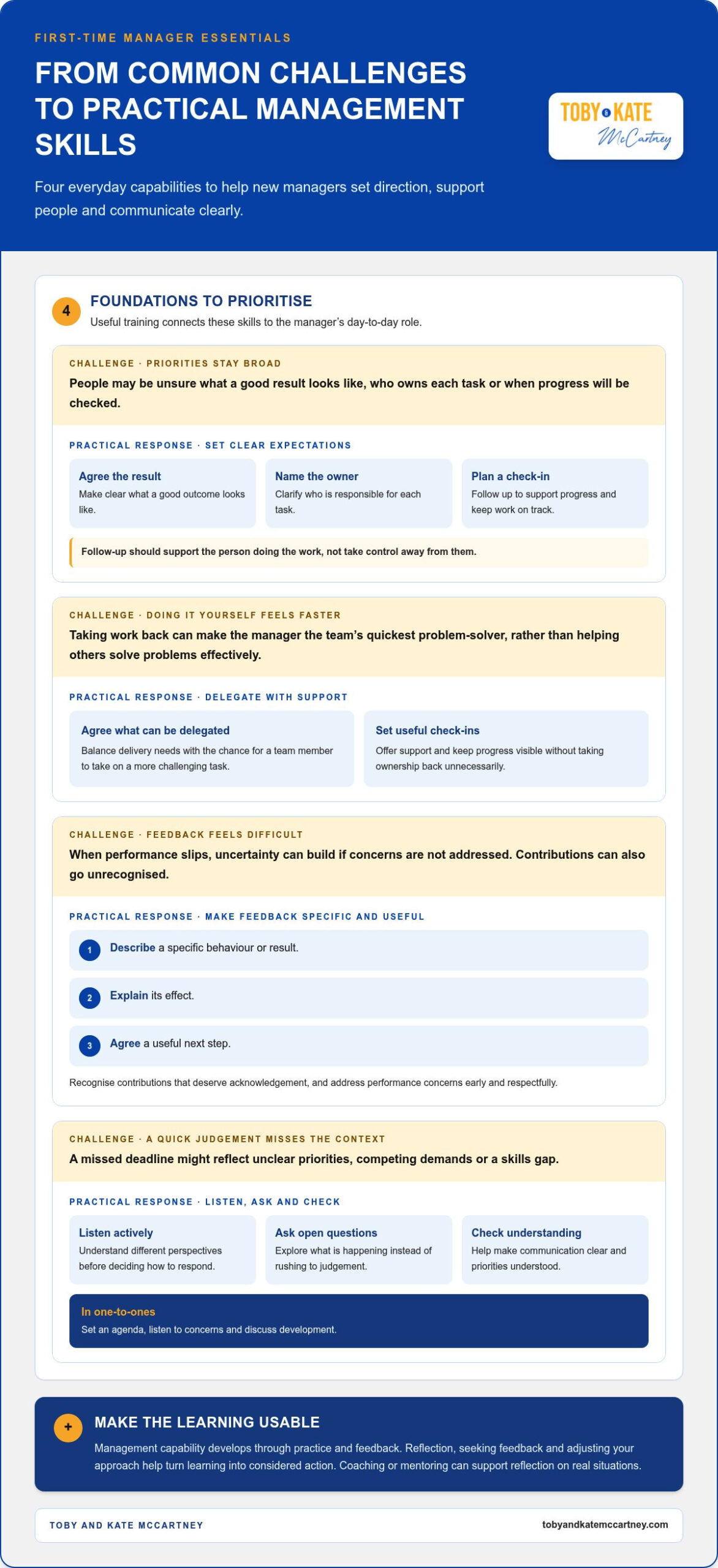
Imagine a deadline is approaching while a team member is ready to take on a more challenging task. Doing the work yourself might feel faster in the moment. Managing well means weighing delivery against development: agree what can be delegated, set useful check-ins and offer support without taking ownership back unnecessarily. The manager’s contribution becomes less about being the team’s quickest problem-solver and more about helping the team solve problems effectively.
Why confidence alone is not enough for a new manager
Good intentions don’t always show you what to say when performance slips, how to delegate without micromanaging or how to handle a difficult conversation fairly. These are learnable skills. Practising them helps a new manager respond with greater clarity and consistency rather than relying on instinct in every situation.
The transition can also bring pressure to prove you deserved the promotion, particularly when you’re managing former peers or learning unfamiliar responsibilities. You don’t need to have every answer immediately. You do need a way to reflect, seek feedback and adjust your approach as you learn.
Development should extend beyond a one-off confidence boost. Leadership training can introduce practical approaches, while coaching or mentoring can help a manager reflect on real situations and turn learning into considered action. Confidence grows stronger when it’s grounded in practice.
What effective first-time manager training should teach
Useful training for first time managers uk gives new leaders a practical toolkit for the conversations and decisions they’ll face straight away. Start with four foundations: setting clear expectations, delegating work, giving feedback and communicating with the team. These connect closely with the skills for a successful management career, including communication and delegation. Effective learning should also show how to apply those skills in the manager’s day-to-day role.
Core people-management skills to prioritise
New managers need to turn broad priorities into clear responsibilities. Agree what a good result looks like, who owns each task and when to check progress. Follow-up should provide support and keep work on track, not take control away from the person doing it.
Feedback is another essential skill. A manager should be able to describe a specific behaviour or result, explain its effect and agree a useful next step, whilst recognising contributions that deserve acknowledgement. Training should also help managers prepare for one-to-ones: set an agenda, listen to concerns and discuss development. If performance begins to fall short, addressing it early and respectfully can prevent uncertainty from building.
Management capability develops through practice and feedback.
Communication and emotional intelligence in everyday management
Active listening gives a manager the chance to understand different perspectives before deciding how to respond. A missed deadline might reflect unclear priorities, competing demands or a skills gap. Asking open questions and checking understanding helps uncover what’s happening rather than rushing to judgement.
Emotional intelligence makes these conversations more constructive. It involves noticing your own reactions under pressure, staying curious and responding with consideration, even when you need to be direct. It doesn’t replace management knowledge; it helps a manager use that knowledge thoughtfully. Clear, consistent communication builds trust, aligns people around priorities and makes difficult conversations easier to approach.
Core people-management capabilities apply across many first management roles. Specialist learning should reflect the work itself. A manager responsible for a customer-facing team may need different operational knowledge from someone leading a technical project. Identify the role-specific demands, but don’t let specialist content crowd out the fundamentals of setting expectations, delegating and communicating well.
Leadership training can build these foundations, while one-to-one coaching or mentoring gives managers space to reflect on real workplace situations. Toby and Kate McCartney provide leadership training and coaching as part of their work supporting professional development.
How to compare first-time manager training formats and approaches
When comparing training for first time managers uk, look beyond the delivery method. A course can offer a clear learning sequence, whilst coaching may focus closely on one person’s challenges. Neither format is automatically best: the right fit depends on what the manager needs to learn and whether they can practise it in their role.
| Format | Structure | Interaction | Flexibility | Application and follow-up |
|---|---|---|---|---|
| Taught programme | Planned sessions with a shared sequence | Discussion and practice may be built in | Follows scheduled sessions | Look for workplace tasks, reflection or later check-ins |
| Self-paced learning | Modules completed independently | Usually less direct discussion | Often easier to fit around work | Managers need to apply ideas themselves; agree how progress will be reviewed |
| One-to-one coaching | Centred on the individual’s development needs | Direct conversation and reflection | Can focus on current challenges | Actions can be tested at work and revisited in later conversations |
| Blended development | Combines formal learning with other activities | May include group input and individual support | Varies with the design | Connects learning to workplace practice, with follow-up planned into the journey |
Use the comparison to assess five essentials: structure, interaction, flexibility, practical application and follow-up. The key question isn’t simply how the learning is delivered, but what the new manager will do differently afterwards and how they’ll reflect on that experience.
When a structured course may be the right starting point
A taught programme can give a group of new managers a shared foundation and a clear sequence, helping them explore core responsibilities together. Content alone isn’t enough, though. Discussion, rehearsing conversations and time to reflect help turn ideas into usable skills. Consider how managers will apply learning between sessions, such as trying a delegation approach and reviewing what happened.
When coaching or blended development may add value
One-to-one coaching can centre development on an individual’s leadership challenges, while blended learning pairs formal input with workplace application. Both can be tailored to a manager’s needs, but tailoring doesn’t guarantee improved performance. Progress still depends on practice, reflection and support in the working environment.
Leadership development can bring these elements together in a purposeful pathway. Toby and Kate McCartney provide leadership training and coaching, including development focused on the manager’s day-to-day responsibilities. Their approach is one option to consider when comparing ways to connect learning with workplace practice: leadership development with Toby and Kate.
How to choose training that fits a new manager and the organisation
The strongest choice starts with the work the manager needs to do, not the most fashionable course topic. For training for first time managers uk, bring together three perspectives: the manager’s development goals, the team’s needs and the organisation’s priorities. Then use this five-step process to turn those needs into a practical plan.
- Define the needs. Identify what the manager, team and organisation need from the role.
- Identify skill gaps. Compare current capability with the behaviours the role requires.
- Compare formats. Weigh taught learning, independent study, coaching or a blended approach against practical needs.
- Plan practice. Decide where the manager can apply new skills in real work and who can support them.
- Review progress. Revisit agreed behaviours and adjust the development plan as the role evolves.
Match learning goals to real responsibilities
Start with the manager’s scope. Do they lead a small team, coordinate cross-functional work or oversee a specialist function? The answer affects which situations they face most often, from setting priorities to handling handovers or supporting technical work. Focus learning on those recurring demands rather than selecting topics simply because they’re popular.
Make each goal observable. Instead of “become a better communicator”, set an aim such as “delegate work with clear outcomes and agreed check-ins” or “run one-to-ones that give team members space to raise challenges”. Clear goals make it easier to choose relevant learning and recognise progress.
Assess application, support and progress
Look for opportunities to practise realistic scenarios, not just absorb information. A manager might rehearse how to clarify a missed deadline, then use that approach in a suitable workplace conversation. Plan time afterwards to reflect: what worked, what felt difficult and what could they adapt next time? Feedback from a manager or mentor can turn that reflection into a specific next step.
A compact scorecard can help compare options. Rate each against the same five criteria:
- Relevance: Does it address the manager’s actual responsibilities?
- Practice: Can they rehearse skills and apply them at work?
- Personalisation: Does it account for individual development needs?
- Accessibility: Can the manager take part and complete learning alongside their workload?
- Follow-through: Is reflection, feedback or a progress review built into the plan?
Review progress against the behaviours you agreed, such as clearer delegation or more focused one-to-ones. This supports a grounded assessment of development without assuming training alone guarantees a business result. For wider context, explore leadership training for managers in the UK. Toby and Kate McCartney provide leadership training and coaching to support professional development; details are available through their leadership training and coaching information.
Build lasting first-time manager capability with a clear next step
The best development route brings together practical management content, a delivery approach the manager can engage with and follow-through in the workplace. A course can introduce useful tools, but lasting capability grows as a new manager applies those tools, reflects on the result and adapts their approach. Keep that principle in mind when choosing training for first time managers uk.
Turn training into everyday management behaviour
Make the next step small and specific. Choose one skill, such as clearer delegation, and use it in an upcoming work situation. Agree the outcome, explain the responsibility and set an appropriate check-in. Afterwards, take a few minutes to consider: what worked, what felt difficult and what would you adjust next time?
Feedback can make development visible. A manager, mentor or trusted colleague might notice whether expectations were clearer or whether the team member had more ownership. Use that observation to reinforce what’s working and identify a useful next practice opportunity. The aim isn’t to get every conversation perfect. It’s to build a repeatable habit of learning from real interactions.
Connect management skills with communication development
Clear communication helps a manager explain priorities and delegate with confidence. Listening helps them understand a team member’s perspective before responding, whilst influence supports alignment when people have different concerns or competing demands. These capabilities strengthen everyday management conversations, from agreeing responsibilities to discussing progress.
Public speaking programmes can complement leadership development by helping managers strengthen communication and presentation skills. That learning supports management development, rather than replacing core knowledge about responsibilities, delegation and supporting a team.
Leadership training offers a structured development route. Where a new manager has a particular challenge or would benefit from individual reflection, one-to-one coaching or mentoring can provide personalised support. Toby and Kate McCartney provide one-to-one coaching, leadership training and mentoring for professional development.
Confidence takes shape through action: learn, apply, reflect and keep practising. Toby and Kate McCartney provide leadership training and development to help managers focus on the capabilities their roles demand. Explore leadership training and development with Toby and Kate.
Make your next step a confident one
The strongest training for first time managers uk connects practical skills to the realities of the role, gives new managers a suitable way to learn and makes room to apply and reflect on that learning. Choose development that responds to the manager’s responsibilities and supports steady progress, rather than expecting one course to do everything.
Leadership training can build a foundation for leading people, while one-to-one coaching or mentoring can be tailored to an individual’s development needs. Communication matters, too: public speaking programmes develop communication and presentation skills that can support managers as they share priorities and influence their teams.
Every new manager can grow into the role with the right focus and support. Start with the capability that would make the biggest difference in their day-to-day work. Explore leadership development with Toby and Kate and take a purposeful next step towards more confident leadership.
Frequently Asked Questions
Is training for first-time managers worth it?
Yes, training can help a new manager build practical skills before ineffective habits take hold. The value of training for first time managers uk depends on how closely the content matches the role, whether the manager can practise and whether there’s support to apply learning at work. Agree observable goals, such as clearer delegation or more focused one-to-ones, and review progress against them. Training supports development, but it can’t promise instant transformation.
What should training for first-time managers cover?
It should cover clear expectations, delegation, feedback, communication, listening and constructive ways to handle challenging conversations. New managers also need to learn how to support people’s development whilst staying accountable for team priorities. The right emphasis depends on the role, so begin with the situations the manager handles regularly. Practical exercises, such as rehearsing a feedback conversation, can connect learning with real workplace responsibilities.
How do I choose the right training format for a new manager?
Compare structured courses, self-paced learning, coaching and blended approaches against the manager’s goals, schedule and need for interaction. Look beyond convenience: consider whether the format includes practice, feedback and time to apply learning at work. Self-paced learning may suit someone who needs flexibility, whilst coaching can offer focused reflection. Choose the approach that supports the skills the manager uses regularly, rather than assuming one format suits everyone.
Can a first-time manager learn leadership skills through coaching?
Yes, coaching can give a manager focused, individual support around their goals and workplace challenges. It can help them reflect on how they’re using new skills, consider different responses and identify practical next steps. Coaching may complement structured learning, but it isn’t automatically a substitute for management fundamentals. If the manager needs guidance on responsibilities, communication or people-management practices, include relevant structured input in their development pathway as well.
How long should first-time manager training take?
There’s no single duration that suits every new manager. The time needed depends on the learning goals, programme structure, responsibilities and opportunities to practise between learning activities. Rather than choosing by duration alone, consider whether the plan gives the manager enough time to understand key ideas, try them in realistic work situations and reflect on what happened. Practice and follow-through help make learning relevant beyond the training session itself.
What is the difference between management training and leadership training?
Management training often focuses on responsibilities such as setting expectations, organising work and supporting performance. Leadership development may also explore communication, influence, direction and how to bring people with you. In practice, the terms overlap. For a first-time manager, look at the actual topics and exercises rather than relying on the course title. The most useful learning connects leadership ideas to the practical responsibilities the manager handles each day.
How can an organisation tell whether manager training is working?
Agree a small number of observable behaviours before training begins, such as clearer delegation or more effective one-to-ones. After the manager has had opportunities to apply the learning, review examples and gather feedback from appropriate colleagues. Course completion alone doesn’t show how skills are being used. Consider the working context and support available, and assess progress against agreed behaviours without assuming training alone will guarantee business results.