
A meeting isn’t successful because it fills a calendar slot; it succeeds when the right people leave with a decision and a clear next step. If you’re working out how to run effective team meetings, start by designing them around the outcome, not the time available. A sharper purpose changes everything.
It’s frustrating when discussion wanders, the same voices dominate, or everyone leaves unsure who owns the follow-up. You don’t need more meetings or complicated rules. You need a clear reason to meet, an agenda that protects focus, and facilitation that makes room for different perspectives.
This practical guide will help you decide when a meeting is necessary, set a realistic structure and keep discussion inclusive and on track. You’ll also learn how to close with documented decisions, named owners and deadlines, so the conversation turns into progress. These are communication skills you can use straight away, whether you’re leading a small team or facilitating a wider group.
Key Takeaways
- Learn how to run effective team meetings by matching the format to the outcome, whether you need discussion, a decision or coordination.
- Build an agenda that tells attendees what each item is for, who will lead it and what it should produce.
- Use active listening and neutral questions to draw out different views without assuming the team agrees.
- Distinguish a confirmed decision from an idea or proposal that still needs approval.
- After important meetings, ask one focused question to identify what worked and what could improve next time.
How to Run Effective Team Meetings by Starting with a Clear Purpose
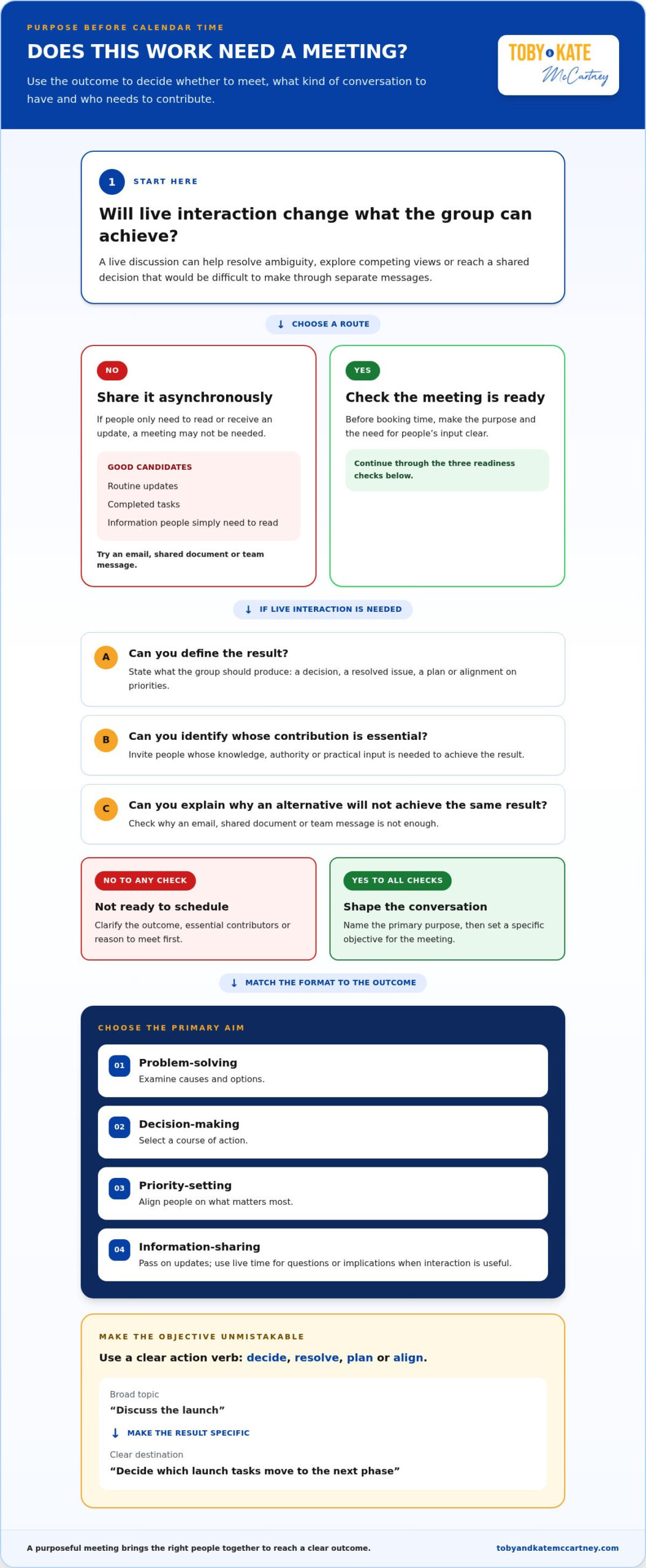
A meeting earns its place when people need to discuss an issue, make a decision or coordinate work together. Before booking time, check whether the conversation needs to happen live. Define the outcome, identify whose contribution is essential, and ask why an email, shared document or team message won’t achieve the same result. If you can’t answer all three questions, the meeting may not be ready to schedule.
“An effective team meeting is a purposeful conversation that brings the right people together to reach a clear outcome.” That principle sits at the heart of how to run effective team meetings. It also reflects the science of effective meetings, which examines how meetings can be optimised for effectiveness and productivity.
When does a team meeting need to happen?
Bring people together when interaction changes what the group can achieve. A live discussion can help resolve ambiguity, explore competing views or reach a shared decision that would be difficult to make through separate messages. For example, if a project team must agree which of two priorities takes precedence, participants can explain constraints, test assumptions and settle on a common direction.
Routine updates, completed tasks and information people simply need to read can usually be shared asynchronously. The key question isn’t “Who needs to hear this?” but “What must each person contribute?” If attendees have no input, judgement or decision to offer, consider sending an update instead. This respects everyone’s focus and keeps live discussion for work that benefits from it.
How to write a meeting objective people can understand
Write the objective as a result, using a verb that makes the purpose unmistakable: decide, resolve, plan or align. “Discuss the launch” is broad; “Decide which launch tasks move to the next phase” gives the conversation a destination. A specific objective also gives you a way to judge success afterwards: did the group reach the decision, resolve the issue or agree the plan?
Let that outcome shape the meeting before you send the invitation. Ask yourself:
- Who needs to attend? Invite people whose knowledge, authority or practical input is needed to achieve the result.
- What preparation will help? Share relevant context or questions so participants can arrive ready to contribute.
- What belongs on the agenda? Include only items that move the group towards the stated outcome.
Purpose also clarifies the type of conversation required. An information-sharing session passes on updates; a problem-solving discussion examines causes and options; a decision meeting selects a course of action; and a priority-setting meeting aligns people on what matters most. These aims can overlap, but naming the primary one helps prevent the discussion from drifting between them. Set the destination first, then build the meeting around it.
Prepare an Effective Team Meeting with a Focused Agenda
Once the meeting has a clear outcome, turn it into a plan people can prepare for. A focused agenda connects each discussion to that result, gives contributors a clear role and protects time for the work that needs the group’s attention. A strong agenda is measured by the clarity of its outcomes, not the number of items it contains.
Use this preparation sequence to make the invitation purposeful:
- Define the outcome. State what the meeting should produce, such as an agreed plan, a decision or a set of priorities.
- Invite essential contributors. Include people whose expertise, authority or delivery role is needed to reach that outcome.
- Share context early. Send relevant documents, questions or background information with enough time for attendees to review and prepare.
- Allocate time deliberately. Give each agenda item a realistic slot. Allow more time for complex discussion and protect time to confirm decisions and actions.
This sequence turns how to run effective team meetings into a practical preparation habit. It also makes it easier to spot when an agenda item doesn’t support the intended result. Remove it, handle it separately or clarify why it needs the group’s time.
What should a team meeting agenda include?
Make the agenda useful at a glance. Start with the objective, then list each item alongside its purpose, discussion lead, time allocation and intended output. Include any pre-reading or preparation needed. This gives attendees a clear route through the meeting, rather than a list of topics that could lead anywhere.
- Information-sharing: Label updates that require listening or brief clarification.
- Discussion or decision: Frame the question participants need to explore or resolve.
- Close: Reserve time to confirm decisions, action owners and next steps.
For example, “Project update” tells people what the topic is, but not what to do with it. “Review the delivery risks and agree which need action” signals the purpose and output. If an item only shares information, consider sending it in advance and using meeting time for questions or implications.
Who should attend, and what should they prepare?
Invite people who will contribute relevant expertise, make or inform a decision, or carry out agreed actions. Name their role in the invitation, such as presenting a recommendation, advising on a risk or confirming delivery implications. This helps each person understand where their input matters, without implying everyone needs to speak on every item.
Be specific about preparation: ask attendees to review a particular document, bring an estimate or consider a defined question. Share materials early enough for people to form an informed view, but avoid assigning background tasks that won’t influence the discussion. Good preparation is focused, not burdensome.
Confident facilitation depends on clear communication as much as careful planning. Leadership and communication development can help you build a more considered approach to guiding group discussion.
Facilitate Effective Team Meetings Without Losing Focus or Participation
A well-prepared agenda gives you a route; facilitation helps the group follow it without shutting down useful contributions. Open by restating the purpose, the outcome you’re working towards and the agenda. Then set simple expectations: explain how people can contribute, how you’ll manage time and how the group will handle topics that sit outside the plan. A clear opening helps everyone understand both the destination and their part in reaching it.
Good facilitation keeps the discussion purposeful and makes participation possible for everyone. That takes active listening, not just moving briskly from one agenda item to the next. Listen for the concern or reasoning behind a comment, then check your understanding with a neutral question: “What’s leading you to that view?” or “What would need to be true for this option to work?” These questions clarify perspectives without treating silence as agreement or steering people towards your preferred answer.
How can a facilitator encourage balanced contributions?
Make room for people who need time to think, rather than relying only on whoever responds first. Ask open questions, pause before inviting another answer and give participants a moment to gather their thoughts. If every person’s input matters, use a round-robin, but apply it selectively so it doesn’t become a routine requirement to speak on every topic.
Reflect back what you’ve heard in fair, neutral language: “I’m hearing a concern about timing and a preference for keeping the current scope. Have I captured that accurately?” This gives contributors a chance to correct your summary and lets the group check whether it recognises the different positions. Balanced participation isn’t about equal airtime at all costs. It’s about making relevant perspectives available to the discussion.
How do you handle disagreement and tangents?
Keep disagreement focused on ideas, evidence and consequences, not the people expressing them. Name the point of difference without taking sides: “It sounds as though we agree on the goal, but not on the order of work.” Then ask whether resolving that difference is necessary for the intended decision. If it is, give it space; if not, record it and return to the question the group came to address.
Use a visible parking list for relevant issues that need separate attention or would take the meeting beyond its scope. Acknowledge the contribution before redirecting: “That’s worth capturing. I’ll add it to the list so we can return to our decision on today’s agenda.” This keeps people from feeling dismissed whilst protecting the group’s focus.
In practice, how to run effective team meetings means guiding the conversation without controlling every contribution. Keep the agenda visible, notice whose views haven’t been heard and intervene calmly when discussion wanders. If a tangent reveals a necessary question, adjust the plan openly; if it doesn’t, park it and bring the group back to its shared purpose.
Turn Team Meeting Discussion into Decisions and Follow-Through
A productive discussion only creates value when people leave knowing what was agreed and what happens next. Before closing, slow down long enough to make the outcome explicit. Recap confirmed decisions, assign each action to a named owner, agree a deadline and identify anything that remains unresolved. This final check gives everyone the same understanding before they return to their work.
Be precise about the difference between a decision and a suggestion. An idea is a possibility; a proposal is an option put forward for consideration; neither is agreed simply because it was discussed. If approval is still required, record the proposal as pending and name who will seek approval and by when. Clear status prevents a tentative conversation from being mistaken for a commitment.
How to record decisions, owners and deadlines
Use a simple action record that makes follow-through easy to scan. For each item, capture the decision or task, the responsible person, the due date and its status. Write actions as observable tasks: “Send the revised rota to the team by Thursday” is clearer than “Sort out the rota”. A specific task makes ownership visible and progress easier to check.
Keep unresolved questions separate from confirmed decisions. Note what still needs clarification, who will investigate it and when the group will revisit it. That way, open issues stay visible without appearing settled. During the close, read the record aloud or display it so owners can confirm that the task and deadline are realistic.
- Decision: Record what the group agreed and any important conditions.
- Action: Name one accountable owner, a clear task and a due date.
- Open issue: Capture what remains undecided and the next step for resolving it.
What should happen after the meeting?
Share concise notes promptly with attendees and anyone responsible for an action. Put decisions and tasks near the top, where readers can find them quickly, and include unresolved points separately. The purpose isn’t to create a transcript. It’s to leave a reliable record people can use to act.
Keep progress visible between meetings through a shared action record or a focused follow-up message. At the next relevant meeting, review outstanding actions and exceptions rather than repeating every update. If a deadline has shifted or a decision is blocked, make that clear and agree what happens next. This creates an accountability loop: outcomes are recorded, work moves forward and anything unresolved returns for attention.
Clear communication and confident leadership help turn discussion into action. Explore this business leadership training guide for more on developing those skills, or build your leadership communication skills through Toby and Kate McCartney’s training and coaching.
Improve Team Meetings by Reviewing What Works and What Does Not
Effective meetings improve through deliberate review, not guesswork. After an important meeting, assess whether it achieved its stated outcome, whether the right people had a chance to contribute and whether decisions or actions were clear. The purpose isn’t to grade the facilitator or scrutinise individuals. It’s to identify what helped the group make progress and what could work better next time.
Keep the review light. Ask participants one focused question, such as, “What would make our next planning meeting more useful?” A specific prompt is easier to answer than a lengthy evaluation form, and it can surface practical changes. Look for patterns across meetings rather than reacting to one person’s preference or a single difficult discussion.
How can a team tell whether its meetings are effective?
Compare what happened with the meeting’s intended outcome. Did the group reach the decision or alignment it needed? Were relevant perspectives heard, did discussion stay connected to the purpose, and can people explain what happens next? A meeting can feel lively yet still fall short if it leaves important questions unresolved or actions unclear.
Record observations briefly after key meetings. If the same issue recurs, such as updates taking over discussion time, treat it as a signal to adjust the format. Use feedback to improve the meeting design, not to judge a person’s style or level of participation.
Then trial one change at a time. For example, shorten a recurring meeting and move routine updates into a written note, or send a clearer preparation question before the next session. Keeping the adjustment focused makes it easier to notice whether it helped. If several things change at once, it’s harder to understand what made the difference.
- Outcome: Did the meeting achieve what it set out to do?
- Participation: Did the people needed for the discussion contribute?
- Clarity: Were decisions, actions and open questions understood?
Use the answers to refine the next meeting, then review again. This simple cycle helps turn how to run effective team meetings into a team habit: observe, adjust and learn. Not every meeting needs a formal debrief. Save a closer review for sessions that matter, or when a recurring meeting no longer seems to justify its time.
Build communication skills that strengthen facilitation
Clear questions help a group examine an issue; active listening helps you understand the views behind an answer; confident speaking lets you summarise, redirect and clarify without losing the room. These are practical facilitation tools, not substitutes for a clear purpose, suitable participants or a well-designed agenda. Communication skills strengthen the structure you’ve already put in place.
Toby McCartney provides one-to-one coaching and leadership development focused on communication and influence. You can explore practical communication and leadership development to build those capabilities. Apply what you learn thoughtfully, then keep reviewing how your team’s meetings work in practice.
Make Your Next Meeting a Better One
Your next meeting is an opportunity to put one small improvement into practice. Choose a change that fits your team, then notice how it affects the conversation. Consistent progress comes from making thoughtful adjustments, not expecting every meeting to be perfect from the outset.
Learning how to run effective team meetings also means developing the confidence to guide people through discussion. Clear communication, attentive listening and influence can help you create space for ideas and keep the group moving towards its purpose. These skills can grow with practice, and leadership development offers another way to strengthen them.
Toby McCartney, a 3x TED speaker, offers practical leadership and communication development, including one-to-one coaching. Build your capability as a facilitator and leader by exploring practical leadership and communication development.
Start with the next conversation. You can shape it into a more confident, constructive experience for everyone in the room.
Frequently Asked Questions
How long should a team meeting last?
Make it as short as the work allows, rather than defaulting to a standard slot. A brief check-in may need only a short window, whilst a complex planning discussion may require longer. Estimate time from the decisions and contributions needed, then leave a little room to confirm the result. If the same meeting regularly finishes early, try a shorter slot and see whether the quality of the discussion holds.
What should be included in a team meeting agenda?
Include the meeting’s intended result and the topics that genuinely need group attention. For each topic, make clear what participants are being asked to do, such as review a risk, compare options or confirm a recommendation. Flag any preparation that will help people arrive ready. A useful test is whether someone could read the agenda and understand why their attendance matters and what the meeting should move forward.
How often should a team have meetings?
Set a cadence around the team’s work, not habit. A project with frequent dependencies may need regular coordination, whilst a stable piece of work may only need a check-in at key milestones. Review the schedule when priorities or workflows change. If updates are routinely minor, reduce the frequency or share them asynchronously; if blockers sit unresolved between meetings, a more regular discussion may be useful.
Can a team meeting be effective without a formal agenda?
Yes, if the purpose is simple and everyone can understand what needs attention. A quick conversation to resolve an immediate question may not need a circulated document, but it still benefits from a clear verbal focus and a defined finish. For recurring or complex discussions, a written agenda is safer because it gives people time to prepare and helps prevent important topics from being overlooked.
How do you keep a team meeting from going off track?
Make the current question visible and refer back to it when discussion wanders. You might say, “We’ve identified a useful issue, but first let’s settle the supplier choice.” If a new subject needs attention, note it for follow-up rather than trying to solve it alongside the original topic. This practical discipline is central to how to run effective team meetings without cutting off relevant input.
What should happen after a team meeting?
Make sure the people responsible for follow-up know what they’ve agreed to do and when it’s due. Share a brief record of the outcome, particularly if someone affected by the decision couldn’t attend. If circumstances change, update the relevant people rather than letting an old action list create confusion. At the next check-in, focus on work that is blocked, overdue or dependent on a fresh decision.
How can you encourage quieter team members to contribute?
Give people more than one way to offer input. Share a question in advance, invite written thoughts before the meeting or ask for views in a round-robin when every perspective is needed. During discussion, use an open invitation such as, “We’ve heard a few options; what might we be missing?” Allow a pause after asking, and avoid putting someone on the spot or treating quietness as agreement.