
What if persuasion isn’t about having the slickest line, but helping people see why your idea matters? The best persuasive speaking techniques combine a clear argument, credible evidence and a genuine connection with your audience. When your message is muddled, attention drifts. And even a strong case can sound forced if the delivery feels over-rehearsed.
If you’ve struggled to hold a room’s attention or worried that influencing people might seem manipulative, you’re not alone. Persuasion doesn’t require pressure or a perfect performance. Start by understanding what your audience needs, then make your case clearly and honestly.
This guide shows you how to shape a memorable argument, use evidence and emotion responsibly, and make a practical call to action. You’ll find ways to build credibility, use stories that connect and adapt your delivery to your listeners, so your message earns attention and gives people a reason to act.
Key Takeaways
- Start with your audience’s needs and a clear aim, so your message invites action rather than applying pressure.
- Use persuasive speaking techniques to balance credibility, sound reasoning and emotional connection.
- Choose rhetorical devices carefully. Each one should support your point, not make your delivery feel scripted.
- Plan a speech by working through audience, central message, supporting points, delivery and rehearsal.
- Build your skill over time: reflect on your aim, notice how people respond and choose one improvement for next time.
How do persuasive speaking techniques work and why?
You want people to understand your point, take it seriously and decide whether to act. That doesn’t require a forceful personality or a polished performance. It takes a message that feels relevant, makes sense and gives listeners room to reach their own conclusion. That is the foundation of effective persuasive speaking techniques: influence built on clarity, not pressure.
Persuasive speaking is spoken communication designed to influence what an audience understands, believes or chooses to do. You might want support for a proposal, a shift in your team’s view or agreement on a practical next step. Ethical persuasion presents a case honestly and respects the audience’s freedom to agree, disagree or ask questions.
Unlike persuasive writing, a speech unfolds in real time. Your voice can add emphasis or warmth, and a pause can give an idea space to land. You can notice puzzled expressions, questions or growing interest, then clarify or adjust. Listeners can reread a written argument, but a spoken one depends on how you guide them through it, moment by moment.
Persuasion is not the same as pressure
Persuasion offers relevant reasons and evidence. Pressure tries to force a response through exaggeration, guilt or claims that sound certain but lack support. The distinction matters at work, where trust is part of the outcome. A proposal might win quick agreement by creating urgency, but if its claims don’t hold up, confidence in the speaker can suffer.
Imagine suggesting a change to how your team shares project updates. A persuasive case could explain the current difficulty, describe how the new approach might help and invite the team to discuss a trial. Acknowledge possible drawbacks, such as the time needed to adjust. That honesty gives listeners a fair chance to assess the proposal instead of making them feel they have to defend themselves.
Leave the choice with your audience. Explain what you recommend, why you believe it’s useful and what action you’re asking them to consider. Don’t imply that an option is risk-free or that everyone already agrees unless you can support those claims. Influence earned through candour is more durable than compliance won through pressure.
Start with the audience, not the technique
Before choosing an opening line or example, ask: what do these listeners already know? What matters to them? What do they need to understand before they can decide? The answers help you choose the right level of detail and connect your point to the audience’s priorities. A clever device won’t help if it feels irrelevant.
The same proposal may need different framing for colleagues and senior decision-makers. Colleagues may want to know how a new update process affects their workload and day-to-day coordination. Senior decision-makers may need a concise explanation of the organisational benefit, the resources involved and how progress could be assessed. Keep the central idea consistent, but adjust the emphasis to address each group’s concerns.
Use relevance as your filter. Choose examples listeners will recognise, make claims that address their questions and shape your call to action around a decision they can take. When people see why your message matters to them, you don’t need to dominate the room. You can speak with purpose and confidence, while leaving space for a genuine response.
Build persuasive speaking techniques around credibility, logic and emotion
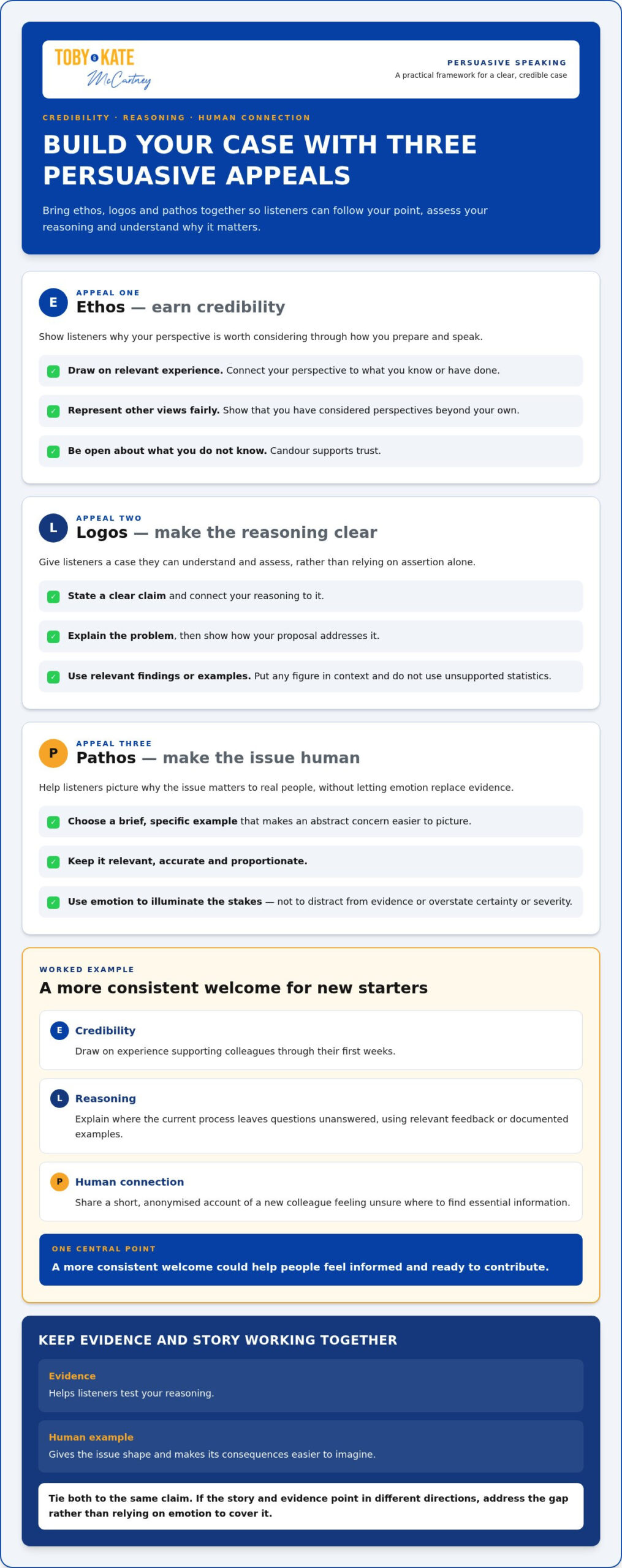
A persuasive speech needs more than a strong claim. Listeners are weighing whether they trust the speaker, understand the reasoning and care about the outcome. Aristotle’s three rhetorical appeals offer a practical framework: ethos is credibility, logos is logic, and pathos is emotional connection. Use them together to make a case people can follow and consider, rather than treating each as a separate trick.
Use credibility and evidence to earn attention
Ethos comes through in how you prepare and speak: draw on relevant experience, represent other views fairly and be open about what you don’t know. Logos gives your case a clear claim, connected reasoning and evidence listeners can assess. If you recommend changing a process, explain the problem, show how your proposal addresses it and share relevant findings or examples. Put any figure in context, and don’t use an unsupported statistic to make an argument sound stronger.
Make the message human without overplaying emotion
Pathos helps listeners understand why an issue matters to real people. A brief, specific example can make an abstract concern easier to picture and remember. Keep it relevant, accurate and proportionate. Emotional language should illuminate the stakes, not distract from the evidence or make the issue seem more certain or severe than it is. A sincere human detail is often more compelling than a dramatic story that feels engineered.
Consider a proposal to improve how new starters are welcomed into a team. Ethos might come from your experience supporting colleagues through their first weeks. Logos could be a clear explanation of where the current process leaves questions unanswered, backed by relevant feedback or documented examples. Pathos might be a short, anonymised account of a new colleague feeling unsure where to find essential information. Together, these elements support one central point: a more consistent welcome could help people feel informed and ready to contribute.
Evidence and story have different jobs. Evidence helps listeners test your reasoning; a human example gives the issue shape and makes its consequences easier to imagine. Keep both tied to the same claim. If the story points one way and the evidence another, address that gap rather than hoping emotion will cover it.
Credibility earns a hearing, reasoning makes the case, and emotion helps the audience see why it matters. That balance is at the heart of persuasive speaking techniques, but none of the three appeals can rescue a message that isn’t relevant to its listeners. Nor can a sound argument compensate for delivery that feels misleading. Your tone, wording and willingness to acknowledge limits all shape whether the audience trusts what you say.
Developing this balance takes practice: plan your argument, speak it aloud and notice which parts feel clear, credible and human. Structured public speaking coaching and presentation development can help you work on your message and delivery through practical exercises.
How to choose persuasive speaking techniques without sounding manipulative
Persuasive speaking isn’t a contest to see who can use the most rhetorical devices or command the room. Techniques are tools, not tricks: each should make your point clearer, more memorable or easier to act on. If a phrase feels designed to corner your listeners or distracts from your reasoning, leave it out. The strongest persuasive speaking techniques support your message without taking away the audience’s freedom to judge it.
Match the technique to the job it needs to do
Choose a device for a clear purpose. A rhetorical question can focus attention on a genuine problem, but it shouldn’t disguise a weak argument or imply there’s only one acceptable answer. Repetition can reinforce a central message; a three-part list can make related ideas easier to recall. Direct address and imperatives can make a call to action clear, but too many commands may sound bossy rather than motivating.
| Technique | Useful moment | Common overuse risk |
|---|---|---|
| Rhetorical question | To open up a relevant issue | It can sound leading if it allows no real answer. |
| Repetition | To reinforce a key phrase or message | Repeating too often can feel heavy-handed. |
| Three-part list | To group related points for emphasis | A neat rhythm can feel forced if the ideas don’t belong together. |
| Personal pronouns | To show shared responsibility or address listeners directly | Overusing “we” may assume agreement; too much “you” can feel accusatory. |
| Statistics | To add relevant, verifiable support | A figure without context can confuse or undermine trust. |
If you’re asking colleagues to adopt a new handover process, for example, you could ask, “Where are updates getting missed?” Use the question to focus attention on a real issue, then explain your proposal. A short three-part summary, such as “clear ownership, timely updates, fewer gaps”, could help people remember the intended benefits. Use it only if those benefits are accurate and supported by your case.
Keep persuasive language credible and natural
Listen for words you’d genuinely use in conversation. Hyperbole can make a modest benefit sound like a guarantee, while unearned flattery can seem like an attempt to win agreement. Before keeping a line, ask: is it accurate? Is it relevant to this audience? Does it respect their ability to disagree? If it fails any test, revise it.
Take particular care with statistics. Explain what a figure refers to and why it matters to your point. Don’t present a number as proof if it doesn’t support the claim. Use “we” only for a genuinely shared aim, and make requests specific without issuing unnecessary commands. “Could we trial this approach for the next project?” invites consideration more naturally than “You must change how you work.”
Rehearse your wording aloud. If a phrase sounds awkward or unlike you, simplify it. A good technique should feel almost invisible: listeners notice the message, not the machinery behind it. Keep only what serves your purpose, fits the audience and leaves the argument on solid ground.
How to plan and deliver a persuasive speech in five steps
A convincing speech is built before you face an audience. Use this five-step process for a short workplace presentation or a more formal speech. Keep the structure simple enough to remember, then adjust the detail and delivery to suit the occasion.
- Understand your audience. Identify what listeners already know, what they care about and what might make them hesitate. A team hearing a short project update may need practical implications; senior decision-makers may need the reasoning behind a recommendation. Let their needs shape your language and examples.
- Set one central message. Write your main point in a single sentence. If your audience remembers only one idea, what should it be? Use that sentence to decide what belongs in the speech and what you can cut.
- Choose supporting points. Select a small number of reasons that make your message credible and easy to follow. Support each with evidence, a relevant example or a clear explanation. Make the links between your claim and supporting points explicit, rather than asking listeners to join them up themselves.
- Make deliberate delivery choices. Decide how to open, where to pause and which words deserve emphasis. Use a visual aid only if it helps listeners understand the argument. Plan a specific, proportionate action that follows from your case, such as considering a proposal or agreeing a next step.
- Rehearse and refine. Practise aloud, not just silently. Notice sentences that are hard to say, transitions that feel abrupt and evidence that needs more explanation. Ask someone whether your message is clear and engaging, then make focused improvements.
Shape a message listeners can follow
Give your speech a clear pathway: claim, reasons, evidence and action. State what you want listeners to consider, explain why, provide evidence they can assess and give them a practical next step. This structure keeps persuasive speaking techniques in service of the argument, whether you have a few minutes in a meeting or longer to develop your case.
For example, a short presentation might recommend changing how a team records decisions. State the recommendation, explain the communication gap it addresses, use a relevant example to show its impact, then ask the team to agree a manageable next step. A formal speech can expand each part, but listeners should still be able to follow the argument from beginning to end.
Rehearse for clarity, pace and presence
On each practice run, focus on one thing: clear meaning, a steady pace or natural delivery. Pause after a key point so listeners can absorb it, and don’t rush the evidence behind your recommendation. If feedback suggests people lose the thread, simplify the wording or strengthen the transition. For more guidance on communicating with authority, explore public speaking for leaders.
Planning gives you a reliable framework; practice helps you make it your own. To develop your speaking capability through structured coaching and presentation development, explore public speaking programme options.
Make persuasive speaking techniques a skill you can keep developing
Strong speaking isn’t a one-off performance. It develops through a cycle: understand your audience, organise a credible argument, choose techniques that suit the moment, then practise and reflect. These persuasive speaking techniques work best when you treat each presentation as a chance to improve, not a test you must pass perfectly.
Turn each speaking opportunity into useful practice
Choose one skill to focus on in your next suitable speaking situation. You might practise stating your main point earlier, using a brief example to make an idea concrete or pausing after an important sentence. Keep the goal manageable. Trying to change everything at once can distract you from connecting with listeners.
Afterwards, review what happened. What did you want the audience to understand or do? Did your message come across clearly? Could listeners identify the action you requested? Note their questions, comments or visible signs of confusion as clues, not as a verdict on your ability. Then choose one adjustment for next time, such as simplifying an explanation or making your closing request more specific.
This reflection routine turns experience into practical learning. If you have a presentation coming up, write down its aim before you prepare, then revisit that note afterwards. Progress comes from applying and refining skills over repeated speaking opportunities, not from expecting an instant transformation. For professionals seeking structured development in business and marketing communication, executive education providers such as clickacademyasia.com offer targeted training programmes.
Explore structured support for presentation development
If you’re ready to develop your speaking further, SpeakUp is a coaching and presentation development programme for aspiring speakers and keynote presenters. It provides a structured way to work on your message and delivery through practical capability-building. Toby McCartney, a 3-time TED speaker, brings relevant speaking experience to this development work.
For related learning, explore advanced communication skills training to build broader communication capability, or learn about NLP Practitioner Certification if you want to develop your understanding of communication and influence.
Your next step can be simple: choose an upcoming talk, name the one idea you want listeners to remember and practise expressing it aloud. If you want guided support to strengthen your presentations, explore SpeakUp and consider how coaching could fit your development goals.
Put your next speaking opportunity to work
Your next presentation doesn’t need to be perfect to move you forward. Choose one idea you want listeners to remember, then decide how you’ll express it. After you speak, reflect on what connected and what you’d refine. That cycle of action and learning is how persuasive speaking techniques become part of your natural communication style.
If you’re ready to develop your presentation skills with structured support, SpeakUp is a coaching and presentation development programme for aspiring speakers and keynote presenters. It combines practical coaching with Toby McCartney’s experience as a 3-time TED speaker.
Explore SpeakUp and develop your presentation skills. Take the next step at your pace and keep building a voice that feels clear, credible and genuinely yours.
Frequently Asked Questions
How do you start a persuasive speech?
Start by deciding what your listeners need to understand or decide, then state your main point early. If you’re proposing a change to a meeting schedule, for example, explain the recommendation before describing the problem it addresses. Add a few relevant reasons and evidence, then make the next step clear. A brief question or familiar situation can draw people in, but move quickly from the opening into your case.
What are three effective persuasive speaking techniques?
A clear example, a focused rhetorical question and a concise three-part list can each serve a useful purpose. An example helps listeners picture a proposal in practice; a question directs attention to the issue; a short list makes key points easier to recall. You could summarise a change as “simpler planning, clearer roles, fewer missed updates”. Choose only what suits your audience and sounds natural in your own voice.
Can storytelling make a speech more persuasive?
Yes, a relevant story can help listeners understand the human effect of an idea. In a presentation about improving customer handovers, a brief account of a client having to repeat information could illustrate the problem more clearly than an abstract description. Keep the story accurate, concise and respectful of anyone involved. Then connect it to the evidence and proposal, so the anecdote adds context rather than standing in for proof.
Is persuasive speaking the same as public speaking?
No. Public speaking means addressing an audience; persuasion is one possible purpose. A briefing that explains a new system may be informative if it simply sets out how it works. If the speaker also aims to gain support for adopting it, the talk has a persuasive purpose. Both rely on clear organisation and delivery, but the speaker’s goal shapes what information to emphasise and what response to invite.
How can you sound confident when delivering a persuasive speech?
Prepare your key points and practise aloud until you can explain them without relying on a full script. Mark where you want to pause, and give yourself a moment to breathe before answering questions. If nerves interrupt your flow, return to the next idea in your notes rather than apologising or rushing. Confidence doesn’t mean eliminating every sign of nerves; it means keeping your message clear and continuing to connect with listeners.
How do you end a persuasive speech effectively?
Close by restating your central idea, giving listeners a final reason to consider it and naming one practical next step. After explaining a proposed trial of a new process, for example, ask the team to agree who will lead it and when to review progress. Keep the request proportionate to the case you’ve made. Don’t introduce fresh evidence at the end; a focused final sentence gives the audience a clear takeaway.