
A business mentor should sharpen your judgement, not make decisions for you. If you’re wondering what to expect from a business mentor, look for more than generic tips or theory that never reaches your working week. Expect focused conversations shaped around your goals, challenges and the decisions in front of you.
It’s understandable to want advice you can put into practice. A productive mentoring relationship gives you space to examine what’s happening in your business, consider relevant experience and identify practical next steps. You bring the context and make the decisions; your mentor helps you see options, test your thinking and stay accountable to the actions you choose.
In this guide, you’ll learn what a mentor can contribute, how to prepare for and make the most of each conversation, and how to turn discussion into action. You’ll also find ways to assess whether a tailored mentoring pathway fits your goals as a business owner, director or emerging leader.
Key Takeaways
- Understand what to expect from a business mentor, including how they can help you explore choices and strengthen your judgement.
- Prepare for more useful conversations by bringing a clear challenge, relevant context and a willingness to consider different options.
- Use a simple action cycle to turn mentoring discussions into practical steps linked to your business, communication or leadership goals.
- Assess whether mentoring is the right fit by looking for relevant experience, tailored guidance and clear expectations.
- Explore Toby and Kate McCartney’s practical mentoring approach. Toby works with a select group of only 10 clients each year.
What to Expect from a Business Mentor: A Clear Starting Point
You’re right to want more than encouragement. When a business decision feels tangled, vague reassurance won’t show you what to do next. Practical mentoring gives you room to examine the issue, understand what’s influencing it and consider a deliberate response. The aim isn’t to hand you a ready-made answer. It’s to help you build clarity and confidence in your own judgement.
So, what to expect from a business mentor? A development relationship that helps you think and act more effectively. A mentor brings perspective, experience and constructive challenge to the issues you raise. They might help you see a leadership situation from another angle, question an assumption or identify a priority buried under competing demands. The conversation should relate to your circumstances, not follow a universal formula for running a business. This broad understanding of mentoring is also explored in Understanding Mentorship.
A mentor can guide your thinking, but you remain responsible for the decisions and direction of your business. You’re not handing over control or asking someone else to carry the consequences. You’re engaging a thoughtful partner who can help you make better-informed choices.
What a business mentor contributes
A mentor’s perspective can help you spot options you might miss when you’re close to a problem. Imagine that a team keeps missing deadlines. Rather than jumping straight to a standard fix, a mentor might ask how priorities are set, where communication breaks down and what you’ve already tried. Those questions can help uncover the issue beneath the visible symptom.
Constructive challenge is part of the value. Your mentor may invite you to test an assumption, compare possible responses or clarify which outcome matters most. Their contribution isn’t a prescribed answer. It’s relevant perspective that you can apply, adapt or set aside according to your goals and knowledge of the business.
What a mentee remains responsible for
You choose what to do with the guidance. A mentor might suggest a different way to approach a conversation with a colleague, for instance, but you decide whether it suits the person, situation and culture of your organisation. You know the context; the mentor helps you examine it with fresh eyes.
Your part doesn’t end when the discussion does. Honest reflection helps you notice what is working, where you feel uncertain and which assumptions deserve another look. Progress also depends on taking action between conversations, then bringing back what happened so you can learn from it. Mentoring can support stronger decisions, but it can’t guarantee growth, revenue or any other business result. The work is shared: the mentor offers guidance, and you turn relevant insight into action.
How Business Mentoring Conversations Work in Practice
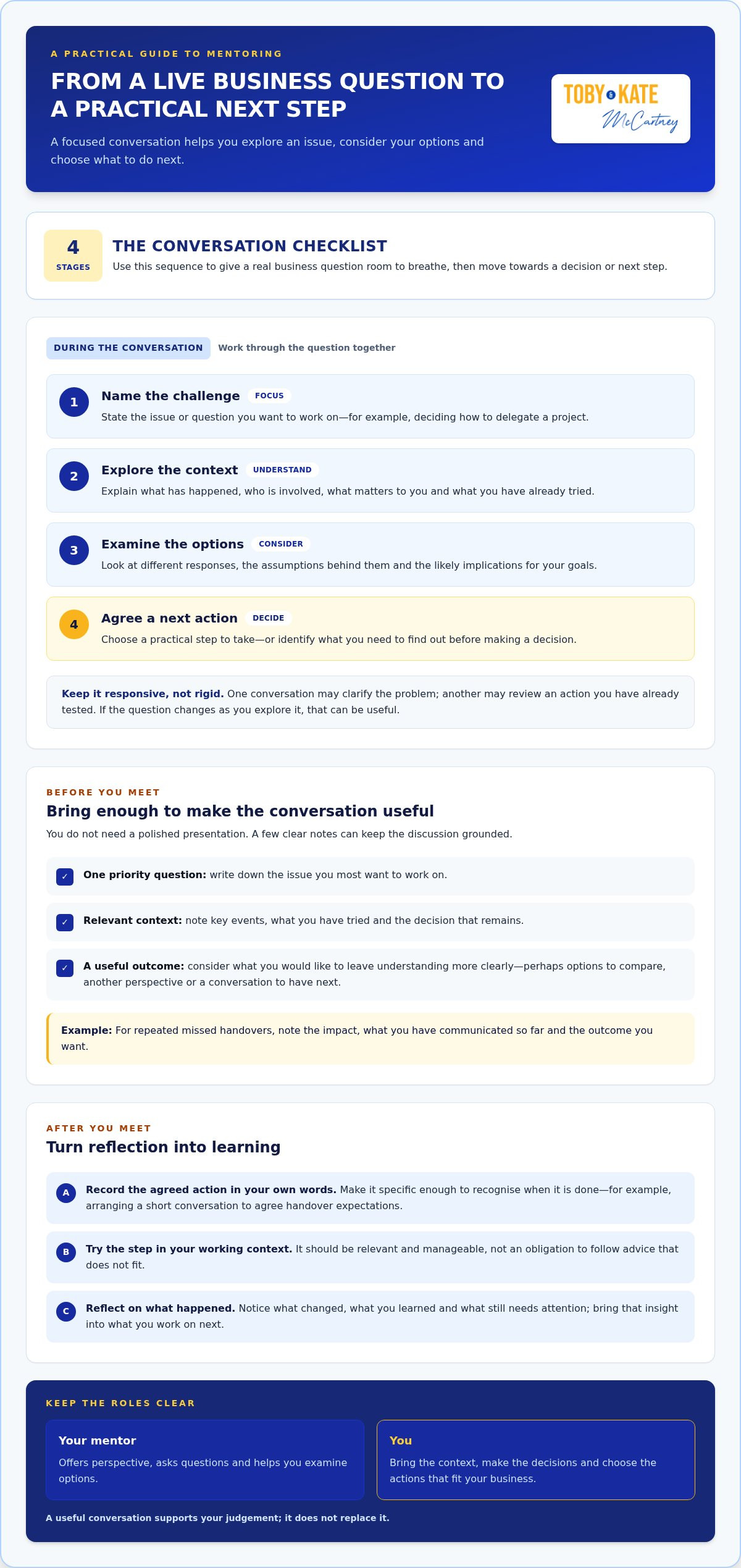
A useful mentoring conversation gives a live business question room to breathe, then turns reflection into a decision or next step. You might bring a choice between two priorities, a leadership challenge with your team or a communication goal, such as making expectations clearer in meetings. The discussion should follow what you need to make progress, not a rigid script. A simple sequence can help you prepare and understand what the conversation is working towards.
- Name the challenge. State the issue or question you want to work on, such as deciding how to delegate a project.
- Explore the context. Explain what’s happened, who is involved, what matters to you and what you’ve already tried.
- Examine the options. Consider different responses, the assumptions behind them and the likely implications for your goals.
- Agree a next action. Choose a practical step to take, or identify what you need to find out before deciding.
This sequence creates focus, not a formula every meeting must follow. One conversation may centre on clarifying the problem; another may help you review an action you’ve already tested. If the original question changes as you explore it, that can be useful. Your mentor should respond to your aims and the realities you bring, rather than steer you through a predetermined agenda.
How to prepare for a mentoring conversation
Before you meet, write down one priority question. Bring enough context to explain it, including relevant events, what you’ve tried and the decision that remains. You don’t need a polished presentation. A few clear notes can keep the discussion grounded. Ask yourself: “What would I like to leave understanding more clearly?” You might want to compare options, see a situation from another perspective or decide what conversation to have next.
For example, if you’re unsure how to address a colleague’s repeated missed handovers, note the impact, what you’ve communicated so far and the outcome you want. This gives the mentor something specific to explore, while leaving space for questions that may reveal what’s getting in the way.
What happens after the conversation
Capture any agreed action in your own words. Make it specific enough to recognise when you’ve done it, such as arranging a short conversation to agree handover expectations. Then try that step in your working context. It should be relevant and manageable, not an obligation to follow advice that doesn’t fit.
Afterwards, consider what changed, what you learned and what still needs attention. Perhaps the conversation surfaced a new obstacle, or the action showed that your original assumption was incomplete. That information can shape what you work on next. A useful mentoring conversation combines focused reflection, an action you choose and a chance to learn from it.
For practical, tailored support with business development, explore Toby and Kate McCartney’s mentoring. Their mentoring and leadership development focuses on your real challenges, communication and influence.
How to Judge Whether Business Mentoring Is the Right Fit
A mentor can have an impressive track record and still not be the right fit for your goals. What matters is whether their experience and approach help you make sense of the challenges you actually face. If you’re trying to strengthen team communication, for instance, it may be more useful to explore how you lead conversations, set expectations and respond to what’s happening in your organisation than to receive advice unrelated to that challenge. Likewise, if your focus is a specialised field such as commercial property, targeted resources like Multifamily Schooled illustrate the value of learning from sector-specific experience.
Mentoring can feel generic if advice arrives before the mentor understands your context. Look for active listening, questions that draw out detail and guidance connected to the priorities you’ve brought. Respectful challenge can help you reconsider an assumption, but you should remain free to decide what fits. Use the comparison below to identify what’s working and where expectations may need clarifying.
| Productive mentoring signs | Expectations to clarify |
|---|---|
| Conversations return to your stated goals and current priorities. | Discussion regularly moves away from the issues you want to address. |
| Questions help you examine assumptions and see options more clearly. | Advice feels generic or arrives without enough understanding of your situation. |
| You leave with a practical step you can assess and choose to take. | You feel pressured to follow a recommendation that doesn’t fit your context. |
| You can talk openly about what has changed and what remains difficult. | It’s unclear how you’ll review progress or what the relationship is aiming to support. |
Signs the mentoring relationship is useful
Useful mentoring keeps your priorities in view whilst giving you space to think beyond your first response. Notice whether the mentor listens closely, asks questions that clarify your options and connects discussion to your working circumstances. Progress doesn’t have to mean an immediate business result. It may mean reaching a considered decision, approaching a leadership conversation with greater clarity or identifying a practical action you can evaluate.
Review the relationship periodically. Ask yourself whether the conversations help you understand your choices, whether the actions feel relevant and whether you’re learning something you can use. If the discussion sounds polished but rarely connects with your day-to-day challenges, raise that directly. A useful relationship can adapt its focus. Many business owners also find that pairing one-to-one mentorship with niche investor networks—such as The Real Estate InvestHER for women building wealth—creates additional opportunities to share strategic insights and maintain momentum.
Expectations and boundaries to make clear
Agree what you want the mentoring to support, how you’ll communicate and what progress would look like to you. Progress might involve clearer priorities or more deliberate communication, rather than a promised increase in revenue or a particular business outcome. Mentoring offers perspective and challenge; it doesn’t transfer responsibility for decisions to the mentor.
These boundaries make it easier to take part with confidence. You can welcome a question that tests your thinking without treating every suggestion as an instruction. You remain closest to your business and accountable for the choices you make. A good fit should strengthen that ownership, not replace it.
Turn Business Mentoring into Practical Progress
A mentoring conversation creates value when you carry its insights into your working week. The aim isn’t to leave with a long list of tasks. Choose a priority, take a relevant step and learn from what happens. This turns mentoring from discussion into an active development process, while keeping decisions and responsibility with you.
Use this cycle to keep the work grounded:
- Choose a priority. Identify the business, communication or leadership objective that matters most right now.
- Agree an action. Decide on one step that could move that priority forward.
- Try it. Put the action into practice in your real working context.
- Reflect and adjust. Notice what happened, what you learned and whether the next step should change.
Progress doesn’t have to mean a dramatic turnaround. Look for observable signs connected to your objective: perhaps a decision is clearer, a conversation has taken place or responsibilities have been made more explicit. These are useful things to review, not guaranteed outcomes or measures that fit every situation. Choose signs that help you assess whether your actions make sense for your business and role.
Choose actions that fit the real challenge
Broad ambitions can be difficult to act on. If your aim is to become a more confident leader, narrow it to a situation you can address, such as preparing for a conversation about unclear responsibilities. A business owner facing a strategic choice might write down the decision, the options and the information still needed. An emerging leader could practise a concise way to present a recommendation. Each action links a wider objective to something concrete.
Keep the step manageable and relevant. You might prepare key points before a discussion, invite a colleague’s perspective or set out the criteria you’ll use to assess a business decision. The right action depends on your context. Ask yourself: What will I do, and how will I know what I learned from doing it?
Review learning without expecting instant transformation
After trying an action, make a brief note of what you did and observed. Did the discussion clarify expectations? Did the decision remain uncertain because you lacked information? Record the detail, not just whether it felt like a success or failure. An imperfect attempt can still reveal a useful adjustment.
Bring that learning into your next mentoring conversation. Look at what changed, what remains unresolved and whether your original priority still deserves attention. This helps you refine your approach rather than repeat a plan automatically. Understanding what to expect from a business mentor includes recognising that development comes through reflection and action, not a promise of instant change.
If focused, practical support would help you put this cycle to work, Explore tailored development with Toby and Kate.
What to Expect from Mentoring with Toby and Kate McCartney
Toby and Kate McCartney provide practical, results-driven business mentorship and leadership development. The focus is on bringing your real challenges into the conversation, then developing your communication, influence and leadership in ways that connect with your goals. You’re not handed a universal formula or promised a particular business result. Instead, mentoring gives you focused space to explore your situation, strengthen your thinking and identify actions that make sense for you.
This approach is designed for business owners, directors and emerging leaders who want to develop how they lead and make decisions. Toby McCartney is a 3-time TED speaker and works with a select group of only 10 clients each year. The selective approach keeps the mentoring focused on individual development priorities rather than treating every challenge as the same.
A tailored development experience
Your goals might centre on communicating with greater clarity, increasing your influence, handling a leadership challenge or developing confidence in a particular business situation. The work can be shaped around the priorities you bring, keeping conversations connected to your role and the outcomes you’re working towards. Tailored guidance helps you examine options and decide which actions fit your circumstances.
Mentoring is distinct from the wider NLP certification pathway. If you’re also interested in structured NLP development, the full pathway combines NLP Practitioner, NLP Master Practitioner and NLP Trainer Training over 18 months, with recognition from the Association of Integrative Psychology (AIP). It’s a separate development option, not an automatic part of mentoring. Consider which direction best matches your aims: focused support for a business or leadership challenge, a broader skills-development pathway, or a clearer understanding of the development you want next.
How to take the next step
Start by naming the area you want to develop. You might want to strengthen communication in your team, navigate a leadership decision or build greater influence in your role. Having a clear priority gives you a useful starting point for exploring whether mentoring or another development programme aligns with your aims. Be ready to explain what’s happening now and what you’d like to approach differently. You don’t need to have the solution worked out already.
For enquiries, call or WhatsApp +44 (0)7789 954 798, or email info@tobyandkatemccartney.com. Based in the UK, operating nationally.
Choose the development focus that matters to you, then take the next step with intention. Explore mentoring and development programmes.
Make Your Next Development Move Count
Your next step doesn’t need to be a sweeping plan. Start by identifying one area where a fresh perspective could help you move forward, then consider what kind of support would make that development practical. Knowing what to expect from a business mentor gives you a stronger starting point: enter the relationship with purpose, stay open to challenge and keep ownership of the choices you make.
Be specific about what you want to develop. Is your focus a business decision, your influence as a leader or the way you communicate with others? Clarity about that priority can help you choose a development direction that feels relevant now, whilst leaving room for your goals to evolve.
If you’re ready to explore a tailored next step, explore mentoring and development programmes. Contact Toby and Kate McCartney to discuss a development focus that matters to you and take the next step with intention.
Frequently Asked Questions
Is business mentoring only for people starting a business?
No. Business mentoring can be useful at different stages of your working life. An established business owner might want to reassess priorities, whilst a director could be developing a new leadership approach. If you’re weighing up what to expect from a business mentor, start with a real question you want to explore, such as whether to pursue an opportunity or how to address a recurring team challenge. You remain responsible for choosing and taking action.
Can a business mentor help with communication and leadership as well as strategy?
Yes. Mentoring can focus on communication, leadership and influence as well as business decisions. For example, you might explore how to present a change to your team or build confidence in a difficult conversation with a colleague. Toby and Kate McCartney’s development offer includes leadership training, communication and influence development, and personalised mentoring. Bring a situation from your role so the discussion connects with your goals, without assuming that mentoring guarantees a particular result.
What should I do if I disagree with my business mentor?
Say what doesn’t fit and explain the circumstances that shape your view. You could ask, “What are you basing that suggestion on?” or describe how a proposed approach might affect your team or customers. Disagreement can reveal different assumptions and help you consider alternatives. You don’t need to agree with every suggestion for mentoring to be useful. The decision remains yours, and thoughtful discussion should be possible without pressure to accept advice.
Can an organisation use mentoring to develop an emerging leader?
Yes. An organisation can use mentoring as part of an emerging leader’s professional development. The focus might be preparing to lead a project, communicating decisions to colleagues or building influence across a team. Agree the purpose with the participant so the development supports their role, whilst giving them space to reflect and apply learning in their own way. The organisation can support the process, but the individual still owns their choices and actions.
Is business mentoring useful if my business is already doing well?
Yes. Mentoring can be valuable when business is going well, not only when you face a crisis. You might use a conversation to examine an opportunity, test an assumption about a new direction or consider which leadership capability to strengthen next. Bring a specific question, such as what would need to be true before you commit resources. A mentor can offer perspective, while you decide whether an idea suits your business and circumstances.
How is a business mentor different from a consultant?
A business mentor generally supports your development through guidance and perspective, whilst a consultant is often engaged to provide specialist input or complete a defined piece of work. The distinction depends on the agreed arrangement, so clarify what you want help with. For example, you might seek mentoring to think through how to approach a strategic choice, rather than asking the mentor to deliver a specialist project or take responsibility for running your business.