
What if a speech people remember starts with fewer ideas, not more? If you’re wondering how to write a compelling speech, start by shaping one audience-relevant message for the ear, then build every part of your speech around it.
It’s easy to end up with a scattered draft, an opening that doesn’t quite land or sentences that look polished on the page but sound stiff aloud. That doesn’t mean you’re short of ideas or need a dramatic speaking style. You need a clear process for deciding what matters most to your audience and expressing it in your own voice.
This practical guide takes you from your first idea to a speech that feels personal, holds attention and leaves listeners with something to remember. You’ll learn how to define your central message, choose an engaging opening, organise your points and bring them to life with stories and natural language. You’ll also find ways to practise for in-person, virtual or hybrid delivery. One clear message. A structure your audience can follow. A speech that sounds like you.
Key Takeaways
- Identify who’ll be listening and what they need from your speech before you begin drafting.
- Use a simple structure: a purposeful opening, two or three connected points and a close that gives your audience a clear final thought.
- Learn how to write a compelling speech using relevant stories, well-chosen evidence and language that feels natural aloud.
- Use signposts to guide listeners through your ideas and make the links between points easy to follow.
- Revise for clarity, timing and speakability, then rehearse aloud so your speech fits the occasion.
What Makes a Speech Compelling? Start With the Audience, Not the Applause
A compelling speech isn’t a display of impressive vocabulary or everything you know about a subject. It’s a clear, audience-relevant message shaped to work when spoken aloud. Success isn’t about making every sentence sound grand. It’s about helping listeners follow your point and see why it matters to them.
Remember that when the blank page feels intimidating. You don’t need to wait for a burst of inspiration. A speech takes shape through deliberate choices: who you’re addressing, what you want them to understand and which ideas deserve their attention. The wider practice of the art of speech writing is about crafting a message for delivery, not simply putting polished prose on a page.
A compelling speech is one clear message, shaped around what its audience needs and written to sound natural when spoken. Keep that definition in mind as you decide what to include. Ornate phrases, excessive detail and attempts to impress everyone can obscure your point. Useful beats elaborate. Specific beats sweeping.
What should a compelling speech make the audience think, feel or do?
Start with a particular audience need, not a broad topic. “Leadership” is a subject; “helping new managers give useful feedback” points towards a speech listeners can use. Ask what this group already knows, what they need and what they might question. The gap between what they know and need gives your message direction.
Then decide what response you want to create. An informative speech aims to clarify or explain; a persuasive speech makes a case and addresses doubts; an inspiring speech helps listeners see a possibility or feel moved to act. These purposes can overlap, but one should lead. It will guide your examples, tone and emphasis. If listeners need practical clarity, use a grounded example. If they’re weighing a proposal, address their likely concerns directly.
Why does a speech sound different from an essay?
Readers can pause, scan backwards and reread a difficult paragraph. Listeners usually hear your words once, in sequence. Make the route through your ideas audible with signposts such as “Here’s the challenge” or “That brings me to the next point”. Repeating a key phrase at meaningful moments can reinforce your message, but repeating whole explanations may lose attention.
Choose plain phrasing over sentences that look impressive but are hard to say. Read each line aloud. If you run out of breath, lose the thread or stumble over a phrase, shorten it or use more familiar words. Listen for rhythm, too: varied sentence lengths help a speech feel lively without forcing a theatrical style.
These aren’t shortcuts to applause. They’re practical ways to respect your listeners’ time and make your idea easier to grasp. Once you’re clear about your audience and the response you want, you have a stronger foundation for deciding what belongs in the speech and what can be left out.
Before You Write a Speech, Find Its Audience, Purpose and One Core Message
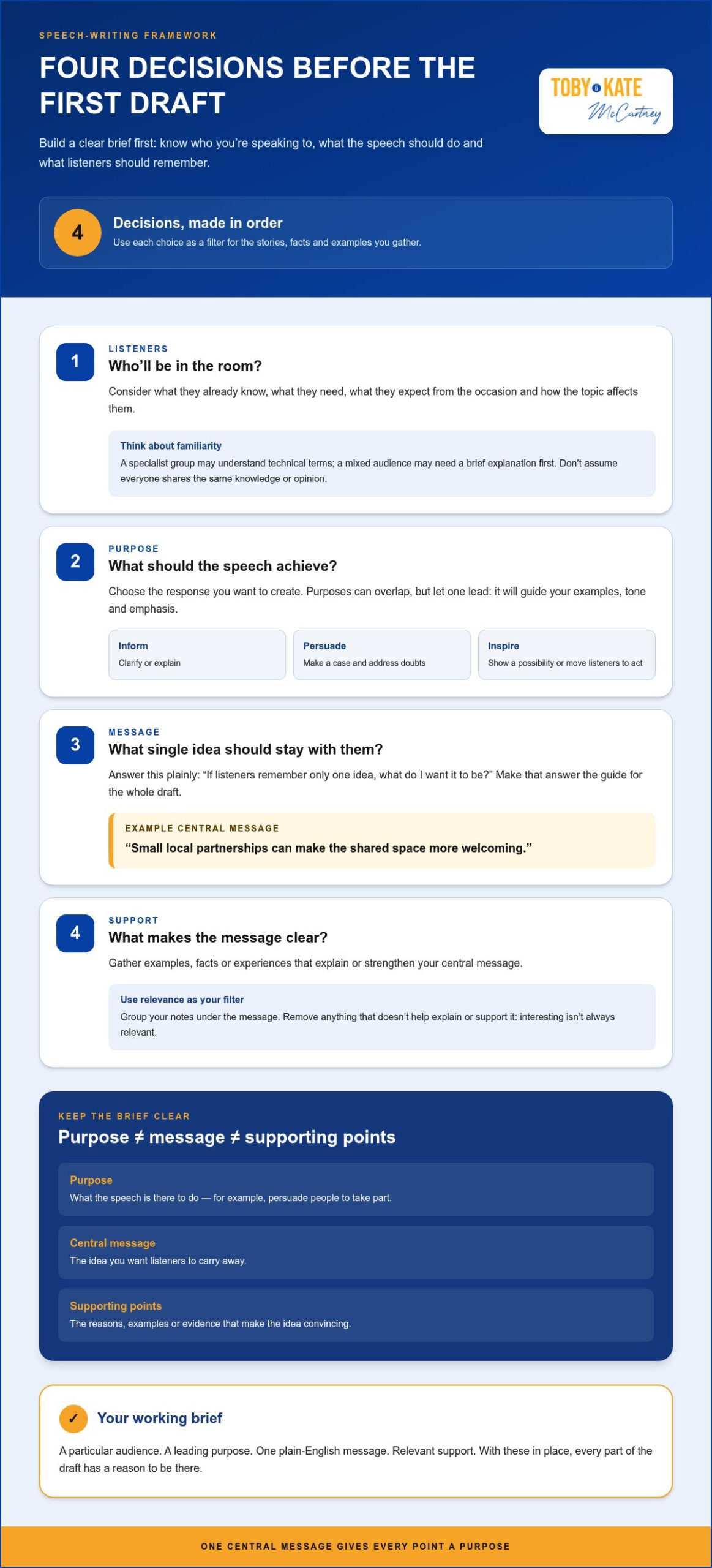
Before drafting, make four decisions in order: identify your listeners, define what the speech needs to achieve, choose the one idea you want them to remember, then gather material that supports it. This sequence gives you a filter for every story, fact and example you’re tempted to include. It also stops research from becoming a pile of interesting but disconnected information.
Write these prompts at the top of your notes:
- Listeners: Who’ll be in the room, and what do they know already?
- Purpose: Should the speech inform, persuade or inspire?
- Message: What single idea should stay with them afterwards?
- Support: Which examples, facts or experiences make that idea clear?
One central message makes a speech easier to follow because every point has a clear purpose and listeners can see how the ideas connect.
How do you identify what your audience needs?
Picture the actual listeners, not an imagined “general audience”. Consider their familiarity with the subject, what they expect from the occasion and how the topic affects them. A specialist group may understand technical terms; a mixed audience may need a brief explanation first. Don’t assume, though. A job title, age group or shared workplace doesn’t mean everyone has the same knowledge or opinion.
Separate what you’re eager to say from what listeners need to understand. If you’re presenting a new process, you might want to explain every feature. The audience may first need to know what’s changing, why it matters and what happens next. Choose examples and vocabulary that make the subject accessible without talking down to people.
How do you reduce a speech to one central message?
Ask: “If listeners remember only one idea, what do I want it to be?” Turn your answer into a plain-English sentence that can guide the whole draft. For example, a speech about a community project might centre on: “Small local partnerships can make the shared space more welcoming.” That sentence is the message, not a list of everything the project has achieved.
Keep three elements distinct. Your purpose is what the speech is there to do, such as persuade people to take part. Your central message is the idea you want them to carry away. Your supporting points are the reasons, examples or evidence that make the idea convincing. Group your notes under the message, then remove anything that doesn’t help explain or strengthen it. Interesting isn’t always relevant.
Now you have a working brief: who you’re speaking to, what the speech should achieve and the thought that holds it together. If you’d value guided presentation development as you put that brief into practice, explore the SpeakUp programme.
How to Structure a Compelling Speech: Opening, Main Points and Close
A strong structure gives your audience a clear route through your message. It doesn’t mean every speech must follow a rigid template. Think of it as a framework: a purposeful opening, two or three connected main points, then a conclusion that brings the message home. When working out how to write a compelling speech, focus on the job each part needs to do rather than filling space to fit a formula.
The opening earns attention and introduces the direction, the main section develops a small number of connected ideas, and the conclusion returns to the central message with a clear final thought or action.
- Opening: Give listeners a reason to pay attention and a sense of what the speech is about.
- Main points: Develop two or three ideas in an order that makes sense, using relevant support for each.
- Close: Bring the ideas together and leave the audience with a thought, decision or next step.
| Section | Its job | Useful question |
|---|---|---|
| Opening | Connect with the audience and orient them. | Why should this matter to these listeners? |
| Main section | Build and support the central message. | What do they need to understand, and in what order? |
| Conclusion | Reinforce the point and create a sense of completion. | What should stay with them after I finish? |
Use signposts to make the structure audible. A phrase such as “First, let’s look at the challenge” tells listeners where you’re taking them. “That leads to the next point” explains the connection, while “So, what does this mean for us?” signals a shift towards the conclusion. These verbal cues matter because listeners can’t scan back through your speech to find their place.
How can you open a speech and earn attention?
Choose an opening that belongs to your message: ask a relevant question, describe a vivid moment, make a concise claim or share an observation specific to the audience. Then connect it to your central idea quickly. A story about a delayed train might catch attention, but it needs a clear link to a speech about improving travel planning. Avoid long scene-setting or a joke that feels separate from your point. Use humour only when it suits the occasion and sounds natural in your voice.
How should the main points and ending work together?
Arrange your points so each one makes the next easier to understand. You might move from problem to response, or introduce an idea before showing the evidence that supports it. Make the link explicit: “We’ve seen what’s getting in the way; now let’s look at a practical response.” In your close, return to the central message without repeating the whole speech. End on one clear thought or action, then stop. A deliberate finish is stronger than adding another point after the conclusion.
Read the structure aloud before polishing individual sentences. If the transitions feel abrupt, the order may need work. A clear route helps you speak with purpose and helps listeners stay with you.
Make Your Speech Memorable With Stories, Evidence and Speakable Language
A clear structure gives your speech a route. Stories, evidence and carefully chosen language make that route easier to picture and remember. Each element should earn its place by serving the central message, not competing with it.
Every story, statistic or quotation should clarify or strengthen your central message; if it doesn’t, leave it out. That’s a useful test when your research and notes start to grow. One well-chosen example can make an abstract idea tangible. A string of loosely related anecdotes or facts can pull listeners in several directions.
How do you use stories and evidence without distracting listeners?
Choose an anecdote with a clear link to your point. For instance, if your message is that a small change can improve a team handover, briefly describe a moment when an overlooked detail caused confusion, then show how a clearer handover could help. Keep only the details listeners need to understand the point. The story supports your message; it isn’t the whole speech.
Use statistics only when they’re accurate, relevant and easy to explain in everyday language. Give listeners the source or context, then say what the finding means for your argument. Introduce a quotation by identifying who said it and why their words matter. An authoritative voice can add perspective, but it can’t replace your explanation.
Evidence works best when it has a specific role. A fact might show the scale of a problem; an anecdote can reveal what that problem feels like; a quotation might offer a useful perspective. Avoid stacking examples that all make the same point. Select the clearest one, explain the connection and move on. That keeps the speech focused while giving listeners something concrete to hold on to.
Repetition can help a key idea land, too. Bring back a central phrase at meaningful points, but vary the surrounding wording so it sounds deliberate rather than mechanical. Repeating a whole paragraph won’t necessarily make the message stronger.
How do you make speech writing sound natural aloud?
Write for the voice, not the page. Use direct, concrete words and vary sentence length: a longer sentence can explain an idea, followed by a short line that lets it land. Read each paragraph aloud and mark anything awkward, breathless or unclear. Then split long sentences, replace unnecessary jargon and choose words you’d comfortably say in conversation.
Review stage directions, too. A note such as “pause for effect” may help during rehearsal, but it shouldn’t become a line you accidentally read aloud. Keep delivery prompts brief and practical, and make sure they suit your natural speaking style.
As you refine your draft, ask whether each example earns its place and whether each sentence is easy to say and follow. These checks turn a written draft into a speech that sounds like you. If you’d like practical guidance developing your presentations, explore the SpeakUp presentation development programme.
Revise and Rehearse Your Speech So It Connects in the Room
Writing the draft is only part of the work. Revision checks that the message is clear; rehearsal reveals how it lands when spoken. If you’re learning how to write a compelling speech, treat these as two connected but distinct stages: first sharpen the words, then practise delivering them.
Work through this revision sequence before polishing individual phrases:
- Message: Can you state the speech’s main idea in one plain sentence? Does every section support it?
- Structure: Does each point lead naturally to the next, and does the conclusion feel earned?
- Clarity: Remove duplicated points, unsupported claims and details that don’t help listeners understand or care.
- Timing: Check the occasion’s allotted time, including any planned pauses or audience interaction.
- Speakability: Read the draft aloud and simplify anything awkward, breathless or difficult to follow.
Edit in that order. If a paragraph doesn’t support the purpose or central message, cut or reshape it before spending time perfecting a sentence. Keep your natural vocabulary and rhythm, too. A speech doesn’t need to sound flawless on the page; it needs to sound clear and believable in your voice.
How can you edit a speech without losing your natural voice?
Read one section at a time and ask what it contributes for the audience. Remove repeated arguments, irrelevant background and claims you can’t support. Then listen for phrases you wouldn’t normally use. Replace them with words that feel natural to say, rather than editing towards artificial perfection. A clean draft should still sound like you, not like a formal report being read aloud.
What should you practise before delivering the speech?
Rehearse aloud with a timer, using the same notes or script you expect to have on the day. If you run over the allotted time, trim a lower-priority example or explanation, then practise again. Don’t rush through every sentence just to fit. Test transitions, mark places where a pause or emphasis will help, and notice where listeners might need a moment to absorb an idea.
You can rehearse from a full script, cue cards or brief prompts. Choose the format that helps you stay connected to the message without losing your place. Practising isn’t the same as receiving delivery coaching: rehearsal helps you spot unclear wording and test your own flow, while coaching can provide guided development of presentation skills. Both focus on the spoken experience, but they serve different roles.
If you want structured support developing your delivery, explore public speaking for leaders. SpeakUp is a coaching and presentation development programme for aspiring speakers and keynote presenters, with a guided pathway for developing your presentations.
Take Your Next Step Towards More Confident Speaking
Your next speech doesn’t need to be perfect before you begin. It needs a clear point, a reason for your audience to care and your willingness to shape the words until they sound like you. That’s the practical heart of how to write a compelling speech: make a start, listen to what works and keep refining.
If you’d like structured support developing your presentation skills, Toby and Kate McCartney’s public-speaking programme offers a practical next step. Toby McCartney is a 3-time TED speaker, and SpeakUp provides coaching and presentation development for aspiring speakers and keynote presenters.
Explore Toby and Kate McCartney’s SpeakUp programme and take the next step towards sharing your ideas with greater purpose. Your voice has value. Give it the preparation and practice it deserves.
Frequently Asked Questions
How long should a compelling speech be?
A compelling speech should be long enough to achieve its purpose and no longer than the occasion allows. Start with the time you’ve been given, then plan space for an opening, your essential points and a clean finish. If the slot includes questions or introductions, account for those separately. A short speech can still make a strong impression if you choose one priority and resist trying to cover the whole subject.
Can a speech be compelling without humour or a personal story?
Yes. Humour and personal stories are options, not requirements. A speech can hold attention through a clear argument, a surprising contrast, a useful demonstration or a precise description of a problem the audience recognises. Choose the approach that fits your subject and speaking style. If a joke feels forced or a personal detail feels too private, leave it out. Relevance and clarity matter more than adding an entertaining element for its own sake.
How do I write a speech when I feel nervous?
Start with a small, manageable task: write the one point you want to make, then draft the first few lines that will help you begin. Feeling nervous doesn’t mean you can’t prepare a strong speech. Make a brief plan for what you’ll do just before speaking, such as setting your notes in order, taking a steady breath and looking towards a friendly face. Focus on sharing your message, not performing perfectly.
What happens if I do not know how much my audience already knows?
Build in a little context without assuming listeners need a full lesson. Introduce any essential term in plain language, then move into the more detailed point. For example, if you’re discussing a new workplace process, explain what it changes before describing its technical steps. You can also invite a quick show of hands or ask a simple opening question to gauge familiarity, then adjust your explanation if the format allows.
Should I memorise my speech word for word?
Usually, it’s more useful to know the route of your speech than to memorise every sentence. Learn the opening and key transitions especially well, then use brief prompts to recall the ideas in between. This gives you room to respond naturally if you lose a line or the audience reacts. If exact wording matters, such as for a formal announcement, practise from a full script while keeping your place easy to find.
How can I make a speech more persuasive without sounding pushy?
Make your case by explaining why it matters to the audience, recognising a reasonable concern and showing how your recommendation addresses it. For example, if proposing a change, acknowledge the effort it may take before describing the practical benefit. Avoid overstating certainty or treating disagreement as a failure to understand. A specific, respectful invitation, such as asking listeners to consider a next step, can be more persuasive than pressure.
Is it better to write a speech exactly as I speak?
Write in a spoken style, but don’t copy every feature of casual conversation. Everyday speech can include filler words, unfinished thoughts and repetitions that are harder to follow in a prepared address. Use familiar phrasing and contractions where they suit you, then edit for precision and flow. If you record yourself explaining the idea, notice the natural words you reach for and use those as a guide, not a transcript to reproduce word for word.