
What if the best way to build rapport is to stop trying to match the other person? If copying their gestures feels awkward or forced, trust that instinct. Effective nlp rapport building techniques are less about imitation and more about noticing what someone says, responding with care and making space for a natural conversation.
It’s frustrating when a conversation feels distant, even when you’re making an effort. It can also be hard to tell whether someone feels comfortable or truly understood. You don’t need a rigid script or a perfect read of every gesture. Small, attentive choices can help you connect more naturally.
This guide explores practical ways to use Neuro-Linguistic Programming (NLP) as a communication toolkit, with a focus on listening, genuine responsiveness and ethical practice. You’ll learn how to reflect someone’s pace and language without mimicking them, ask questions that keep the conversation open, and notice when to adapt, pause or give them more space. Rapport grows through responsive attention, not mechanical imitation. It’s a skill you can develop and bring into everyday conversations.
Key Takeaways
- Build connection through attentive, responsive communication, not by pretending to be someone else.
- Use matching and pacing flexibly, choosing subtle ways to respond rather than copying every gesture.
- Read conversational cues with care: one change in posture or tone can’t tell you everything about how someone feels.
- Practise nlp rapport building techniques by noticing, listening and responding, then reflect on what helped the conversation feel more comfortable.
- Develop your approach through ongoing practice and reflection; NLP Practitioner certification offers a structured learning pathway.
What NLP rapport-building techniques are really for
You want conversations to feel more natural and attentive, without performing a version of yourself you think someone else will like. That’s the useful aim of NLP rapport-building techniques: to help you notice how another person communicates and respond with care. The goal isn’t to copy their mannerisms or win them over. It’s to make it easier for both of you to take part in a conversation with greater awareness.
In this context, rapport means a sense of connection supported by responsive communication. It can help people understand one another, but it isn’t proof of instant trust, agreement or influence. Rapport is the sense of connection that can grow when you respond attentively to another person, not the result of copying their behaviour. That distinction keeps the focus on mutual understanding rather than performing a technique on someone.
NLP, or Neuro-Linguistic Programming, includes ideas and techniques for considering how language and behaviour relate to communication. For an overview of its concepts and scientific debate, see Neuro-linguistic programming (NLP) on Wikipedia. Treat rapport-building ideas as a practical communication toolkit, not a guarantee or a substitute for evidence about what a particular person is thinking.
How rapport differs from agreement or instant trust
You can feel heard without changing your mind. Imagine a colleague proposes a new deadline, and you explain that the team can’t meet it without dropping another priority. They acknowledge your concern, ask what trade-off you’d recommend, and still favour a different plan. You may disagree, yet the exchange can remain respectful because each person has listened and responded clearly. Rapport supports the conversation; it doesn’t decide its outcome.
That boundary matters. A sense of connection doesn’t give you permission to steer someone’s choices, press for agreement or assume they trust you. Ethical communication leaves room for the other person to say no, disagree or end the discussion. Aim to understand their perspective, not to use a feeling of ease as leverage.
Why NLP uses verbal and non-verbal responsiveness
Communication involves the words people choose, how they deliver them and the body language that accompanies them. Paying attention to these channels can help you respond more thoughtfully. But a single cue, such as crossed arms or a pause, can have several explanations. It might reflect discomfort, concentration, habit or something unrelated to the conversation.
Context is your guide. Listen to the person’s words, consider the situation and notice whether their responses change as the conversation develops. If you’re unsure, ask a respectful question rather than treating a gesture as a hidden message. A simple “Would you like to say more about that?” gives them the choice to clarify, redirect or leave the subject. That’s responsive communication in practice: stay curious, check your assumptions and let the other person’s answer shape what you do next.
How matching, mirroring and pacing create a more natural connection
Matching is a broad response to someone’s communication style, not a move-by-move copy. You might keep your tone measured when they speak thoughtfully, or use a similar level of formality in a work discussion. These small adjustments can help your responses feel more in step while leaving you free to speak and act naturally.
Subtle responsiveness notices the other person and adapts; deliberate mimicry copies their behaviour and can make the interaction feel staged. Treat the ideas behind nlp rapport building techniques as options to use with sensitivity, not instructions to perform. If you catch yourself monitoring every movement, return your attention to what the person is saying.
Use matching and mirroring without copying gestures
Mirroring usually means reflecting a broad feature of someone’s behaviour, such as their relaxed posture, rather than reproducing each gesture. Cross-over matching responds through a different channel: for example, you might give a small nod as the other person speaks instead of matching the rhythm of their hand movements. Keep it subtle and natural.
Try matching one broad feature at most, such as conversational pace or level of energy, then focus on listening. Personal space, culture and setting all affect what feels comfortable; what seems friendly to one person may feel intrusive to another. Avoid copying distinctive gestures, accents or expressions. If the exchange feels less comfortable, stop adjusting and give the conversation room.
Practise pacing and leading with care
Pacing means first acknowledging the person’s current perspective, pace or concern before suggesting a possible shift. It isn’t pretending to agree. In a work conversation, you could say, “I can see why the short deadline feels difficult when the brief is still changing.” That shows you’ve heard the concern without claiming to know exactly how they feel.
Then, if it seems welcome, invite a next step: “Would it help to agree which part of the brief needs settling first?” This moves from listening towards a practical possibility while keeping the decision shared. An Office of Justice Programs abstract discusses NLP in professional communication, including matching language and physical position in probation work. The NLP and communication in professional settings reference offers one example of these ideas in a specific context, not a universal script.
Give the other person room to decline, disagree or change the subject. If they don’t take up your suggestion, don’t push for a different response. Return to listening or ask what would be useful to discuss instead. That flexibility makes pacing responsive rather than a tactic for steering someone towards your preferred outcome.
These skills become more useful through reflection and practice: notice what you adapted, whether it felt appropriate and how the other person responded. If you’d like a structured pathway for developing practical NLP communication skills, explore NLP Practitioner learning.
How to tell if rapport is developing, and when to adjust
Rapport isn’t a score you can read from someone’s face. Look for patterns across the conversation, and stay curious about what they mean. Reciprocal turn-taking, fuller answers or a willingness to continue may suggest that the exchange feels comfortable. They aren’t proof: someone may be engaged but short on time, or quiet because they’re thinking.
The same caution applies to signs that seem less positive. A change in tone, posture or eye contact can have many causes, including tiredness, distraction, cultural preferences or the situation itself. Don’t diagnose a feeling from one cue or insist that a conversation is going well. Check your understanding instead.
What conversational cues can and cannot tell you
Notice whether the other person is contributing, asking questions or developing what you’ve said. Then consider the wider context: have they mentioned needing to leave, or are you discussing a difficult subject? Eye contact, smiling and posture vary between people and settings, so no single behaviour reliably confirms comfort or connection.
A simple, open question is more useful than a guess: “How does this conversation feel for you?” Or, in a work discussion, “Would it be useful to explore this further, or should we move on?” Their answer gives you direct information and lets them guide what happens next.
When to stop matching and give someone space
Brief replies, less participation or an explicit request to pause are prompts to slow down, not clues to interpret with certainty. Stop trying to match their pace or energy. You might say, “Of course, we can leave that there,” then allow a pause or return to a neutral topic. Respect the words they use rather than arguing that they seem comfortable.
If they invite you to return to the subject, follow their lead. If they don’t, let it rest. Rapport doesn’t require constant agreement, emotional closeness or matching; respectful conversation can include disagreement and quiet moments. The aim of nlp rapport building techniques is not to keep every exchange moving in a particular direction, but to respond appropriately to the person in front of you.
Use this simple check:
- Observe: Notice the conversation as a whole, such as whether both people have room to speak.
- Check: Ask an open question instead of treating a gesture or change in tone as a definite signal.
- Adapt or give space: Continue if they want to, slow down if they seem unsure, and pause when they ask.
This approach keeps your attention on mutual comfort rather than performing a technique. You don’t need to agree, mirror every movement or create instant closeness. Stay responsive, check your assumptions and let the other person’s words and choices shape the next step.
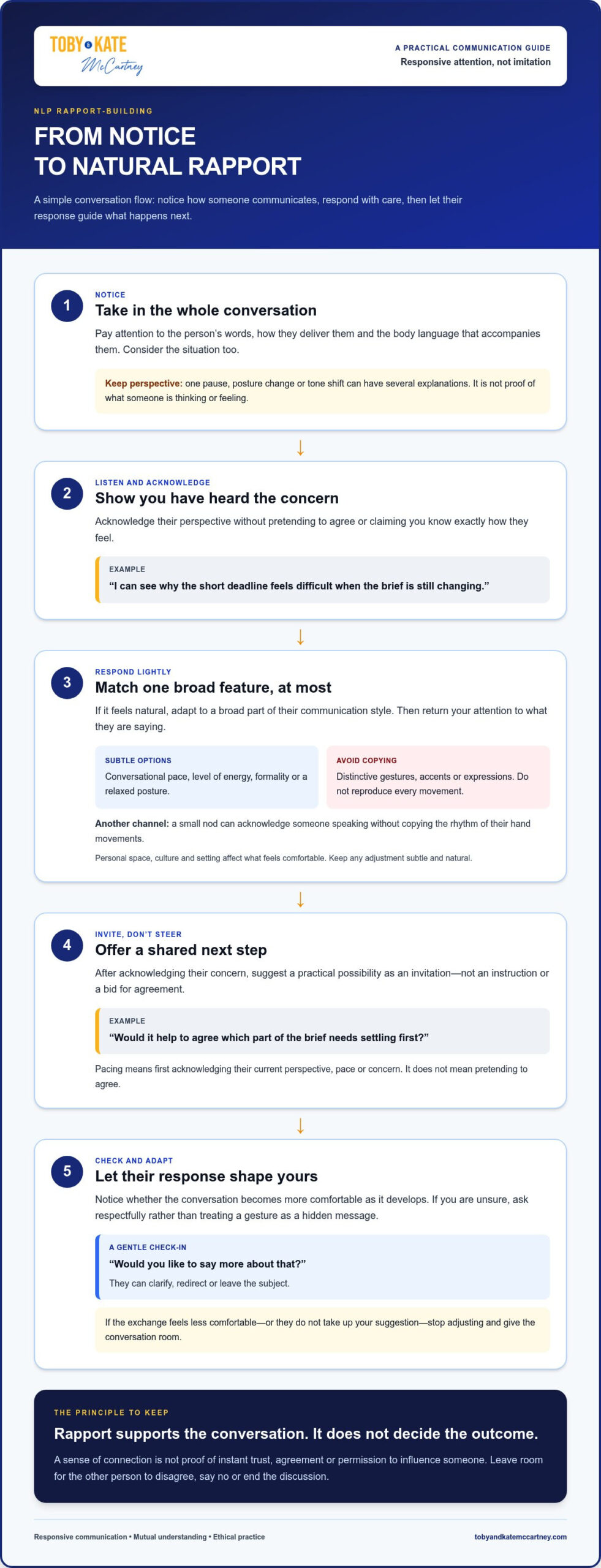
A practical NLP rapport-building exercise for your next conversation
Put the ideas into practice in a low-pressure setting, such as a routine meeting or a chat with someone you know. This isn’t a performance, and you don’t need to make the conversation go a certain way. Use the four steps below to keep your attention on the person and respond naturally. The aim is to practise presence, not perfect technique.
Follow a four-step practice: notice, listen, respond, reflect
Move through the steps in order, but stay flexible. If the other person changes the subject or signals they’d rather not continue, follow their lead. The sequence is a prompt to help you pay attention, not a script to recite.
- Notice. Take in the broad feel of the exchange. Is the pace brisk or unhurried? Is the setting formal or relaxed? Treat these as observations, not conclusions about the person’s mood. You don’t need to copy their posture, gestures or exact speaking rhythm.
- Listen. Give the other person your attention and identify the main point they’re making. For instance, in a meeting they might be concerned that a project deadline is unclear. Resist planning your reply whilst they’re speaking. Let them finish, and listen for what they say matters most.
- Respond. Reflect the point in your own words, then offer a relevant acknowledgement or question. You might say, “It sounds as though agreeing the priorities would help clarify the deadline. Have I understood?” This gives them the chance to correct you, add context or take the conversation in another direction.
- Reflect. Notice how the exchange develops after your response. Did they clarify their view, continue readily or indicate they’d prefer to move on? Their response can guide your next move, but it isn’t a verdict on whether you’ve built rapport. Keep listening rather than trying to manufacture a particular reaction.
Review the conversation without judging yourself
Afterwards, take a moment to review your approach. Ask yourself whether you listened fully or spent the conversation preparing your next point. Think of one moment when you adapted naturally, and another when allowing more space might have helped. Check, too, whether your response felt genuine and suited to the person and setting.
Keep the review constructive. You’re learning, not grading yourself or the other person. Choose one small behaviour to practise next time, such as letting someone finish before you respond, or checking that you’ve understood their main point. Don’t memorise a set phrase and force it into every exchange. A question that feels appropriate in a project meeting may sound out of place in a casual conversation.
Over time, reflecting on real interactions can help you make nlp rapport building techniques feel more adaptable and natural. For broader development, explore advanced communication skills training. If you’re ready to build your communication skills through structured NLP learning, explore NLP Practitioner training.
Develop NLP rapport skills through structured learning
Rapport isn’t mastered by finding one perfect phrase or gesture. It develops through repeated practice: you try a response, notice how it lands, reflect on your assumptions and adjust next time. The nlp rapport building techniques that feel useful in one conversation may not suit another, so responsiveness matters more than following a fixed formula.
Everyday conversations offer room to practise, but you may want a fuller framework if you’re developing communication skills for work, leadership or personal growth. A meeting that repeatedly stalls, difficulty listening under pressure or uncertainty about how to respond can be useful prompts to examine your approach. They don’t mean you need a qualification to communicate well. Informal practice can be valuable in its own right.
When informal practice may not be enough
If you’re ready to explore communication in a more structured way, learning alongside practice and reflection can give you a broader pathway. Feedback can help you notice habits you might miss on your own, such as interrupting, assuming you’ve understood or filling every silence. In the same way that dedicated sports tuition from organisations like SgGolfCoach helps players spot subtle technical habits they cannot see themselves, guided feedback can illuminate blind spots in how you interact. Keep reflecting honestly, and make space for other people’s preferences. No technique can replace listening to what they actually say.
Formal learning is a choice, not a requirement for better conversations. You might simply choose one habit to work on, then review how it felt and what you’d change. If you’d like to explore a more structured route, consider what skills you want to develop, how you’ll apply them and how they fit your goals.
Explore the NLP Practitioner learning pathway
Toby and Kate McCartney offer an NLP Practitioner Certification for people interested in developing their understanding of NLP. It’s a relevant option if you want to explore rapport and communication as part of a broader learning journey, rather than relying on isolated tips. Consider what you want to learn, how you might apply it and how you’ll keep reflecting on the effect your communication has on others.
Start with a practical next step: in your next conversation, choose one thing to practise, such as listening without rehearsing your reply. Afterwards, reflect on whether your response felt genuine and appropriate, and what you might do differently. Build from there at your own pace. If structured learning feels like the right next step, explore NLP Practitioner Certification.
Make your next conversation a chance to grow
Every conversation gives you an opportunity to practise being more present. Choose one small intention for your next exchange: listen without rushing to reply, check that you’ve understood, or leave a little more space. Then notice what feels natural and what you’d adjust. That’s how nlp rapport building techniques become part of your communication, not a performance you have to maintain.
If you’re ready to take that development further, Toby and Kate McCartney offer NLP Practitioner, Master Practitioner and Trainer Training certifications, alongside programmes in public speaking, leadership training and one-to-one coaching. Explore the learning pathway that best fits your interests and goals.
Explore NLP Practitioner Certification and take your next step towards more thoughtful, confident communication. You can build these skills one conversation at a time.
Frequently Asked Questions
What are NLP rapport-building techniques?
NLP rapport building techniques are communication practices that help you respond more attentively to another person. In a planning meeting, for example, you might summarise a colleague’s concern before offering your suggestion, giving them a chance to correct or add to your understanding. These techniques are best treated as prompts for thoughtful interaction, not scientific guarantees or a formula for making someone trust you.
Is mirroring someone’s body language manipulative?
Not necessarily; intent and how you apply it matter. Naturally responding to someone’s relaxed manner can be part of an ordinary conversation. Deliberately copying their movements to influence them, especially without regard for their comfort, risks feeling deceptive. Keep your attention on what they’re communicating, not on reproducing their posture. If you notice yourself acting out gestures rather than listening, stop and return to the conversation.
Does matching and mirroring always build rapport?
No. A person may find close imitation distracting, uncomfortable or inappropriate, and a communication style that feels natural to you may not suit them. Consider a video call: matching someone’s energetic delivery could come across as forced if they’re simply speaking loudly to be heard. Prioritise clarity and genuine interest. If your attempt to adapt seems to disrupt the exchange, drop it and respond in your own natural way.
How can I build rapport in a work conversation?
Start by being clear about the purpose of the discussion and giving the other person room to explain their priorities. In a project handover, you might ask, “What information would make this easier for you to pick up?” Then confirm practical details, such as who is doing what, without assuming that friendliness means agreement. A useful professional exchange can be respectful and productive even when colleagues have different views.
Can you build rapport without eye contact?
Yes. Eye contact isn’t required for a considerate or engaged conversation, and expectations differ between people and situations. You can show attention by following what someone says, responding to the relevant points and allowing them time to speak. During a phone call, for instance, concise verbal acknowledgements can help signal that you’re listening. Focus on whether communication is clear and comfortable for both of you, rather than enforcing a particular behaviour. For those who experience social anxiety or navigate neurodivergent communication differences, organisations such as socialskillsaustralia.com.au offer evidence-based training to help build genuine connection in everyday settings.
How long does it take to build rapport?
There’s no fixed timeframe. A brief exchange may feel comfortable quickly, whilst trust in a working relationship may depend on consistent interactions over time. The subject, setting and people involved all shape how connection develops. Rather than watching the clock or trying to accelerate closeness, pay attention to whether communication is becoming clearer and more reciprocal. Let the other person set their own pace, and don’t treat quick agreement as proof of trust.
Can NLP rapport techniques help with difficult conversations?
They can help you approach a difficult conversation with more care, but they can’t guarantee agreement or resolve the underlying issue. Before raising a concern, decide what you need to communicate and what outcome is realistic. Use specific examples, avoid attributing motives, and invite the other person’s perspective. If discussion becomes unproductive, suggest a pause or a return to the issue later, rather than using rapport techniques to push for a decision.