
What if changing career didn’t mean throwing away your experience or making a risky leap? NLP training for career change could help you build on strengths you already have and explore new directions in coaching, training, speaking or personal development. It’s sensible to ask whether a certificate alone will prepare you for real work, and how to make a transition without rushing your finances or professional life.
A practical approach is to treat your career change as a pathway, not a single decision. Identify where your communication and people skills could transfer, practise applying them and set manageable milestones before making a bigger move. This article will help you assess which direction may fit, understand the skills involved and plan a considered next step. Training can support your development, but it doesn’t guarantee a job, clients or income.
You’ll also find out what Toby and Kate McCartney’s 18-month hybrid pathway involves: NLP Practitioner and NLP Master Practitioner Certification, NLP Trainer Training, one-to-one coaching, live online sessions, in-person classes and group learning. The programme is recognised by the Association of Integrative Psychology. Here’s how to weigh up the learning, practical development and career transition itself, so you can move forward with clarity.
Key Takeaways
- Career change can mean a new role, specialism or way of working. Clarify the kind of change you want before choosing your next step.
- Explore how nlp training for career change could strengthen communication, influence and self-awareness for a new professional direction.
- Separate learning from career outcomes: training can build capability, but it doesn’t guarantee work, clients or income.
- Turn your idea into a practical plan by identifying skill gaps, practising, gathering feedback and setting observable milestones.
- Compare your goals with Toby and Kate McCartney’s 18-month pathway, priced at £375 per month, before deciding whether it fits your plans.
NLP career change? Start with the work you want to do
Wanting a fresh start and needing to protect your stability can both be true. You don’t have to resign first and work out the plan later. Career change can mean moving into a completely new role, developing a specialism within your current field or changing how you work, perhaps from leading teams to training them. Start by getting specific about the change you’re seeking.
Try this prompt: What do I want more of, less of and to contribute? You might want more meaningful conversations, less time on administration and more opportunity to help colleagues develop. Your answers can point towards a direction worth exploring without forcing you into a final decision today.
Neuro-linguistic programming (NLP) is a useful subject to understand before considering training. Its background, concepts and criticisms are part of an informed view. NLP training can support learning, communication and self-awareness. Those capabilities may help you engage with people, explain ideas or reflect on how you work, but completing training doesn’t guarantee employment, clients or income.
Career exploration helps you test a direction; it doesn’t automatically deliver a career outcome. Keep that distinction in view as you consider where your existing strengths might take you.
Which career directions could NLP training support?
Coaching, training, speaking and personal development are possible directions to explore, each drawing on people skills in a different way. Coaching involves listening and asking questions that help someone clarify their goals. Training calls for clear explanations and facilitation; speaking relies on shaping a message and communicating it to an audience. Personal development work may bring these skills together to support reflection and learning. These are pathways to investigate, not promised roles. Ask which activities you’d enjoy practising and who you’d like your skills to serve.
Separate the desire to leave from the direction you want to build
Before deciding what to leave, take stock of what you’d carry forward. Make three short lists:
- Transferable strengths: for example, explaining complex ideas, building trust or facilitating discussions.
- Interests: the topics, people or challenges that hold your attention.
- Experience: work, volunteering or life experience that gives you useful perspective.
Then ask: What kind of work do I want these skills to serve? A manager who enjoys developing colleagues might explore training or coaching; someone energised by presenting could investigate speaking. Treat each as a hypothesis, not a commitment. Try a small action first: talk with someone familiar with that kind of work, practise facilitating a short discussion or write down what you learn after a relevant experience. These low-risk experiments help you gather evidence before making a major professional or financial decision. That’s a stronger starting point for nlp training for career change: a direction to test, grounded in what you can already do and what you want to contribute.
How NLP training can build skills you can use in a new professional direction
A course gives you a foundation. Professional capability grows as you turn what you learn into skills, practise using them and develop the judgement to apply them appropriately. That distinction matters if you’re weighing up nlp training for career change: you’re not only learning ideas, you’re considering how to use them in real conversations and working situations.
For example, noticing how you communicate can help you adapt an explanation when a colleague seems confused. Listening carefully and asking a focused question can make a one-to-one conversation more productive. Reflecting on your own assumptions may help you pause before responding to feedback. These are practical behaviours, not instant expertise. They become more useful through practice, reflection and thoughtful application.
Exercises such as practising a conversation, presenting an idea or reflecting on how an interaction went can help you test a skill in a low-stakes setting. After each attempt, consider what you intended, what you observed and what you might change next time. Learning can support your development, but it doesn’t guarantee a role, clients or a ready-made career.
Completing training marks a learning milestone; establishing a career takes continued practice, professional judgement and work to build your place in the field.
Connect transferable skills to coaching, training and speaking
Think about how a capability might show up in different settings. Listening and clear questions can support a coaching conversation focused on someone’s goals and choices. Facilitation can help a group stay engaged during a training session, while presenting skills can help you communicate an idea to an audience. Influence and leadership capabilities may also be relevant in organisations, where clear communication can help teams work towards shared objectives. These are applications to explore, not guaranteed outcomes.
To make the connection concrete, take one skill you already use and identify how it could serve a different audience. If you’re used to explaining processes to colleagues, consider how you might structure that explanation for a group of learners. Then practise, seek feedback and reflect on what you’d adapt. This helps you assess whether the work itself appeals, not just the idea of a new title.
Understand the Practitioner-to-Trainer learning pathway
The pathway progresses through NLP Practitioner (Level 1), NLP Master Practitioner (Level 2) and NLP Trainer Training. The programme’s certification is recognised by the Association of Integrative Psychology (AIP). For an overview of Practitioner certification, explore this NLP Practitioner certification guide. The stages provide a structured learning route; how you apply that learning to a career remains your own professional journey.
As you explore nlp training for career change, connect each stage of learning to a capability you want to develop, such as facilitating a group or communicating more effectively. Toby and Kate McCartney’s NLP development pathway is one option to consider as you decide what kind of structured learning could support your next steps.
NLP training is not a career guarantee: assess the route before committing
Completing a course doesn’t guarantee work, clients or income. Training can give you knowledge and opportunities to practise, but building a professional direction also takes application, feedback and decisions about how you’ll use your skills. That’s why nlp training for career change should start with a clear goal, not an assumption that certification alone will make a transition happen.
Your aim affects what a useful next step looks like. You might want to explore NLP for personal development, use communication skills in your current role or work towards a new direction in coaching, training or speaking. Compare the routes before committing:
Personal development
Aim: Explore the subject and its relevance to you. Practice: Reflect on what you learn and try applying it in everyday conversations. Next action: Identify a question or skill you want to explore. Plan for: Learning may be valuable without leading to a professional change.
Adding skills to an existing role
Aim: Strengthen a capability such as communication or leadership. Practice: Apply it in suitable work situations and reflect on the results. Next action: Choose one specific behaviour to develop. Plan for: You’ll need to make time to practise alongside existing responsibilities.
Pursuing a new professional direction
Aim: Explore work such as coaching, training or speaking. Practice: Build experience using relevant skills and seek constructive feedback. Next action: Test the work through small, relevant activities. Plan for: Course completion doesn’t create a role or client base by itself.
Choose a learning goal that matches your intended transition
If you’re exploring, focus on learning and testing whether the subject fits your interests. If you want to strengthen your current role, name the capability you want to develop, such as guiding a discussion or presenting information clearly. For a new professional direction, include practice and positioning in your plan. Coaching, training and speaking all call for continued development beyond a course.
Plan for practical realities without making a sudden leap
Consider the time, finances and existing responsibilities you need to balance before committing to training or changing work. You could speak with people familiar with the work you’re considering, practise a relevant skill in an appropriate setting and record what you learn from the experience. Progression through NLP training can also be part of your research; the NLP Master Practitioner certification guide may help you understand that stage.
Keep your next decision proportionate to what you know. Coaching requires ongoing practice in conversations; training and speaking require repeated opportunities to facilitate or present, followed by reflection on what worked. Use those experiences to refine your direction while maintaining your current commitments. A considered transition is built through evidence and deliberate steps, not a sudden leap of faith.
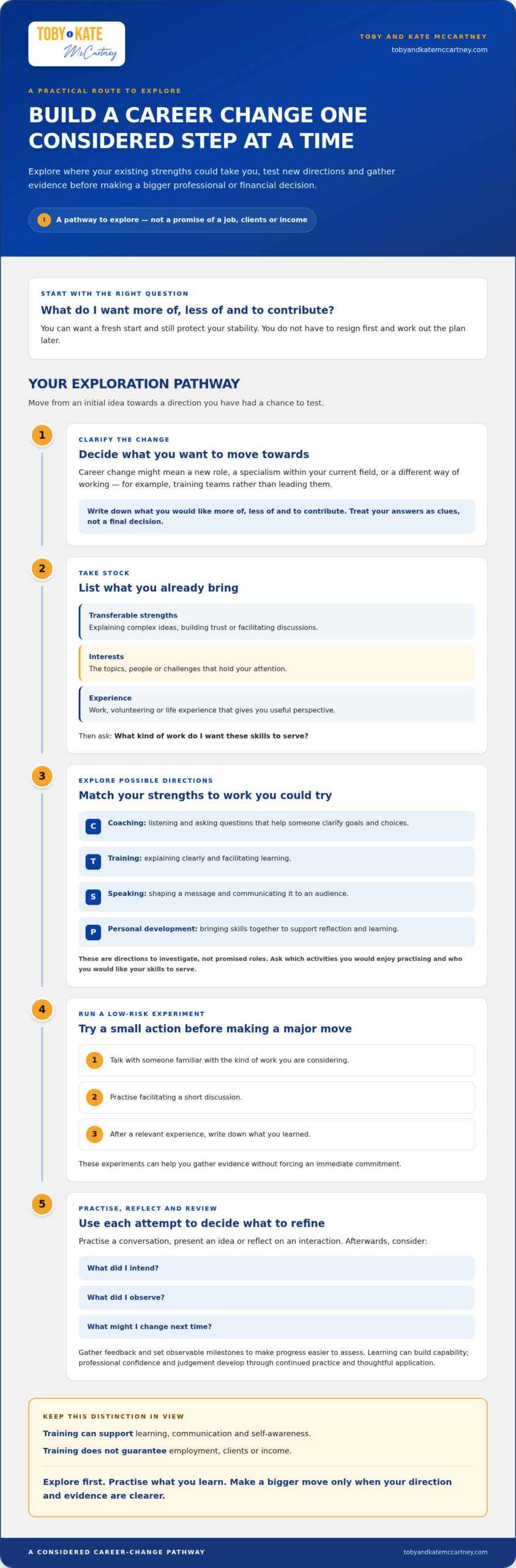
Build a career-change plan around practice, feedback and clear milestones
A career plan becomes easier to act on when you can see what progress looks like. Instead of waiting until you feel completely ready, set small milestones that help you test your direction, build skills and make decisions with better information. This is especially useful if you’re exploring nlp training for career change whilst balancing current work and personal commitments.
Use this sequence to turn an idea into a practical plan:
- Define your direction. Choose one area to explore first, such as coaching, training, speaking or personal development. Write down what attracts you to it.
- Identify a skill gap. Name one capability you want to develop, such as listening attentively, facilitating a discussion or presenting an idea clearly.
- Choose relevant learning. Look for learning that connects to that capability and gives you a way to practise it.
- Put the skill into practice. Complete a suitable practice session, such as delivering a short presentation or practising a structured conversation with a peer.
- Review and adjust. Record what felt effective, what feedback you received and what you want to try next.
Turn a broad career idea into a focused experiment
Keep your first experiment manageable. If training interests you, volunteer to explain a process to a small group in an appropriate setting. If speaking appeals, practise a short talk and ask a trusted listener what was clear or engaging. Afterwards, write a few reflections: what worked, what felt difficult and what you’d like to develop. This isn’t a test of whether you’re suited to a career; it’s a way to gather useful evidence about your interests and learning needs.
Feedback helps you notice things you may miss on your own, whilst repeated practice gives you a chance to refine your communication. Focus on observable changes: did you explain your point more clearly, listen without interrupting or guide the discussion towards its purpose? Treat feedback as information, not a verdict. Your next milestone could be another practice session or exploring a different aspect of the same direction.
Build a learning rhythm that fits around existing commitments
A realistic rhythm should work alongside your responsibilities, not depend on an abrupt change to them. Toby and Kate McCartney’s pathway blends home study, live online sessions, in-person classes and group learning, with one-to-one coaching included. If you’re considering how communication and leadership skills apply in organisations, business leadership training in the UK offers a related perspective.
Before committing to a transition, consider the time you can set aside, your financial responsibilities and the support you may need at home or work. A simple checklist can help you reflect:
- Can I describe the direction I want to explore?
- Have I identified a skill to practise?
- Can I make space for learning without neglecting current commitments?
- Do I have a practical next step and a way to review it?
This checklist doesn’t predict suitability or guarantee a particular outcome. It helps you see what you’ve considered and what still needs attention. If a structured learning pathway fits your plan, explore Toby and Kate McCartney’s NLP training pathway as a possible next step.
Explore Toby and Kate McCartney’s 18-month NLP training pathway
Once you’ve clarified the direction you want to explore and considered how you’ll practise, a structured learning route may help you build capability step by step. Toby and Kate McCartney’s pathway is designed for people interested in coaching, training, speaking or personal development. It offers a defined programme of learning, not a promise of employment, clients or career results.
What the full certification pathway includes
The full pathway lasts 18 months and costs £375 per month. It brings together three stages:
- NLP Practitioner (Level 1)
- NLP Master Practitioner (Level 2)
- NLP Trainer Training
Learning combines home study, live online sessions, in-person classes and group learning. One-to-one coaching is also included in the full pathway. This hybrid blend gives you different ways to engage with the material and develop your skills, while the staged structure takes you from Practitioner learning through to Trainer Training. The programme’s certification is recognised by the Association of Integrative Psychology (AIP).
Toby McCartney is a 3-time TED speaker. That experience is relevant if you’re drawn to developing communication and speaking skills, but consider it alongside the programme’s learning formats and your own goals. Think about how you learn best: do you value independent home study, live sessions, in-person classes, group learning or one-to-one coaching? The pathway brings these formats together rather than relying on a single mode of study.
Decide whether this structured route fits your next step
Before choosing a full pathway, return to the direction you’ve identified. If you’re exploring nlp training for career change, consider whether you want to develop facilitation skills. If you’re interested in coaching, think about the communication skills you want to practise. If speaking appeals, reflect on the value of structured learning and opportunities to develop your delivery. The right fit depends on your aims, your preferred learning blend and the time you can give to development alongside other commitments.
Toby works with a select group of only 10 clients each year. Treat this as a practical fit consideration, not a reason to rush your decision. Give yourself space to weigh the pathway against your career-change plan and the practice you intend to build beyond training. Learning can prepare you for a direction; developing a professional practice remains a separate, ongoing process.
For enquiries, call or WhatsApp +44 (0)7789 954 798, or email info@tobyandkatemccartney.com. Address: United Kingdom. If the pathway aligns with your next step, explore the NLP training and coaching pathway.
Make your next move a deliberate one
You don’t need to map out an entirely new career before taking a useful first step. Choose one question you want to answer: Do you enjoy helping someone clarify their thinking? Do you feel energised when sharing ideas with a group? A small, purposeful experiment can turn those questions into insight grounded in experience.
Set a point to review what you learn. Note what held your interest, which skills you’d like to strengthen and what you want to understand before committing further. This gives your career change room to take shape without demanding an abrupt decision. The value of nlp training for career change lies in how thoughtfully you connect learning to a direction that matters to you.
If you’re ready to explore a structured next step, explore the NLP training and coaching pathway. Contact Toby and Kate McCartney by phone or WhatsApp on +44 (0)7789 954 798, email info@tobyandkatemccartney.com, or use the address details: London and Scotland, UK. Take the next step by matching the pathway to your goals and the time you can commit.
Frequently Asked Questions
Can NLP training help me change careers without leaving my current job?
Yes. You can explore nlp training for career change whilst staying in your current job, using what you learn to test whether coaching, training or speaking suits you before making a larger move. For instance, practise a communication skill in an appropriate work situation, then reflect on what you enjoyed and what you’d like to develop. Keep your existing responsibilities in view as you plan time for learning and practice.
Do I need previous coaching experience before starting NLP training?
The pathway begins with NLP Practitioner (Level 1), followed by NLP Master Practitioner (Level 2) and NLP Trainer Training. You can start by learning and practising the foundational skills rather than presenting yourself as an established coach. If your experience is in management, teaching, customer service or another people-focused role, consider which strengths could transfer. Your practical experience and professional judgement can continue to grow as you learn.
What careers can NLP training support?
NLP training may support exploration of coaching, training, public speaking and personal development. Each direction draws on a different mix of skills: coaching centres on focused conversations, training involves explaining ideas and facilitating learning, and speaking calls for shaping and delivering a clear message. Personal development can bring communication and reflection together. Treat these as possible directions to investigate, then consider which activities fit your interests; training alone doesn’t secure a job or clients.
Does NLP training guarantee that I will get coaching clients or a new job?
No. Completing NLP training doesn’t guarantee coaching clients, a new job or income. Certification can form part of your preparation, but you’ll still need to decide how to apply your skills, practise and build a professional direction over time. For example, someone exploring coaching might clarify who they hope to support and practise explaining their approach. Treat the course as a development step, not an automatic career outcome.
Can I fit NLP training around work and other commitments?
The pathway uses a hybrid learning blend: home study, live online sessions, in-person classes, group learning and one-to-one coaching. These formats offer different ways to engage with the material, whilst you’ll still need to organise time around work and personal responsibilities. Before committing, sketch a realistic calendar that accounts for learning, practice and reflection. This can help you assess how a structured programme could sit alongside your existing commitments.
Is the Toby and Kate McCartney certification recognised?
Yes. If recognition matters to your decision, consider it alongside the programme structure and how its learning formats connect with the direction you want to pursue. Recognition is not a promise of employment, clients or a particular professional result; your next steps will still depend on how you apply and continue developing your learning.
How many clients does Toby McCartney work with each year?
Toby McCartney works with only 10 clients each year. This selective mentorship limit is a useful factor to consider as you weigh up whether a structured, guided learning experience fits your aims. Use it as information for your decision, not a reason to rush. Think about the direction you want to explore, the learning blend you prefer and the time you can realistically commit.