
What if a small change in the words you choose could help you pause, listen and respond with greater clarity? If you’re wondering how to use nlp in everyday life, you may be looking for practical ways to improve conversations, make considered decisions or reflect on your reactions.
First, it helps to distinguish between two meanings of NLP. Neuro-Linguistic Programming is the personal-development approach explored here. Natural Language Processing is the artificial intelligence technology used by computer systems that work with human language. They are different fields. Neuro-Linguistic Programming offers techniques you can practise in daily situations, but it is not a guaranteed fix or a substitute for professional mental health support.
This guide shows you how to apply simple NLP-inspired practices to everyday conversations, choices and personal reflection, with clear boundaries around what they can and can’t do. You’ll also learn when structured training may help you develop your skills further. Start by noticing your responses, practise deliberately and review what works for you.
Key Takeaways
- Separate Neuro-Linguistic Programming from the AI meaning of NLP so you can focus on the practices relevant to personal development.
- Learn how to use nlp in everyday life by noticing your language and considering another perspective before choosing how to respond.
- Use practical prompts to listen carefully, prepare for a challenging conversation and review a personal goal.
- Try a simple pause, notice, reframe and choose process, and recognise when structured learning or feedback could help you develop further.
What does NLP mean in everyday life: technology or personal development?
NLP can refer to two quite different fields: natural language processing, a branch of artificial intelligence, and Neuro-Linguistic Programming, a personal-development approach. If a search result discusses machine learning, chatbots or software analysing text, it means the technology. This guide focuses on the human-centred meaning: practices for paying attention to language, perspective and behaviour in everyday situations.
The distinction matters. Your phone’s predictive text, for example, uses natural language processing to interpret text and suggest what might come next. It isn’t practising Neuro-Linguistic Programming. The shared initials don’t signal a connection between the two fields. Once you know the clues, you can tell whether a result is about computers processing language or people reflecting on how they communicate and respond.
How to tell which NLP meaning a search result uses
Look at the surrounding words. Technology-focused pages often mention AI, machine learning, chatbots, text analysis or automated translation. They explain how computer systems work with human language. Personal-development pages are more likely to discuss communication, goals, beliefs, coaching or behaviour. They focus on how a person interprets a situation and chooses a response.
- Technology clues: AI, algorithms, chatbots and text analysis.
- Personal-development clues: communication, goals, beliefs and coaching.
These clues help you find the information you want, especially if you’re searching for how to use nlp in everyday life. Don’t mistake advice about training an AI model for a personal communication exercise, or assume a coaching technique explains how a computer processes words.
What Neuro-Linguistic Programming can mean in daily practice
Neuro-Linguistic Programming is a personal-development framework that uses attention to language and perspective to help people reflect on their responses and behaviour. In practice, you might notice that you’ve described a presentation as “a disaster waiting to happen”. Ask what specific part concerns you and what you can prepare. The question gives you room to examine your interpretation; it doesn’t prove that the concern is unfounded.
Treat these practices as prompts, not universal rules. The same phrase or exercise won’t work for everyone, and another person’s thoughts can’t be reliably inferred from their word choice or body language. Ask a curious question, listen to the answer and check your understanding instead of assuming you know what they mean.
The Neuro-linguistic programming (NLP) overview discusses the approach’s origins, concepts and criticisms. Keep that context in mind: everyday NLP can offer ways to reflect and communicate more deliberately, but it can’t guarantee a particular result or replace clinical mental health treatment. Use it as one practical tool for awareness, with realistic expectations.
Using NLP to notice language, perspective and response
Everyday communication can shift quickly when a phrase lands badly or a conclusion feels obvious. A practical NLP-inspired habit is to notice the words in play, then check what they mean before you react. This isn’t about policing how you or anyone else speaks. It’s about replacing snap assumptions with curiosity and choosing a response that fits what you actually know.
Language awareness also applies to your own goals. “I want to be more confident” expresses a genuine intention, but it doesn’t yet tell you what to do. Ask what confidence would look like in one specific situation. Perhaps it means sharing an idea at a team meeting or asking a clear question. A defined next action gives you something concrete to practise and review.
Use language awareness to make a conversation clearer
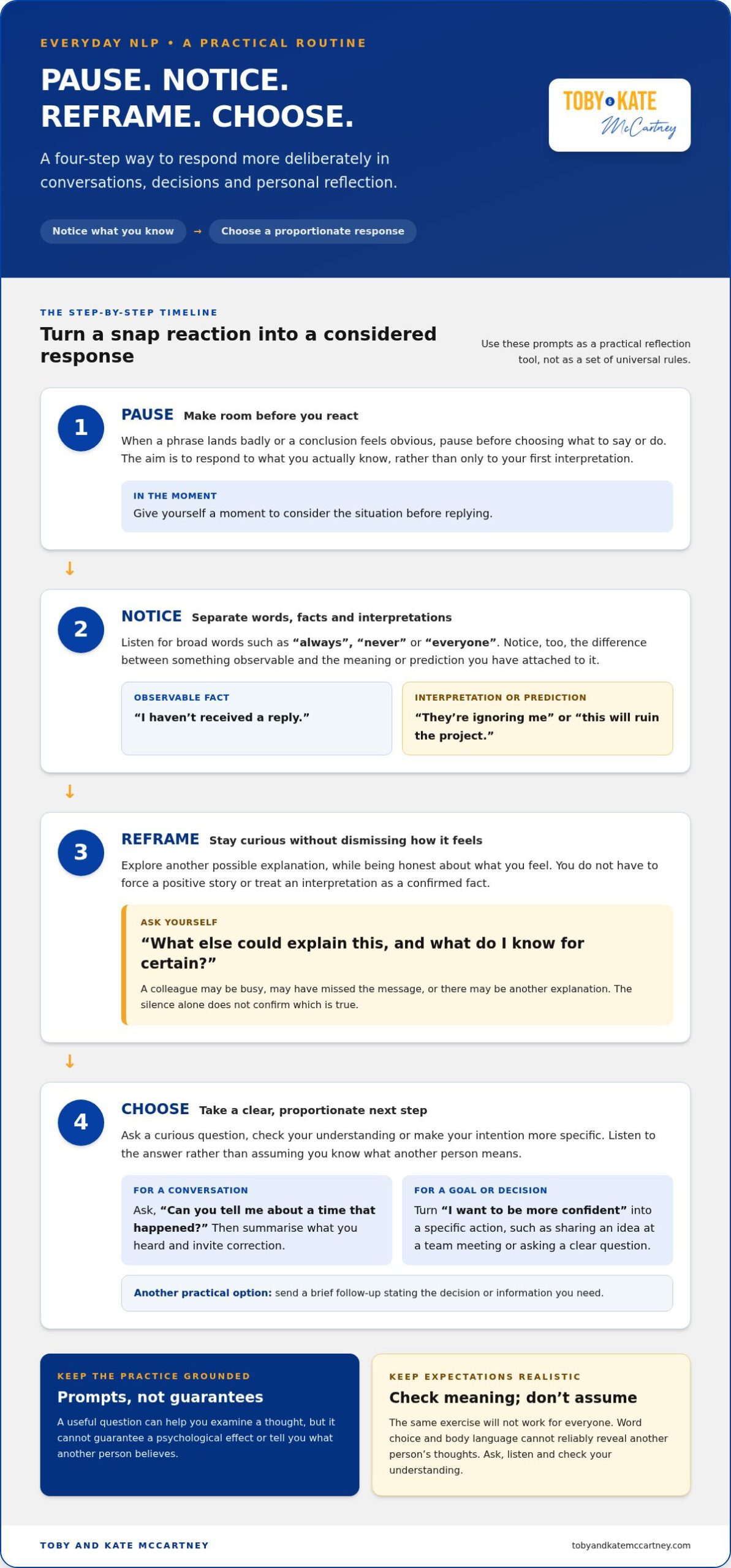
Listen for broad or absolute words such as “always”, “never” or “everyone”. They can make a concern sound fixed, even when the speaker has one particular example in mind. Rather than arguing over the wording, ask an open question: “Can you tell me about a time that happened?” Then summarise what you heard and invite correction: “So the main issue was the late change, have I understood that?”
This approach works both ways. If someone says, “You never keep me informed”, resist replying only to the word “never”. Ask what information they needed and when. You can acknowledge their concern without agreeing with a sweeping statement. A useful question opens a route to clarification, but it can’t guarantee how the other person will respond.
Reframe a situation without dismissing how it feels
Separate what you can observe from the meaning you’ve attached to it. If a colleague hasn’t replied to your message, the observable fact is that you haven’t received a reply. “They’re ignoring me” is an interpretation; “this will ruin the project” is a prediction. Either may feel convincing, but neither is confirmed by the silence alone.
Ask yourself, “What else could explain this, and what do I know for certain?” They may be busy, may have missed the message, or there may be another explanation. You don’t have to force a positive story or pretend you’re not frustrated. Choose a proportionate next step, such as sending a brief follow-up with the decision or information you need.
A useful prompt can help you examine a thought; it can’t guarantee a psychological effect or tell you what another person believes. That distinction keeps the practice grounded. For an overview of the difference between Natural Language Processing (AI) and Neuro-Linguistic Programming, Western Governors University discusses the two uses of NLP in separate contexts.
To practise how to use nlp in everyday life, try this sequence when a conversation feels tense: notice the exact words, separate fact from interpretation, consider one other reasonable explanation, then choose a clear question or next action. The aim isn’t to erase emotion. It’s to make room for a deliberate response.
If you want structured practice and feedback, practical NLP training and coaching can support you as you build your communication skills.
Where everyday NLP can help: conversations, decisions and personal goals
Small shifts in attention can make everyday situations easier to approach. You might listen for what someone is actually asking, prepare a clear opening for a difficult conversation or turn a personal ambition into a step you can take. These practices aren’t about controlling the outcome. They’re about communicating with intention and choosing your next move with care.
| Everyday situation | Practical prompt |
|---|---|
| Listening to a colleague | “What seems most important to them right now?” |
| Preparing for a difficult conversation | “What do I need to explain, and what do I need to understand?” |
| Reviewing a personal goal | “What would progress look like in a way I can observe?” |
| Clarifying a team expectation | “What does a good result look like, and who is responsible for each step?” |
| Making a decision | “Which parts are within my control, and what information is still missing?” |
Apply the ideas in everyday conversations
Begin with the concern the other person has actually stated. If a colleague says a deadline feels unrealistic, don’t jump to a motive such as lack of commitment. Ask one clarifying question first: “Which part of the timeline feels hardest to meet?” Listen before offering a solution. Then summarise their point in your own words and check that you’ve understood. A simple correction can prevent you from solving the wrong problem.
This approach is useful when a discussion feels tense, but it isn’t a way to decode someone or steer them towards the answer you want. NLP should not be treated as a tool for reading minds, exploiting personal information or disguising pressure as rapport. Respectful communication gives the other person room to disagree, add context or set a boundary.
Use reflection to support decisions and goals
Describe a personal goal in observable, realistic terms. Instead of “I’ll become better at presenting”, choose an action such as rehearsing the opening of a talk and asking a trusted colleague for feedback. You control the preparation, not every audience reaction. That distinction helps you focus effort where it can make a difference.
Afterwards, review what happened without turning a setback into a verdict about your ability. What did you try? What response did you notice? What would you adjust next time? A missed step can show that the action was too large, the timing didn’t work or more preparation would help. Adapt the plan, then choose one manageable next move.
Leaders can use the same discipline to clarify expectations without turning communication into a control tactic. Agree what success should look like, invite questions and make responsibilities explicit. Leave space for people to raise constraints and suggest a different route. This creates a shared reference point, not a script for forcing agreement.
If you’re exploring how to use nlp in everyday life, treat each prompt as an experiment in clearer communication and more deliberate choices. Keep what helps you reflect, and change or set aside what doesn’t fit the situation.
A simple four-step NLP practice for a situation you face today
Try this brief practice before a conversation you’re finding difficult, such as asking your manager to clarify a changing deadline. You don’t need special equipment or a formal session. The aim isn’t to guarantee a particular response; it’s to help you approach the discussion with more awareness and a clear next step. Move through the four stages, then adapt or stop if the exercise feels unhelpful.
-
Pause
Before drafting a message or starting the conversation, take a moment to interrupt your automatic response. Name the situation neutrally: “The deadline has changed, and I need to understand what’s expected.” This is more specific than “Everything’s going wrong.” A pause doesn’t require you to feel calm or ignore urgency. It gives you a chance to choose your next action instead of letting your first reaction choose it for you.
-
Notice
Pay attention to the words and assumptions shaping your response. You might notice thoughts such as “They’ll think I can’t cope” or “I’ll never finish on time”, alongside feelings such as frustration or worry. Separate what you know from what you’re inferring. You know the deadline has changed; you may not know why, what can be reprioritised or how your manager will respond. Naming that distinction can make the real question clearer.
-
Reframe
Look for one alternative perspective that still fits the facts. Perhaps the deadline changed because another task has become more urgent, or perhaps your manager hasn’t realised how the change affects your workload. These are possibilities to check, not reasons to dismiss your frustration or assume you know someone else’s motives. Ask yourself: “What could I ask to understand the situation better?” That question keeps the reframe grounded and useful.
-
Choose a response
Decide what you want the conversation to achieve, then choose a respectful action that supports it. For example: “I can work towards the new deadline. Could we agree which task should take priority?” This makes a clear request without accusing anyone or pretending you can control their answer. Afterwards, review what happened: Was your question understood? Did you get the information you needed? If not, consider what you could clarify or change next time.
That’s the practice: pause, notice, reframe and choose. Keep it flexible. If reflecting in this way increases your distress or doesn’t help, set it aside and use another approach that feels appropriate. With repetition, you can learn which prompts help you prepare and where you need more information or support.
For guided practice and feedback as you develop your communication skills, explore practical NLP training.
When to practise alone and when structured NLP learning may help
You don’t need formal training to try a simple reflection prompt. If you want to make one conversation clearer or define a personal goal, independent practice may be enough for now. Notice what you try, consider what happened and adjust your approach. Keep expectations realistic: a useful exercise can support awareness, but it won’t transform every situation or guarantee a particular response.
Signs that independent practice may be enough for now
Self-practice can suit you when your aim is specific and manageable, such as preparing a question for a meeting or deciding on one next step towards a goal. Test a prompt, reflect on whether it helped and adapt it. Progress may be gradual. If an exercise feels unhelpful, leave it aside rather than pushing through.
Everyday communication practice also has clear limits. It isn’t professional coaching, and neither should be confused with clinical mental health support or treatment. NLP prompts can help you reflect on how you communicate, but they aren’t a diagnosis or a substitute for appropriate clinical care when that’s what you need.
What structured NLP training can add
Deeper learning may suit you if you want to develop your skills systematically, practise with others and receive guidance as you apply ideas. Toby and Kate McCartney provide practical NLP training and coaching through a flexible hybrid format. The full certification pathway combines home study, live online sessions, in-person classes, one-to-one coaching and group learning, so you can learn through practice as well as independent study.
The pathway includes NLP Practitioner (Level 1), NLP Master Practitioner (Level 2) and NLP Trainer Training. For someone considering a professional direction in coaching, training or speaking, a structured pathway can provide a foundation for continued practice. The certification is recognised by the Association of Integrative Psychology (AIP), and the full pathway spans 18 months.
Training is an option, not a requirement. You can use the ideas in this guide without enrolling. How to use nlp in everyday life starts with practising thoughtfully in real situations; formal study may suit you if you want a more guided route and sustained development.
If you’re ready to explore that next step, discover the NLP learning pathway and see how structured practice could support your personal or professional goals.
Make your next step a deliberate one
Choose one situation ahead of you and decide how you want to show up in it. You might aim to listen more fully, ask a clearer question or take one considered step towards a goal. Keep the intention small enough to act on, then notice what you learn. That’s a practical starting point for how to use nlp in everyday life: not a promise of instant change, but a chance to practise with purpose.
If you’re ready to develop your skills with more structure, Toby and Kate McCartney’s flexible hybrid certification pathway spans 18 months and is recognised by the Association of Integrative Psychology (AIP). Training is delivered by Toby McCartney, a 3-time TED speaker. The pathway builds on everyday practice through guided learning, but it isn’t a requirement for using the ideas in this article.
Explore practical NLP training and coaching to consider whether a structured learning pathway fits the goals you want to pursue. Take your next step at your own pace, with curiosity and confidence.
Frequently Asked Questions
What does NLP mean in everyday life?
In personal development, NLP means Neuro-Linguistic Programming, a set of ideas and practices for exploring communication, perspective and behaviour. In daily life, that might mean noticing how you describe a challenge and asking what specific part you can address. The initials also stand for natural language processing in artificial intelligence. Check the context of a search or conversation to see which meaning is intended.
How can I use NLP in a conversation?
Use NLP-inspired communication by getting curious about what the other person means before deciding how to respond. For example, if a family member says planning a shared task is “too much”, ask which part feels difficult rather than immediately taking over or defending your approach. Listen to their answer, then agree a practical next step together. This gives both of you a chance to clarify what would actually help.
Can NLP help me change negative thinking?
NLP exercises may help you examine a discouraging thought, but they can’t guarantee that you’ll change how you feel. If you catch yourself thinking, “I always get this wrong”, look for the specific event behind that judgement and what it does or doesn’t tell you. You might identify one thing to try differently next time. If distress is persistent or affecting daily life, consider seeking appropriate professional support.
How do I practise NLP on my own?
Choose one recent moment you’d like to understand better, such as putting off an important phone call. Write down what happened, the words you used to describe it and what you did next. Then consider what you might test in a similar situation, such as preparing one opening sentence. Review the result afterwards. This simple record can help you spot patterns without treating one experience as a rule.
Is NLP the same as artificial intelligence?
No. In artificial intelligence, NLP usually means natural language processing, which enables computer systems to work with human language. A tool that sorts written feedback by topic is using that technological meaning. Neuro-Linguistic Programming concerns personal-development practices. The shared acronym can make search results confusing, so include terms such as “coaching” or “AI” in your search to find the relevant field.
Can NLP be used to influence other people?
Communication skills can affect how clearly you express an idea, but they can’t reliably reveal or control what another person thinks or chooses. Use them to explain your intention, ask questions and understand the other person’s position, not to pressure them into agreement. For instance, make a request directly and allow space for a genuine answer, including a refusal. Respectful influence supports choice; manipulation tries to bypass it.