Coaching helps you clarify what you want to change and turn that clarity into purposeful action. NLP coaching models explained through six logical levels show how your environment, behaviour, capabilities, beliefs and values, identity, and purpose can shape change. The key insight is that a difficulty in what you do may connect to what you believe about yourself, so lasting progress can involve more than changing one behaviour.
You may already know that coaching can help you move forward, but the process can feel less clear when a challenge goes beyond a practical goal. NLP offers a framework for exploring how different levels of experience relate, from the conditions around you to your sense of who you are and what matters to you.
This article explains what coaching is, how NLP models bring those levels together, and how models such as Logical Levels and SOAR can help make a challenge easier to understand. You’ll see how identity connects with behaviour, and why that connection can create a more deliberate path to change.
Key Takeaways
- Use the six-level framework to explore whether a challenge sits in your environment, behaviour, capabilities, beliefs and values, identity, or sense of purpose.
- Notice how beliefs and identity can shape the actions you take, then consider which level may be most useful to address.
- Distinguish practical obstacles from capability gaps: changing the conditions around you may call for a different response than building a skill.
- Understand how NLP can sit within coaching, either as a coach’s main approach or as one set of tools used alongside other methods.
- Compare models such as GROW, SCORE and Disney strategy to see how different frameworks can help structure reflection and move towards an outcome.
How change at different levels may influence other levels
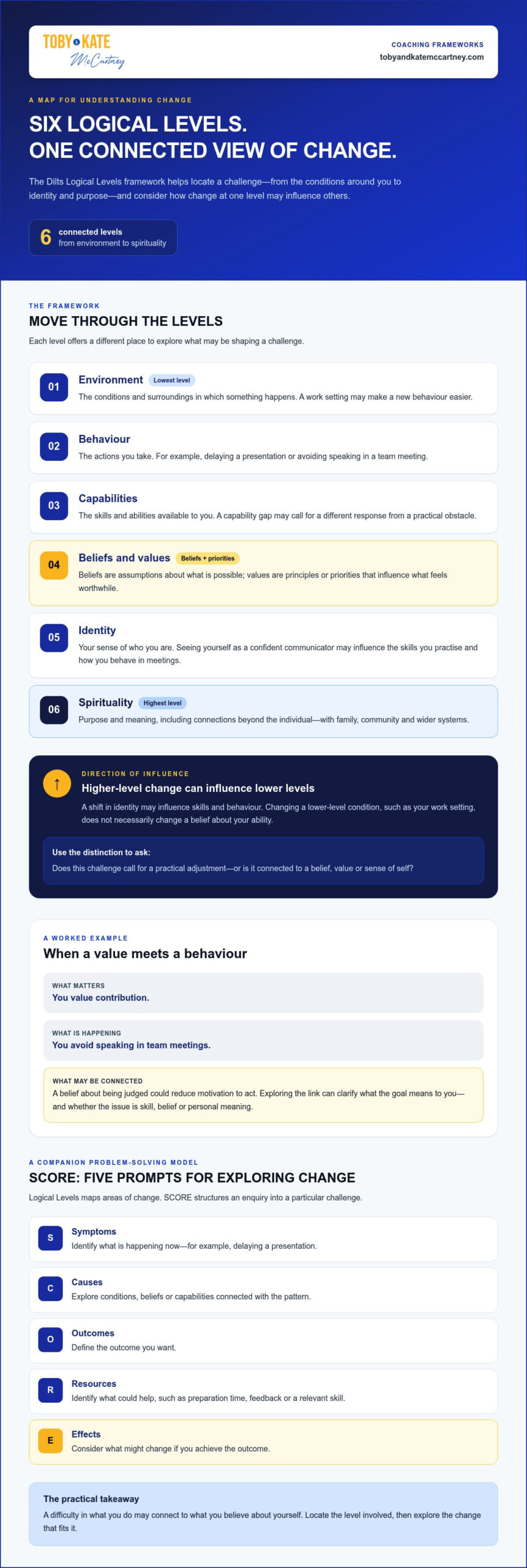
The Dilts Logical Levels framework organises change across six connected levels, from environment to spirituality. It can help you identify where a challenge sits and consider how a shift at that level may affect other parts of your experience.
Influence Across Logical Levels
Influence across logical levels describes how change at one level can affect experience and action at others. The model has six levels: environment, behaviour, capabilities, beliefs and values, identity, and spirituality. Environment is the lowest level; spirituality, concerned with purpose and meaning, is the highest. In this framework, change at a higher level can influence lower levels, while changing a lower level does not necessarily shift a higher one.
For example, changing your work setting may make a new behaviour easier, but it might not alter a belief about your ability. A shift in identity, such as seeing yourself as a confident communicator, may influence which skills you practise and how you behave in meetings. This distinction helps you consider whether a practical adjustment addresses the challenge or whether it connects to a deeper level.
Gregory Bateson’s work informed the Logical Levels model, which Robert Dilts developed further in NLP. A coach can use the framework to explore whether a difficulty involves surrounding conditions, an action, or an assumption about what is possible. In an organisation, comparing individual and organisational values can reveal misalignment during change and help shape a more cohesive strategy.
Values and Motivation in Change
Values are principles or priorities that influence what feels worthwhile, while motivation is the drive to pursue an outcome. In the Logical Levels framework, values sit alongside beliefs, between capabilities and identity. This position invites you to examine how your priorities relate to your skills, actions, and sense of self.
Imagine you value contribution but avoid speaking in team meetings. The behaviour may conflict with a value, while a belief about being judged could reduce your motivation to act. Exploring the connection can clarify what the goal means to you, rather than treating participation as a task to complete. It can also help distinguish a skills gap from a question of personal meaning.
At the higher levels, identity and spirituality connect action with who you believe yourself to be and what gives life purpose. NLP describes spirituality as extending beyond the individual, including relationships with family, community, and wider systems. This does not make every practical problem an identity issue. Instead, the levels offer a way to consider whether values strengthen motivation or a mismatch makes action harder to sustain.
The SCORE Model
SCORE is an NLP model for examining a problem and the changes that could lead towards a desired outcome. Its steps are Symptoms, Causes, Outcomes, Resources, and Effects. Dilts and Epstein developed the model during a self-modelling project after noticing differences in how they and advanced NLP students solved problems.
Start with Symptoms: identify what is happening now, such as delaying a presentation. Next, explore Causes, including conditions, beliefs, or capabilities connected with that pattern. Define the Outcome you want, then identify Resources that could help, such as preparation time, feedback, or a relevant skill. Finally, consider Effects: what might change if you achieve the outcome?
These stages turn a broad concern into a structured exploration. For instance, “I want to feel more confident” becomes clearer when you identify the presentation situation, your current response, useful resources, and the likely impact of speaking up. SCORE complements Logical Levels: one maps areas of change, while the other organises inquiry into a particular challenge. Together, they help you examine both the problem and the wider meaning of progress.
Beliefs, values and identity
In NLP, beliefs are assumptions about what is possible, values are priorities, and identity is your sense of who you are. These ideas are connected, but they are not interchangeable. A belief such as “I can’t lead meetings” may shape behaviour; a value such as fairness may influence how you lead. Identity adds another layer: you might describe yourself as a thoughtful manager rather than a forceful one. Separating these concepts makes the challenge more precise.
Pay attention to language. “I failed to prepare for that presentation” describes an event; “I’m a failure” turns it into an identity statement. That shift can narrow the options you notice. A coach might explore the evidence behind the belief, the meaning attached to the event, and whether the label fits other examples. The aim is not to replace every difficult thought with a positive phrase. It is to examine how your words frame your choices.
Values help explain why an outcome matters. Consider a manager who wants a promotion but also values time with family. If the imagined role seems to threaten that priority, motivation may falter, even when the manager has the required capability. Clarifying the conflict can reveal what to explore: the desired role, assumptions about its demands, or the manager’s definition of success. The ambition can then be considered against more personally meaningful criteria.
Identity can influence which actions feel natural or acceptable. Someone who sees themselves as “not a confident speaker” may avoid presenting, even after developing strong communication skills. A useful coaching conversation can separate identity from a specific behaviour: Which situations feel difficult? What do you already handle well? What small action could provide new evidence? This keeps reflection grounded in examples, rather than treating one label as the whole story.
In practice, explore the connection in sequence: name the goal, identify the value behind it, notice the belief shaping your response, then examine the identity language you use. For example, a team leader who values collaboration might believe that setting boundaries is selfish. Testing that assumption against a real conversation can uncover a more balanced interpretation. NLP training can introduce frameworks for this kind of inquiry; certification is a separate learning decision, not proof that every belief is accurate.
These distinctions make self-discovery more actionable. Rather than asking only, “How can I change?”, consider what matters, what you believe, and how you describe yourself in a particular situation. If you’d like to explore structured NLP development, connect these reflections with the language and choices you want to practise.
Environment, behaviour and capabilities
In the Logical Levels framework, environment means the conditions around you, behaviour is what you do, and capabilities are the skills and strategies you use. These levels help distinguish a difficult situation from your response to it. For example, struggling to finish a report could involve interruptions in your workspace, putting off the task, or uncertainty about organising the information. Each points towards a different kind of change.
Start with the setting. A noisy office, unclear instructions, or competing deadlines can make a task harder to manage. Adjusting the environment might mean agreeing on a quieter work period or clarifying who owns each part of a project. That change can support a new behaviour, such as drafting the report before opening email. But a better setting does not automatically provide the planning skill needed for complex work.
Capabilities include learned skills, strategies, and ways of responding. If you know what to do but struggle to begin, the obstacle may lie elsewhere. If you repeatedly lose track of project stages, you might need a clearer planning method. A coaching conversation can distinguish these patterns by examining a specific example: what happened, what action followed, and which skill or resource could have supported a different response?
Robert Dilts created the NLP BAGEL design to help a coach calibrate a coachee’s internal state using observable cues. The design encourages attention to what can be noticed, rather than relying only on a person’s summary. In a conversation about an upcoming presentation, a coach might observe posture, gestures, and language alongside the person’s description. These cues inform exploration; by themselves, they do not establish what someone thinks or feels.
This framework can bring useful structure to coaching, whether the focus is a work course, a communication challenge, or a personal goal. It can help you decide whether to alter conditions, practise a behaviour, or develop a capability. NLP also includes designs used in coaching and therapy, such as the Resolve design created by Dr Richard Bolstad. The setting and purpose of a conversation matter: a coaching model organises inquiry, while the person’s specific needs shape what is relevant.
Neuro-linguistic programming and coaching
Coaching gives you a structured conversation for clarifying goals and exploring action. NLP adds models and techniques focused on language, attention, and patterns of response. If you want NLP coaching models explained alongside the broader coaching process, the key distinction is how the coach uses those tools.
Comparing Coaching Approaches
NLP coaching uses NLP concepts within a broader coaching framework, while traditional coaching can draw on different methods. CBT focuses on links between thoughts, feelings, and behaviour, often using structured techniques to examine them. The distinction matters because the approach shapes the questions and tools used to explore your goal.
Evidence needs careful interpretation. A 2012 review in the British Journal of General Practice identified 10 experimental studies of NLP and health outcomes; four of five randomised trials found no difference between groups. Tomasz Witkowski examined 35 years of NLP research and concluded its theoretical claims were unsupported. A 2015 meta-analysis of NLP psychotherapy reported an effect of 0.54, but psychotherapy findings don’t establish coaching effectiveness.
These findings highlight criticisms: some theoretical claims lack support, and evidence from therapy or health studies cannot prove coaching effectiveness. Coaching is goal-focused; it is not a substitute for clinical mental health care.
GROW, SCORE and Disney Strategy
GROW, SCORE, and Disney Strategy are frameworks that organise reflection and help turn a broad aim into focused exploration. GROW focuses on a goal, current reality, options, and the way forward. SCORE examines symptoms, causes, outcomes, resources, and effects. Disney Strategy uses distinct perspectives for imagining, evaluating, and planning an idea.
These models offer different routes through a coaching conversation, rather than one universal script. A clear objective may suit GROW, while a recurring problem may benefit from SCORE’s broader investigation. If you want NLP coaching models explained through practical choices, let the challenge guide which framework you explore.
How the GROW Model Works
GROW works through four linked stages: Goal, Reality, Options, and Will, also called the Way forward. First, define what you want to achieve. Then examine the present situation, generate possible actions, and decide what you will do next. In NLP coaching, questions about language, beliefs, or patterns can deepen each stage without replacing its basic structure.
For example, if you want to contribute more in meetings, clarify what success looks like, explore what currently happens, identify options such as preparing a point, and choose a specific next action. This connects reflection with behaviour.
Common NLP Coaching Techniques
Reframing explores a different interpretation of an event; anchoring links a chosen cue with a resourceful state; visualisation mentally rehearses a desired situation. Before a presentation, you might reconsider a previous mistake, recall a moment of composure, then picture delivering your opening clearly. These techniques give your attention a deliberate focus.
A session can include questions, reflection and an agreed action, with its structure shaped by the objectives. NLP coaching sessions can last 60, 90 or 120 minutes, depending mainly on those objectives. The number of sessions depends on the goal, the complexity of the issue and how progress develops over time.
What are the main NLP coaching models, such as GROW, SCORE and Disney strategy?
Coaching models give a conversation a useful shape, helping you examine a goal, understand a challenge, and choose a way forward. GROW, SCORE, and Disney Strategy offer different routes, while other NLP designs focus on patterns, states, or successful performance.
GROW: structure a goal-focused conversation
GROW stands for Goal, Reality, Options, and Will, also called the Way forward. It is a coaching framework, not an NLP-only model, but NLP questions can be used at each stage. For example, a goal of contributing more in meetings becomes clearer when you define what success looks like, explore what currently happens, consider options, and choose an action.
This structure can help when you have a specific outcome but need to move from intention to action. The Reality stage examines present circumstances; Options opens up possible responses. The final stage turns discussion into a commitment, such as preparing one point before a team meeting.
SCORE: map a problem and its desired outcome
SCORE stands for Symptoms, Causes, Outcomes, Resources, and Effects. Dilts and Epstein developed it during a self-modelling project after noticing differences in how they and advanced NLP students approached problem-solving. Its five lenses can help you explore a recurring difficulty without treating the first explanation as the whole story.
For example, if a project keeps stalling, Symptoms describe what is happening; Causes explore contributing factors. Outcomes clarify the desired change, Resources identify what could help, and Effects consider what achieving the outcome may influence. This wider view can be useful when a goal connects to several parts of work or life.
Disney Strategy: explore an idea from different perspectives
Disney Strategy uses three perspectives: Dreamer, Realist, and Critic. You first imagine possibilities, then consider practical ways to make one happen, and finally look for gaps or risks. A team planning a new service might generate bold ideas as Dreamers, map delivery as Realists, then test assumptions as Critics.
Separating these perspectives helps prevent early criticism from shutting down useful ideas. It also gives the Critic a constructive role: identify what needs strengthening, rather than dismissing the ambition outright.
Other NLP designs and choosing a model
Not every NLP design is a step-by-step coaching model. Robert Dilts’s BAGEL design helps a coach calibrate a coachee’s internal state using observable cues. The ROLE design describes how representational systems are oriented and linked to create an effect, such as a feeling or behaviour. Success Factor Modeling identifies characteristics of successful people or organisations; it also considers alignment between personal values and those of successful models.
Choose by purpose: GROW for shaping action, SCORE for investigating a problem, or Disney Strategy for developing and testing an idea. For tailored support applying a framework to your own goal, explore one-to-one coaching.
Toby and Kate McCartney: NLP Practitioner Certification
Toby and Kate McCartney’s NLP Practitioner Certification is a next step if you want to study NLP models and deepen your understanding beyond this overview. It may suit you if you are interested in applying NLP concepts in personal or professional settings, or building a foundation for further study.
If you already have NLP experience and want to deepen your learning, the NLP Master Practitioner Certification offers a further training pathway. Public Speaking programmes and NLP Trainer Training are also available if you want to focus on communication or develop as a trainer. These options serve different aims, so consider whether you want to learn NLP, strengthen a specific skill, or train others.
To explore which pathway fits your goals, contact Toby and Kate McCartney.
Turn insight into your next move
Understanding how identity can shape behaviour gives you a useful place to begin, but insight becomes more valuable when you apply it to a goal that matters. Knowing NLP coaching models can help you choose a framework; your next step is to decide whether you want to use these ideas in your own development, communication, or work with others.
Toby and Kate McCartney offer NLP Practitioner Certification and NLP Master Practitioner Certification for those ready to develop their NLP knowledge through training. Their Public Speaking programmes may also suit you if your focus is communicating with greater clarity and confidence. Choose the pathway that best connects with the capability you want to build.
You don’t need to map out every stage before you begin. Start with the outcome you want to pursue and the kind of learning that could support it. Contact Toby and Kate McCartney to explore your next step. Your growth starts with a decision you can act on.
Frequently Asked Questions
What is Coaching?
Coaching is a collaborative conversation that helps you clarify a goal, examine what is getting in the way, and decide on useful action. For example, if you are preparing to lead a project, a coach can help you define what success looks like, identify the conversations you need to have, and plan your first step. You remain responsible for your choices; the coach supports your reflection and follow-through.
Main differences between NLP and coaching?
Coaching is the broader process of supporting someone towards a goal, while NLP is one approach a coach can use within that process. A coach might draw mainly on NLP or select NLP tools alongside other methods. For instance, someone preparing for a leadership interview could use coaching to clarify their objective and NLP-informed questions to examine how their self-talk shapes their preparation.
What does NLP mean?
NLP stands for Neuro-Linguistic Programming. The name connects neurological experience, language and learned patterns of thought or action. Richard Bandler and John Grinder created NLP in the 1970s; John Grinder was a linguistics specialist. The word “programming” refers to patterns people learn, not computer code. This lens directs attention to how communication and habitual responses can influence the way someone approaches a situation.
What does NLP mean in coaching?
In coaching, NLP means applying NLP ideas to help someone explore how they interpret situations and respond to them. For example, a manager who finds it difficult to give feedback could examine the words they use internally, clarify what respectful feedback means to them, then plan a conversation. The coach keeps the discussion connected to the person’s chosen goal and practical next action.