
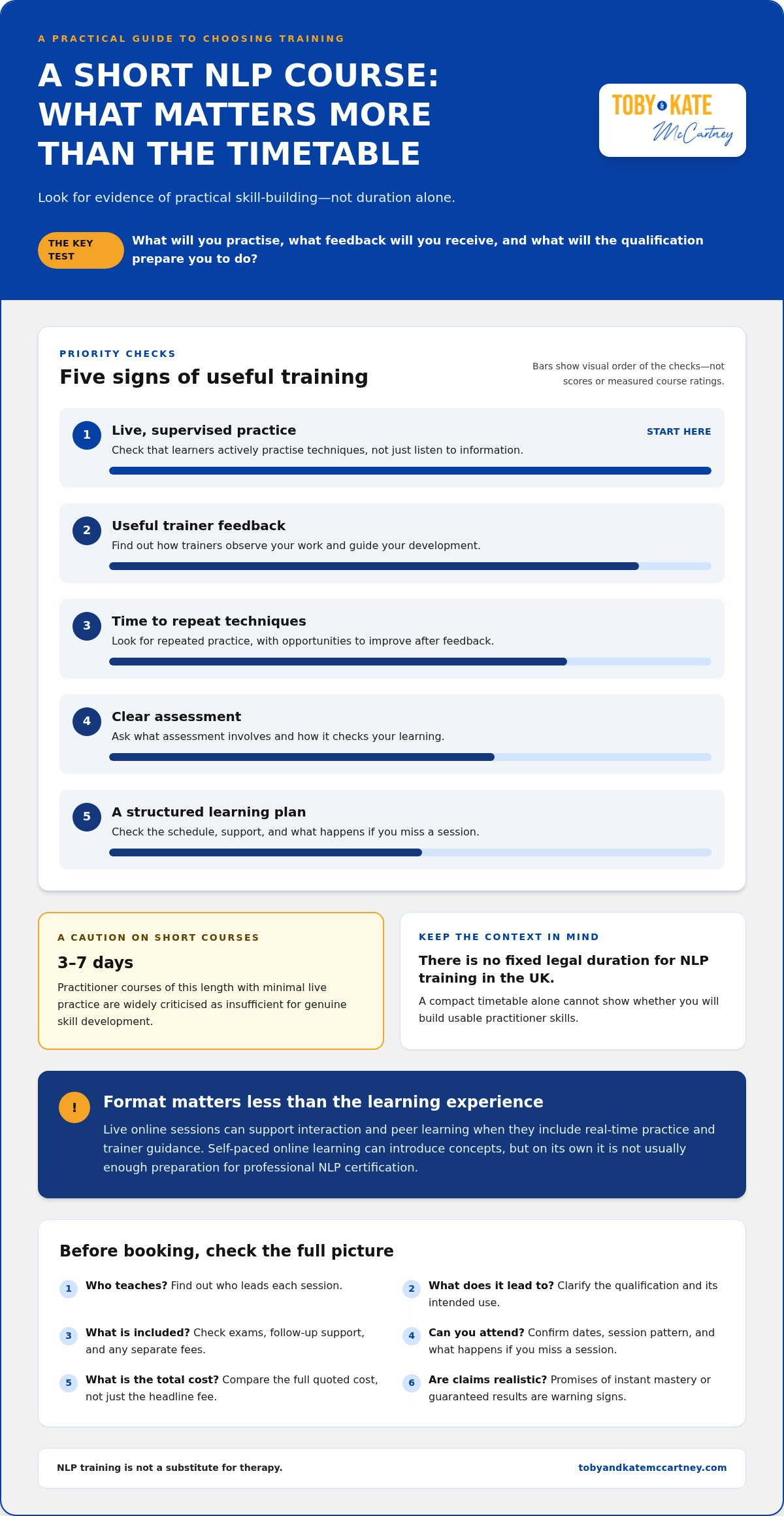
A two-day NLP course isn’t automatically poor training, but it isn’t proof of professional readiness either. There’s no fixed legal duration for NLP training in the UK, so how to choose an NLP training provider comes down to what you’ll practise, the feedback you’ll receive and what the qualification prepares you to do. Courses lasting 3–7 days with minimal live practice are widely criticised as insufficient for genuine skill development.
A short course can be an appealing way to explore NLP without committing to a longer pathway. Look beyond the timetable: useful training develops practical skills through live interaction, repeated practice and feedback, not information alone.
This guide helps you weigh a short course against a Foundation, Practitioner or Master Practitioner pathway, compare live online and in-person formats, and understand professional membership and accreditation. You’ll be better placed to choose training that fits your aims, learning style and next step.
Key Takeaways
- Judge a short course by the live practice, feedback and support it includes, not its compact timetable alone.
- Match your starting point and professional aims to the right stage of the NLP qualification pathway.
- Compare online and in-person learning by how much real-time interaction and practical guidance each format provides.
- Understand what professional membership and accreditation mean, and how they can inform your choice of training.
1. 2 Day NLP practitioner training courses – they’re cheap but are they any good?
A two-day course can introduce NLP, but duration alone can’t show whether you’ll build usable practitioner skills. NLP training has no fixed legal standard for its duration in the UK. Practitioner courses lasting 3–7 days with minimal live practice are widely criticised as insufficient for genuine skill development. Ask what you’ll practise, how trainers give feedback and how your learning is assessed.
For a short course, review the schedule from start to finish. Does it include supervised practice, feedback and time to repeat techniques, or mainly presentations? Self-paced online learning can introduce concepts, but on its own it is not usually enough preparation for professional NLP certification. Live online sessions can support interaction and peer learning when they include real-time practice and trainer guidance.
Course dates and availability matter when fitting training around work and study. Before booking, find out the scheduled dates, session pattern, what happens if you miss a session, and whether follow-up learning is included. These details help distinguish a brief introduction from a structured training course.
How much do NLP training courses cost in the UK, including exams and follow-up fees? The total depends on the format, teaching and assessment included, and whether exams or follow-up support cost extra. Compare the full quoted cost, not just the headline fee.
What should you ask before booking? Ask who teaches each session, how much live practice is included, what assessment involves, and whether exam or follow-up fees are separate. Clarify the course dates and the qualification it leads to, too.
What are the risks and limitations of NLP training? Too little practice can leave you without the skills to apply what you learn, while promises of instant mastery or guaranteed results are warning signs. NLP isn’t a substitute for therapy.
Can an employer fund NLP training or count it as continuing professional development in the UK? Funding depends on workplace policy and the course’s relevance to your role. CPD recognition depends on the requirements of your professional body.
2. NLP foundation, practitioner and master practitioner pathways
Think of NLP qualifications as a pathway, not interchangeable course labels. A common progression is Foundation Diploma in NLP, NLP Practitioner, then NLP Master Practitioner. Foundation training introduces core concepts; Practitioner training develops applied skills, while Master Practitioner study builds on that grounding. Choose the stage that matches your experience and intended use, not simply the title.
Look for experiential learning: demonstrations, supervised repetition, feedback and assessment. An original benchmark for Practitioner certification described 120 hours of workshop attendance with a Certified NLP Trainer. Dr Phil Parker recommends about 20 days of full training over a few months for someone aiming to become a practitioner. These are useful points of comparison, not a single legal duration that every provider must follow.
How many training hours and how much supervised practice do courses provide? Compare teaching hours with time spent practising, receiving feedback and repeating techniques. The total alone doesn’t show how confidently you can apply what you learn. Ask whether exercises are observed and supported, and whether practice takes place in peer groups or with members of the public under supervision. Public-facing practice should have clear boundaries and appropriate supervision.
How do you compare class sizes, teaching methods, support and refund policies? Some providers run groups of 10–15, while some events have 40 to hundreds of participants; compare access to trainers and assistants, practical exercises, learner support and written refund terms. Smaller groups may allow more individual feedback, but teaching structure matters too.
What should a Practitioner or Master Practitioner syllabus include? Look for clearly described skills, live interaction, practice, feedback and appropriate assessment, with advanced work building on Practitioner learning. UK options include classroom, live online and self-paced courses, but each format should make its teaching and support structure clear. If you’re comparing a structured NLP Practitioner Certification pathway, focus on how supervised practice develops genuine readiness to use the skills.
3. Live online versus in-person training
Live online NLP training can work as well as classroom learning when it’s synchronous, interactive and meets recognised professional standards. Dr Phil Parker says online training can match face-to-face training when it includes live interaction and enough training-team members to support learners. The key difference isn’t simply the screen: it’s whether you can practise, observe others and receive useful feedback during sessions.
Before choosing an online course, find out how the trainer structures each session. Look for live demonstrations, paired or small-group exercises, time for questions, and feedback on your practice. A video lecture followed by independent worksheets, for example, offers a different learning experience from a live virtual class where you practise a technique and discuss the result with a trainer.
In-person training brings everyone together for demonstrations and practice. You can observe body language directly, move between exercises and talk with classmates during breaks. This may suit learners who build confidence through face-to-face coaching or find online sessions distracting. Consider practical details too: travel, the venue and scheduled dates can affect whether you attend consistently.
Online learning can be flexible, but it still calls for active participation. Check whether sessions happen live, how learners practise together, and how trainers respond when someone needs support. A course with live interaction should explain how you contribute, receive feedback and stay connected with the group. Self-paced material alone cannot provide that real-time exchange.
Choose a format that suits your learning habits and gives you meaningful practice. If you learn by doing, prioritise interactive exercises in either setting. When comparing courses, map out a typical session for each: note when the trainer demonstrates, when you practise and when feedback happens. This reveals whether the format helps you build skills, rather than simply attend sessions.
4. Professional membership and accreditation
NLP has no single authority overseeing every qualification. In the early 1980s, its founders, Richard Bandler and John Grinder, went their separate ways. Different schools and certifying bodies followed, so “accredited” can mean different things across NLP courses. Treat the label as a prompt to identify the organisation, its standards and what it has assessed.
In the UK, the Association for NLP (ANLP) describes itself as an accrediting body for NLP. ANLP recommends choosing a trainer accredited by, or at least a member of, a reputable professional organisation. Its Trainer members agree to follow the ANLP Code of Ethics and Trainers Code of Ethics. ANLP validates certifications submitted by those trainers and requires external references. It also has a complaints procedure for concerns about members.
ABNLP and ANLP are different organisations. If a provider refers to ABNLP accreditation, establish which organisation the initials represent and what the status covers. Don’t assume it means ANLP membership or validation. Dr Phil Parker recommends checking whether an NLP training course is listed by ANLP, BIH or INLPTA. A listing or membership can inform your decision, but compare the syllabus, assessment and qualification level as well.
How can you verify a trainer’s experience, credentials and reputation? Ask about their training background, which body recognises their credential, and their teaching experience. Read the organisation’s published ethics standards and complaints process, such as ANLP’s, and find out who will teach your course.
Use accreditation as one part of your decision, not a substitute for examining the training itself. Compare the named qualification with your intended use, and make sure the course’s stated level matches your next step. To explore professional NLP training pathways, take the next step in your NLP development.
Toby and Kate McCartney: NLP Practitioner Certification
Toby and Kate McCartney’s NLP Practitioner Certification is a practical next step if you’re ready to develop your NLP skills through a structured qualification pathway. It may suit you if a short introduction has sparked a deeper interest or you want to apply NLP in personal or professional settings.
If you already have Practitioner-level training and want to develop further, NLP Master Practitioner Certification offers the next qualification step. For those aiming to train others, NLP Trainer Training provides another pathway. Each serves a different goal, so decide what you want to learn and how you intend to use it.
Choosing a course takes time and focus. Use this guide’s criteria to identify the pathway that fits your aims, then explore the relevant programme details. Contact Toby and Kate McCartney to discuss your next step.
Turn your learning into a purposeful next step
The right NLP pathway supports what you want to do next. Consider where you want to use these skills, whether in professional communication, personal development or future training work. This clarity makes choosing an NLP training provider more purposeful: you’re selecting a pathway that fits your direction, not just a qualification title.
Toby and Kate McCartney offer NLP Practitioner Certification and NLP Master Practitioner Certification, as well as public speaking programmes. These options link NLP learning with practical communication and continued development, according to your aims.
If you’re ready to explore a pathway that fits your goals, contact Toby and Kate McCartney. Take the next step with confidence, and keep your growth aligned with the future you want to create.
Frequently Asked Questions
2 Day NLP practitioner training courses – they’re cheap but are they any good?
A two-day course may be useful as an introduction, but it shouldn’t be mistaken for comprehensive practitioner preparation. Decide what you need: exploring NLP concepts differs from developing skills for professional use. Before enrolling, review a sample timetable and see how much time is set aside for practice, applying techniques and individual feedback. A course focused mainly on demonstrations may not meet your learning goal.
Choosing an NLP training provider?
To choose an NLP training provider, first define your purpose: personal development, workplace communication or professional NLP practice. Then compare the intended learning outcomes with the format and qualification level. If you want to apply techniques at work, for example, look for exercises relevant to workplace conversations rather than choosing on the course title alone. A written outline makes it easier to compare providers consistently.
How can I be aware what is the best NLP Training, or not?
There’s no single best course for every learner: suitability depends on your goals and how you learn. Try this practical test: read a sample exercise and ask whether you’ll have the chance to practise it, reflect on the result and apply it to a real situation. Consider whether the trainer explains the course’s limits clearly. Be cautious of claims of instant mastery or guaranteed results.
What are NLP qualifications?
NLP qualifications are certificates or diplomas awarded after training, and their names commonly indicate different learning stages. A Foundation Diploma introduces NLP, Practitioner training develops applied skills, and Master Practitioner study builds on Practitioner-level learning. Since no single authority oversees every NLP qualification, compare the course content, assessment and issuing organisation instead of assuming similar titles mean identical training.
Which NLP course should I choose?
Choose the course that builds the capability you need next. A Foundation course can help you explore NLP; Practitioner training may suit you if you want a stronger practical grounding. If you already have Practitioner-level training and want to deepen your learning, consider Master Practitioner study. If presentations are your focus, training centred on public speaking skills may also be relevant.
What qualifications, accreditation or professional memberships should an NLP training provider have?
Look for a trainer whose qualification, membership and course listing you can identify by name. In the UK, ANLP recommends choosing a trainer accredited by, or at least a member of, a reputable professional organisation. Read the organisation’s ethics requirements and complaints process, then compare them with the trainer’s stated credentials. Membership adds useful context, but doesn’t replace a review of course content and assessment.