
A negative thought can sound convincing without telling the whole story. NLP reframing techniques for negative thoughts can help you question an interpretation, keep the facts in view and choose a more useful response. Reframing doesn’t mean denying what happened or pretending a difficult situation feels easy.
If you’ve caught yourself thinking, “I always get it wrong” or “Nothing will change”, you know how quickly a thought can shape your feelings and behaviour. You don’t have to force yourself to be positive. Instead, examine what a thought is based on and consider a more balanced response.
This article shows you how to identify and question unhelpful thoughts, practise alternatives with techniques such as the Swish Method and anchoring, and explore the intention behind a repeated response. You’ll also learn to challenge limiting beliefs while staying realistic about the situation in front of you. Small, deliberate shifts can give you more choice in what you do next.
Key Takeaways
- Separate the facts of a situation from the meaning you’ve attached to them before choosing a more balanced interpretation.
- Practise a replacement response repeatedly, using visualisation or an anchor to make it easier to access when an automatic thought appears.
- Explore what a recurring reaction may be trying to achieve, then consider alternative ways to meet that need.
- Challenge limiting beliefs by testing the evidence and choosing a practical next step that acknowledges the situation without letting one thought define you.
Practising NLP techniques to change automatic responses
NLP can help you practise different responses, though its evidence base remains limited and inconsistent. NLP is generally described as a broader set of techniques focused on language and mental patterns, rather than a structured psychological therapy. Check the training body’s stated accreditation criteria, and seek help from your GP or a mental health professional if persistent thoughts affect daily life, or explore dedicated workplace mental health support through LEAPS.
-
Turn absolute thoughts into specific descriptions
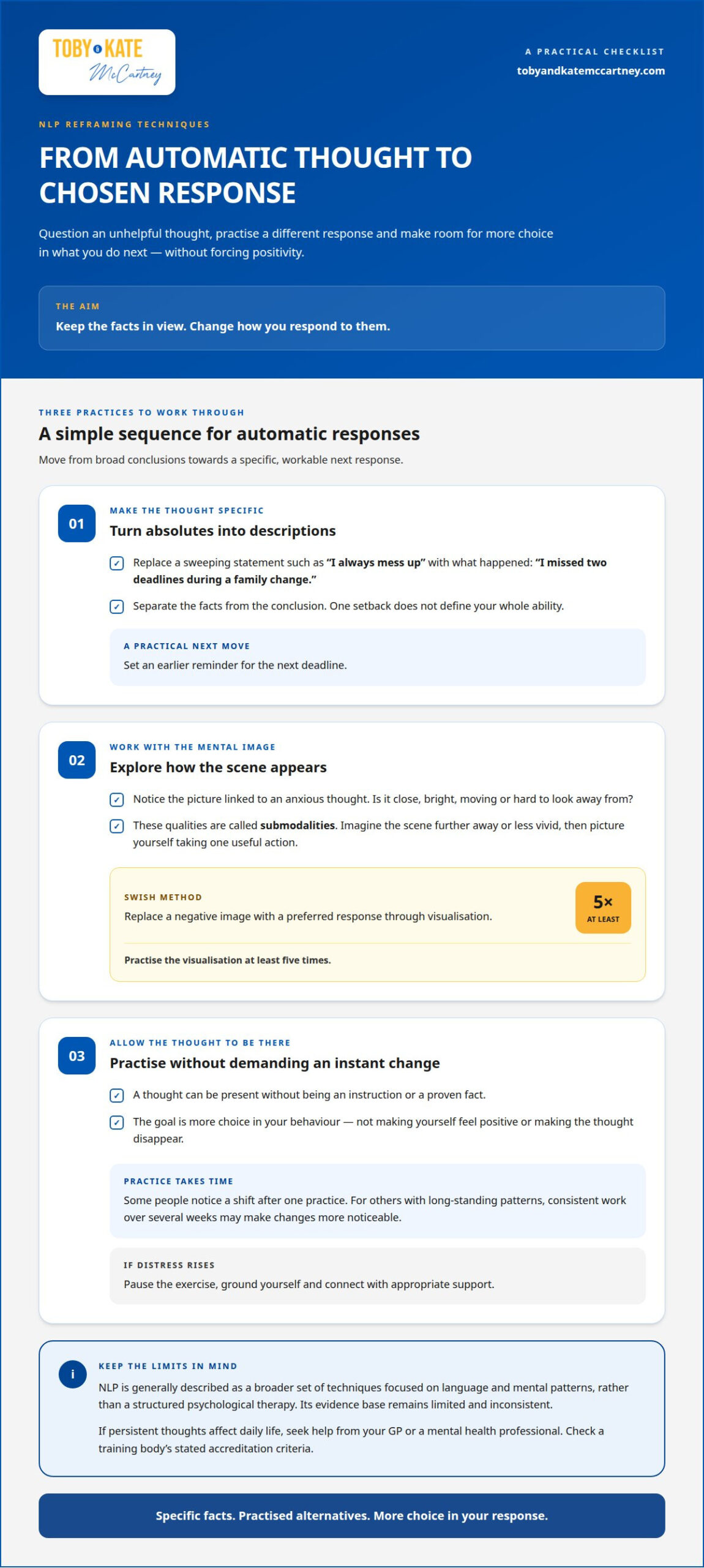
Replace “I always mess up” with a description of what happened, such as “I missed two deadlines during a family change”. Then separate the facts from your conclusions. Don’t let one setback define your whole ability. Specific language gives you a clearer starting point for a helpful response, such as setting an earlier reminder for the next deadline.
-
Explore changes to mental images
Notice the mental picture attached to an anxious thought: is it close, bright, moving or hard to look away from? In NLP, these qualities are called submodalities. Imagine the scene further away or less vivid, then picture yourself taking one useful action. The Swish Method replaces a negative image with a preferred response; practise the visualisation at least five times.
-
Accept thoughts that may not change
Let a thought be present without treating it as an instruction or a proven fact. NLP may help you question a pattern and rehearse a different response, but the thought itself may remain. Aim for more choice in your behaviour, not forced positivity. If reflection feels overwhelming or distress rises, pause the exercise, ground yourself and connect with appropriate support.
Build awareness through repeated practice rather than demanding an instant outcome. According to the NHS, reflecting on and assessing unhelpful thoughts can become easier over time. Some people notice a shift after one practice, whilst consistent work over several weeks may make changes more noticeable for others with long-standing patterns.
Can NLP Change Negative Thought Patterns?
NLP reframing can help you practise alternative responses to recurring patterns. It changes your perspective, not the facts of a difficult situation.
-
Identify a behaviour’s positive intention
Ask what a repeated behaviour might be trying to do for you, without assuming the behaviour itself is helpful. For example, avoiding a difficult conversation might be an attempt to prevent conflict or rejection. NLP Six Step Reframing separates the behaviour from its presumed positive intention, then explores alternative actions that could meet the same need.
To practise, name the behaviour, identify its possible purpose, then generate different responses. This doesn’t mean accepting harmful consequences. It offers a way to understand the pattern and choose a more constructive action.
-
Reframe thoughts neutrally or positively
Write down the thought and create a neutral alternative before trying a positive one. “I can’t cope with this” might become “This situation is stressful, and I can take one step.” Make sure your new language acknowledges the challenge rather than disguising it. A useful reframe supports action; it doesn’t require you to feel positive immediately.
Repeat the alternative when the thought returns, and notice whether it changes your response. A phrase such as “I can ask for clarification” gives you a specific next move.
-
Link positive emotional states to sensory cues
Recall a specific moment when you felt calm or confident. As you bring that memory to mind, press your thumb and forefinger together, linking the gesture with the feeling. Repeat the memory and gesture together, then use the cue when stress rises. Treat it as a prompt to access a familiar state, not a switch that removes every difficult emotion.
-
Distinguish reframing from forced positivity
Keep the facts and change only the interpretation. Reframing isn’t pretending everything is fine or dismissing pain. Compared with NLP’s broader focus on language and mental patterns, CBT is a structured psychological therapy with a strong research base. NLP’s evidence base is more limited and methodologically inconsistent.
NLP reframing can intensify distress if you pressure yourself to feel positive or revisit upsetting material too quickly. Pause if you feel overwhelmed, ground yourself and seek appropriate support. Six Step Reframing explores a behaviour’s positive intention and develops alternative responses; it doesn’t guarantee a change in thought patterns.
For structured practice, explore guided NLP learning.
Using alternative responses to challenge limiting beliefs
Challenge a limiting belief by testing its evidence, considering another perspective and choosing a response you can act on. The aim is flexible thinking, not replacing every unhelpful thought with an unrealistically positive one.
-
Generate alternative explanations
Write down the belief and identify what supports it, then look for other explanations. If you think, “My colleague didn’t reply because they’re angry with me”, consider practical possibilities: they may be busy or have missed the message. According to the NHS, checking evidence and considering alternative explanations can help you assess unhelpful thoughts. Don’t treat a possibility as proof; keep your interpretation open.
-
Consider alternative perspectives
View the same moment through another person’s eyes. Ask what a trusted friend might say, or what you might conclude with more information. For example, a short comment from a manager could be a request for clarification rather than evidence that your work is poor. This shift in perspective doesn’t erase the comment; it creates room to respond thoughtfully.
-
Choose believable, actionable thoughts
Turn a sweeping belief into a balanced statement you can accept. Replace “I’ll never get this right” with “I’m still learning this task, and I can ask for feedback.” For instance, someone stepping into a demanding new role—such as a new father navigating early parenthood with guidance from greatdad.com—can benefit greatly from reframing feelings of inadequacy into a manageable learning curve. A useful alternative recognises the challenge and points towards a next step. Avoid phrases that feel false or demand instant confidence, as they can widen the gap between your thinking and experience.
-
Generate alternative behaviours
Choose two or three actions that could meet the need behind an unhelpful response. If avoiding a presentation protects you from feeling exposed, alternatives might include rehearsing with a colleague, asking for feedback or preparing notes. Try one action in a manageable situation, then notice the outcome. The purpose is to expand your choices, not criticise yourself for the original behaviour.
Reframing negative thoughts
Use a short sequence to turn harsh self-talk into a fairer interpretation and a practical next step. Keep the facts intact; change the meaning you assign to them. You can use nlp reframing techniques for negative thoughts to examine your interpretation without dismissing what happened.
-
Identify negative self-talk
Write down the exact thought that appears after a difficult moment. Notice patterns such as expecting the worst, seeing only failure or blaming yourself entirely. For example, after receiving one correction, you might think, “My work is always poor.” Separate the event from that broad conclusion. This gives you a specific thought to examine instead of treating an emotional reaction as proof.
-
Explore examples of reframed self-talk
Replace “I failed, so I’m not capable” with “This attempt didn’t work; I can identify what to change.” Reframe “They criticised me because I’m useless” as “There may be one point in that feedback I can use.” If anxiety says, “I’ll make a fool of myself”, try “I may feel anxious, and I can still prepare.” Each alternative acknowledges the challenge without turning it into a verdict about you.
- Test your new wording against the evidence. The NHS thought record uses seven prompts to examine thoughts and feelings, including what supports or contradicts your interpretation. Ask what you would say to a friend in the same situation. Choose credible language, not an exaggerated claim that you must feel confident or positive.
- Connect the alternative thought to one observable action. If “I can’t handle this conversation” appears, prepare one point you want to explain, then decide when to raise it. Notice what happens afterwards, including any emotional shift or new information. Practising nlp reframing techniques for negative thoughts can help you develop a considered response, but it won’t solve the underlying problem by itself.
If you want structured support applying these steps to a recurring belief, explore one-to-one coaching.
Toby and Kate McCartney
Toby and Kate McCartney offer NLP training for people who want to develop these techniques systematically and apply them in personal or professional settings. If you’re ready to move beyond occasional reframing and build a broader understanding of NLP, the NLP Practitioner Certification offers a pathway into its methods. The NLP Master Practitioner Certification is a further step in developing your practice.
This training may suit you if you want to strengthen how you work with language, perspectives and behavioural patterns. It isn’t a substitute for clinical mental health support if persistent or distressing thoughts affect your wellbeing. Choose the approach that fits your needs, and consider training when your goal is to learn and practise NLP skills.
Contact Toby and Kate McCartney to discuss which learning pathway best matches your goals.
Make your next response a deliberate choice
The next time a familiar negative thought appears, treat it as a cue to pause and choose how you want to respond. You don’t need to silence every difficult thought before taking a constructive step. With practice, nlp reframing techniques for negative thoughts can become part of how you approach challenges, decisions and conversations.
If you’d like to develop your communication skills alongside this personal practice, Toby and Kate McCartney’s public speaking programmes offer a related pathway. You can also get in touch to discuss which learning option best fits your goals and the skills you want to build.
Contact Toby and Kate McCartney to explore your next step. Start with curiosity, practise with intention and keep moving towards the response you want to make.
Frequently Asked Questions
Does NLP Actually Work?
NLP may help some people explore communication and behaviour patterns, but its evidence base is limited and methodologically inconsistent. It shouldn’t be presented as a proven treatment for mental health conditions. Judge a technique by whether it helps you respond more thoughtfully in a specific everyday situation, such as preparing for a challenging conversation, rather than assuming it will work for everyone.
What Is NLP?
NLP is a collection of techniques for examining how language, perceptions and behavioural patterns shape your experience of a situation. It’s used in coaching, communication training and personal development. For example, you might interpret a colleague’s brief message as disapproval, then examine the assumptions behind that interpretation before deciding how to respond.
What Is Neuro-Linguistic Programming?
Neuro-Linguistic Programming is the full name for NLP, a set of approaches that emerged in the 1970s. It focuses on connections between the way people perceive experiences, use language and develop behavioural patterns. The term describes a broad framework, not one single exercise, so techniques and how they’re applied can vary between coaching and personal-development settings.
What Is Reframing in NLP?
Reframing in NLP means considering a different context or perspective for an experience while keeping its facts in view. For instance, if a presentation runs over time, you might see it as a cue to refine your pacing rather than proof you’re a poor speaker. A reframe is useful when it supports a considered next step, not when it dismisses valid concerns.
What is NLP reframing for negative thoughts?
It’s the practice of examining a negative thought and finding a more balanced way to understand it. If “I’m not suited to leadership” follows a difficult decision, look at that specific decision rather than judging your whole ability. A useful alternative might be, “I can review what happened and seek input before deciding next time.”
What NLP reframing techniques can help with negative thoughts?
Useful options include Meta Model questioning, Six Step Reframing, the Swish Method and anchoring. Choose based on what you want to work on: questioning broad assumptions, exploring the intention behind a repeated behaviour, changing a mental image or associating a sensory cue with a remembered calm state. Keep the exercise grounded in real circumstances and choose a practical response you can try.