
What if the difference between a struggling practitioner and a world-class coach isn’t the number of techniques you’ve memorised, but the depth of the identity shift you’ve undergone? You’ve likely felt the pull of this transformative field, yet found yourself stalled by the noise of unaccredited trainers and the confusion of which certification level actually matters. It’s a common hurdle. You want to move beyond being an information consumer to becoming a true behavioural architect. This guide cuts through the static to give you the precise roadmap for becoming an NLP coach who commands respect and delivers undeniable results.
You already know that mastery requires more than just a weekend workshop; it demands a structured, elite skill set that separates the amateurs from the professionals. We’re going to bridge that gap together. In the following sections, you’ll discover the essential certification pathways for 2026, the critical difference between a simple practitioner and a professional coach, and how to select a mentor who matches your highest ambitions. It’s time to stop wondering and start leading.
Key Takeaways
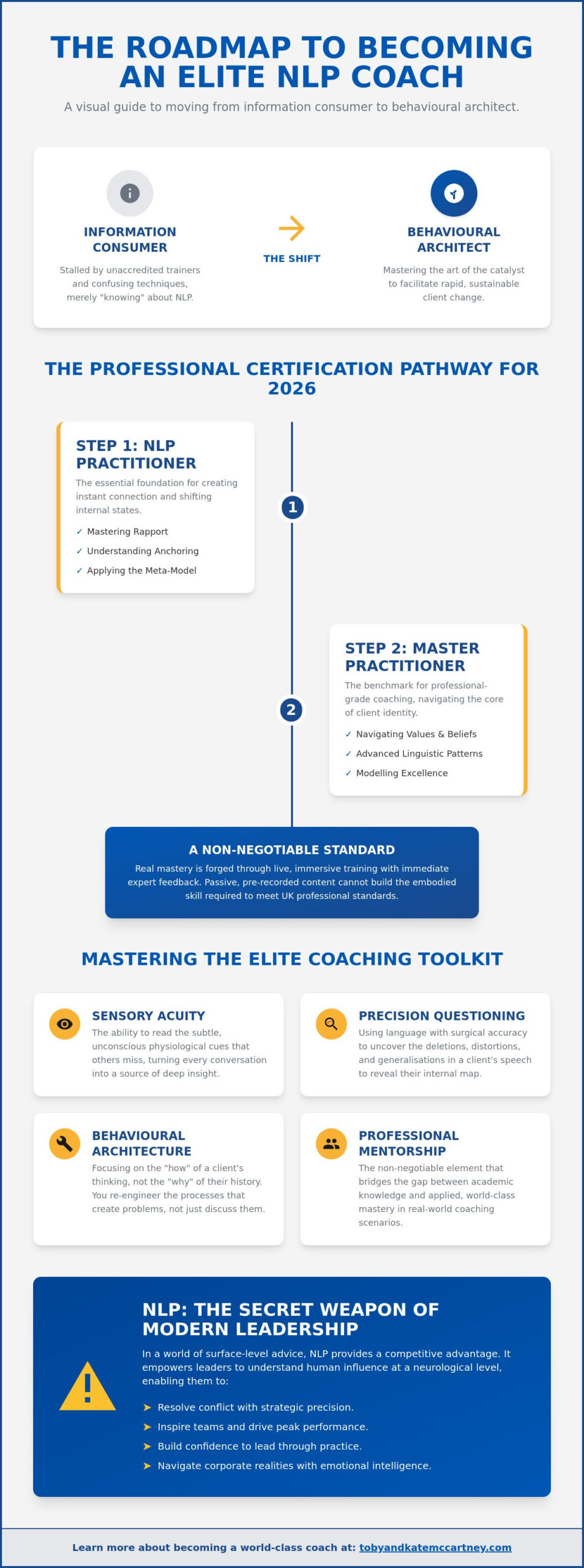
- Understand the vital shift from merely knowing techniques to becoming a behavioural architect who facilitates rapid, sustainable client change.
- Discover the precise certification roadmap for becoming an NLP coach, moving from foundational Practitioner skills to advanced Master Practitioner expertise.
- Master the elite coaching toolkit, including sensory acuity and precision questioning, to read unconscious responses and influence outcomes with clarity.
- Learn how to overcome the fear of coaching real people by organising practice sessions that build your confidence and professional identity.
- Recognise why professional mentorship is the non-negotiable element that separates academic knowledge from applied, world-class mastery.
Defining the Journey: What It Truly Means to Become an NLP Coach
You aren’t just looking for another certificate to hang on your wall. You’re looking for a metamorphosis. Becoming an NLP coach in 2026 isn’t about memorising scripts or collecting badges; it’s about mastering the art of the catalyst. Whilst many people “know” Neuro-linguistic programming, very few possess the precision to use it as a professional coaching tool. The difference is profound. One is an academic exercise; the other is a high-stakes intervention that drives rapid, sustainable behavioural change. You’re stepping into a role where you don’t just talk about problems. Instead, you re-engineer the very processes that create them.
The demand for elite communication and mindset experts has reached a fever pitch. In a world of surface-level advice, people are desperate for leaders who understand the mechanics of the mind. This is where you come in. By adopting the McCartney philosophy, you view coaching as a pathway to attainable excellence. It’s a journey that takes you from a state of curiosity to a state of absolute readiness for action. You’re not just learning a trade; you’re joining a community of like-minded achievers who refuse to settle for mediocre results.
The Role of a Behavioural Architect
Traditional mentoring often gets bogged down in the “why” of history. An NLP coach operates differently. You’re a behavioural architect. You focus on the “how” of thinking. Instead of excavating the past, you’re identifying the internal maps that dictate a client’s present actions. It’s a shift from passive listening to active neuro-linguistic intervention. An NLP coach is an expert in the structure of subjective experience. You see the patterns others miss. You hear the deletions, distortions, and generalisations in their speech. Then, you provide the tools to build a better reality. This focus on structure rather than content allows for shifts that feel instantaneous yet last a lifetime.
Why NLP is the Secret Weapon of Modern Leadership
Coaching skills are no longer optional for those at the top. In the corporate world, managers and HR professionals are realising that standard leadership training isn’t enough. They need to understand human influence at a neurological level. This is your competitive advantage. Whether you’re enhancing your current executive role or transitioning from a corporate background into a bespoke coaching practice, these skills are your secret weapon. You’ll gain the ability to resolve conflict, inspire teams, and drive performance with a level of clarity that feels like a master-level skill set. Becoming an NLP coach empowers you to navigate modern leadership realities with emotional intelligence and strategic precision, ensuring you are always two steps ahead of the curve.
The Certification Hierarchy: Navigating the NLP Training Pathway
Becoming an NLP coach is a journey of tiered mastery. It requires a commitment to a structured path that moves from foundational skills to elite-level influence. You cannot shortcut this process with pre-recorded, passive content. Real transformation happens through live, immersive training where you receive immediate feedback from experts. This ensures you meet rigorous UK professional standards, adhering to the synchronous training hours required by major accrediting bodies, and build the confidence necessary to lead others. It’s about moving beyond information and into the realm of embodied skill.
Step 1: The NLP Practitioner Foundation
Your journey starts here. This level provides the essential building blocks: Rapport, Anchoring, and the Meta-Model. These aren’t just theories; they are the tools you’ll use to create instant connection and shift internal states. A high-quality NLP Practitioner Certification UK prioritises supervised practice. This hands-on experience is vital. It’s the difference between reading about a technique and actually witnessing it work in real-time. You’ll learn to read the subtle cues that others miss, turning every conversation into an opportunity for growth.
Step 2: Elevating to Master Practitioner
Once you’ve mastered the basics, you must go deeper. The NLP Master Practitioner Certification is where you learn to navigate the complex landscape of values and beliefs. This is the benchmark for professional-grade coaching. You’ll explore advanced linguistic patterns that allow you to facilitate change at a neurological level. It’s about moving from “doing” NLP to “being” an NLP master. You’ll gain the ability to dismantle limiting beliefs and help clients architect a future that matches their highest potential.
Step 3: Specialised Trainer and Coach Training
For those who aspire to lead groups, the NLP Trainer Training Certification is the final peak. The transition to becoming an NLP coach at this elite level involves leading groups and mastering public influence. This stage integrates public speaking and leadership training into your repertoire. You transition from one-to-one interventions to mastering public influence. It’s about creating a multi-dimensional career where you can inspire hundreds as easily as you can coach one, becoming a visionary in your chosen field.
As highlighted by Psychology Today on NLP, the application of these techniques in a professional context requires a deep understanding of psychological principles. Choosing the right pathway ensures your practice is both ethical and effective. If you’re ready to start this ascent, exploring our mentoring services can provide the bespoke guidance you need to reach the top with confidence.
Mastering the Toolkit: Essential Skills of an Elite NLP Coach
Possessing a certificate is just the beginning; true mastery lies in the execution. When you commit to becoming an NLP coach, you’re developing a level of sensory acuity that borders on the extraordinary. You aren’t just listening to words. You’re observing micro-muscle shifts, changes in breathing depth, and subtle skin colour variations. These are the unconscious signals that reveal a client’s true state. By reading these cues, you can intervene before a limiting belief even reaches their conscious mind. It’s about being present with such intensity that nothing escapes your notice. You become the mirror that reflects the client’s potential back to them.
Precision questioning is your primary instrument. Whilst others offer vague advice or surface-level encouragement, you use clean language to strip away the client’s mental clutter. You challenge their generalisations and deletions with surgical accuracy. This isn’t just about information gathering. It’s about forcing the brain to search for new, more resourceful answers. To do this effectively, you must master the “Coach State.” This is a place of absolute personal resourcefulness. You cannot lead a client out of a hole if you’re standing in it with them. You remain grounded, curious, and detached from the outcome, ensuring your influence remains ethical and your professional boundaries stay firm.
Advanced Linguistic Influence
Mastering Advanced NLP Techniques allows you to use the Milton Model to bypass conscious resistance. By using artfully vague language, you invite the client’s unconscious mind to find its own solutions. This is particularly powerful when reframing limiting beliefs in real-time. You don’t argue with their reality; you expand it. You take their “I can’t” and turn it into a “How might I?”, shifting their entire neurological landscape during a single conversation. It’s a master-level skill that turns every session into a breakthrough.
The Art of Instant Rapport
Rapport is the foundation of every intervention. However, becoming an NLP coach means going far beyond basic matching and mirroring. You’re seeking deep unconscious alignment. You’re pacing their world to lead them to a better one. This level of influence is critical in high-stakes or high-conflict scenarios. When tensions are high, your ability to maintain rapport allows you to guide the energy of the room. You become the emotional anchor, providing the stability needed for others to find their own resourcefulness. This isn’t just a coaching skill; it’s a leadership imperative that ensures your impact is felt long after the session ends.
From Student to Professional: Building Your Identity as a Coach
The transition from the classroom to the coaching room is often the most daunting phase of becoming an NLP coach. You’ve mastered the models and practiced the techniques, yet a lingering question remains: “Am I actually ready to coach real people?” This hesitation is natural. It’s a sign that you respect the power of the tools you hold. To bridge this gap, you must move from passive learning to active implementation. Don’t wait for a state of “perfection” that doesn’t exist. Instead, lean into the process of becoming.
Start by organising pro-bono practice sessions with peers or acquaintances. These sessions aren’t just for their benefit; they are the crucible where your confidence is forged. They provide the vital social proof and testimonials you need to launch a professional practice. Professional mastery isn’t a destination; it’s a practice. Even the most successful coaches rely on ongoing mentoring and professional supervision. This ensures you remain sharp, ethical, and resourceful whilst navigating the complexities of client work. As you grow, you’ll naturally gravitate towards a specific niche. Whether you choose corporate leadership, personal breakthrough, or high-level performance coaching, your niche should align with your existing expertise and your deepest passions.
For those aiming to build a career in the therapeutic sector, you can learn more about Martin Hogg (Private Practice Success) to access specialised business coaching and accredited training for counsellors and therapists.
Establishing Professional Credibility
Signalling your commitment to excellence is non-negotiable. Joining respected professional bodies like the ANLP demonstrates that you adhere to a rigorous code of ethics and standards. This, combined with professional indemnity insurance, provides the foundation of trust your clients require. Beyond the paperwork, your greatest asset is your own congruence. You must walk your talk as an NLP professional, embodying the very change you facilitate in others. When you live the principles you teach, your authority becomes effortless and your influence becomes undeniable.
Integrating NLP into a Business or Career
You don’t always need to start a standalone practice to reap the rewards of your training. Many professionals find success by creating a “hybrid” role, where their skills enhance their current position. When pitching to corporate clients or HR departments, focus on the tangible results: improved communication, conflict resolution, and leadership resilience. Our Neuro-Linguistic Programming Training is designed to help you articulate this value with absolute clarity. You aren’t just becoming an NLP coach; you’re becoming a high-value asset in any professional environment. If you’re ready to step into your new identity, our leadership training can help you master the art of professional influence and strategic command.
Elevating Your Impact: Why Professional Mentorship is Non-Negotiable
The final secret to elite performance isn’t hidden in a manual. It’s found in the company you keep. Who you choose to learn from determines the absolute ceiling of your success. In the journey of becoming an NLP coach, you’ll find a massive divide between “academic” NLP and “applied” mastery. Academic knowledge is safe, theoretical, and often static. Applied mastery, however, is what happens in the heat of a real-world coaching session. It’s the ability to pivot when a client’s response is unexpected and the intuition to know exactly which linguistic tool will break a decade-old deadlock. You can’t get that from a pre-recorded video; you get it from a mentor who has already achieved the results you desire.
Toby and Kate McCartney provide the vital bridge between theory and elite performance. They don’t just deliver information; they act as a catalyst for your own professional shift. By stepping into their world, you’re gaining access to a master-level skill set that has been refined in the highest echelons of leadership and public influence. This is about more than just passing an assessment. It’s about joining a community of high-achievers and visionary leaders who are committed to making a tangible dent in the world. When you align yourself with mentors of this calibre, your trajectory changes instantly.
The McCartney Difference: Mastery, Energy, and Results
The learning environment Toby and Kate create is fundamentally transformative and high-energy. They embody the “Empowering Master” persona, combining the weight of authoritative expertise with the nurturing guidance of a world-class mentor. Their background in public speaking and leadership training is vital for your growth, as it teaches you how to command a room whilst maintaining deep individual rapport. Their commitment to your success doesn’t end when the session finishes. They are invested in your ability to translate these tools into a viable, high-impact career. You aren’t just another student in a classroom; you’re a future peer in the field of human excellence.
Your Next Bold Step
The pathway is now clear. You’ve seen the progression from foundational NLP Practitioner Certification to the advanced heights of Master Practitioner and Trainer levels. You understand the toolkit, the identity shift, and the necessity of professional standards. Now, it’s time to stop researching and start becoming an NLP coach. The world doesn’t need more people who “know about” NLP; it needs experts who can lead others to their own breakthroughs. Take the leap. Explore our mentoring services or secure your place in our next certification programme. Your future as a world-class coach starts the moment you decide to take action.
Claim Your Place Amongst the Elite
You now hold the definitive roadmap for becoming an NLP coach who doesn’t just understand the tools but embodies the mastery required for real-world impact. We’ve defined the vital shift from academic theory to applied excellence and identified the certification hierarchy necessary for professional authority. Your growth is no longer a matter of ‘if’ but ‘when.’ By choosing a pathway rooted in decades of elite performance experience, you ensure your skills are sharp, ethical, and ready for the demands of modern leadership.
Founded circa 2003, Toby and Kate McCartney offer accredited NLP Trainer Training and Master Practitioner certifications that specialise in public speaking and leadership for high-level impact. They provide the catalyst you need to turn potential into professional mastery. Stop waiting for the perfect moment and start architecting the career you deserve. Begin your journey to mastery with Toby and Kate McCartney today. You have the value; it’s time to show the world what you’re truly capable of achieving.
Frequently Asked Questions
Do I need a degree to become an NLP coach in the UK?
No, you don’t need a university degree to start your journey in becoming an NLP coach. NLP is a vocational pathway focused on practical mastery rather than academic theory. Whilst a background in psychology or business can be helpful, the certification process itself provides the specific linguistic and behavioural tools required to facilitate change. You’ll focus on results and client outcomes, which are the true currency of a successful coaching practice.
How long does it take to become a fully certified NLP coach?
The timeline depends on your ambition and the depth of mastery you seek. A foundational Practitioner course typically requires around 50 to 120 hours of synchronous training, often delivered over seven to ten days. To reach professional-grade mastery as a Master Practitioner, you should expect to invest an additional ten days of intensive study. True expertise, however, comes from the consistent application of these tools in real-world sessions over several months.
Is NLP coaching a regulated profession in the United Kingdom?
NLP coaching is not a government-regulated profession in the United Kingdom. There are no state-mandated licenses required to practice. Instead, the industry is self-regulated by respected professional bodies like the ANLP and ABNLP. This makes choosing an accredited trainer vital. Aligning yourself with these organisations signals your commitment to high ethical standards and provides the professional credibility that clients and corporate organisations demand in 2026.
What is the difference between an NLP Practitioner and an NLP Coach?
An NLP Practitioner understands the models, whilst an NLP Coach facilitates professional transformation. Practitioner training gives you the “what” and “how” of the techniques themselves. Becoming an NLP coach involves integrating those tools into a structured professional relationship designed to drive specific client outcomes. It’s the difference between knowing how to use a hammer and being a master architect who knows exactly where to strike to create a lasting shift.
Can I start an NLP coaching business immediately after my Practitioner course?
You can technically start coaching after your Practitioner course, but Master Practitioner status is the recognised benchmark for professional excellence. Practitioner level gives you the foundational tools to begin practicing with peers and pro-bono clients. However, to command professional fees and handle complex behavioural shifts, the advanced linguistic and belief-change work found at the Master level is essential. Building your business on a foundation of elite skill ensures long-term sustainability.
How much can I expect to earn as a professional NLP coach in 2026?
Earnings for professional coaches vary significantly based on your niche, experience, and level of influence. Industry reports from 2026 suggest that certified coaches often command hourly rates between £90 and £150, whilst executive coaches in corporate environments can earn substantially more. Your income potential is directly linked to the results you deliver. By mastering high-level communication and leadership skills, you position yourself to work with high-achieving clients who value rapid, sustainable transformation.
Which accreditation body is the most respected for NLP in the UK?
Several bodies are highly respected in the UK, including the ANLP (Association for Neuro Linguistic Programming) and the ABNLP. Each has slightly different requirements for training hours and curriculum standards. The best choice depends on your specific career goals and the level of professional recognition you desire. Always ensure your trainer is accredited by at least one of these major organisations to guarantee that your certification carries weight in the global marketplace.
Can I learn NLP coaching online, or is in-person training better?
You can learn via both formats, but live, immersive training is the gold standard for behavioural mastery. Whilst online courses offer flexibility, they often lack the immediate, high-stakes feedback required to refine your sensory acuity. In-person or live synchronous training allows you to practice techniques in real-time under expert supervision. This ensures you’re not just consuming information but actually embodying the skills needed to lead others with absolute confidence and precision.