
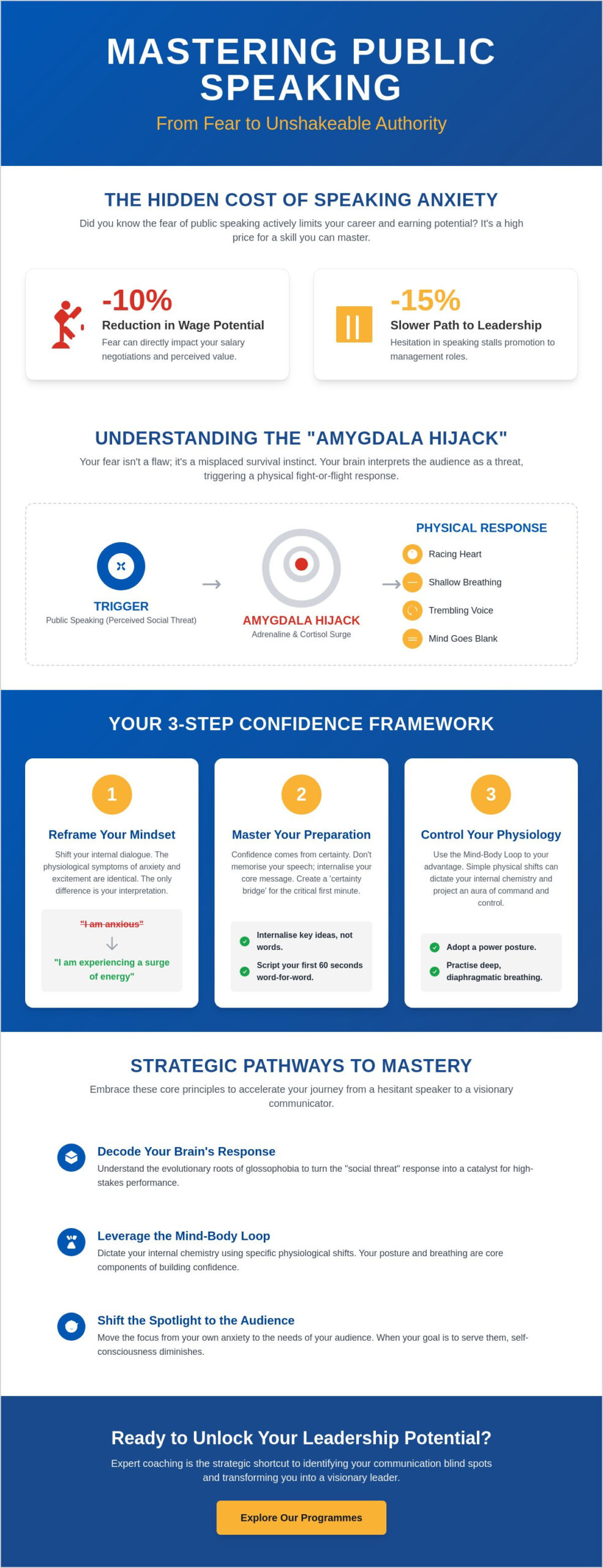
Did you know that the fear of public speaking can slash your wage potential by 10% and stall your journey to leadership by a staggering 15%? It’s a high price to pay for a skill that’s entirely within your grasp. You’re likely familiar with the cold sweat, the trembling hands, and that sudden, terrifying blankness when all eyes in the room turn toward you. It feels like a physical betrayal. Yet, it’s simply a state of mind that you haven’t mastered yet. This guide is your definitive roadmap for confidence building for public speaking, designed to help you reclaim your authority and turn that nervous energy into a powerful professional influence.
Recognising that these communication habits often take root early, many families find that Public Speaking Courses for Children (ages 6-10) provide a vital foundation, helping young people develop the self-assurance that many adults later spend years trying to reclaim.
We agree that the dread of looking foolish in front of your peers is a massive barrier to the career growth you deserve. You want to feel calm, in control, and ready to handle even the sharpest Q&A sessions with grace. By reading further, you’ll discover the psychological shifts and practical techniques needed to command any room with natural authority. We will explore how neuro-linguistic mastery and physiological grounding can transform you from a hesitant speaker into a visionary communicator who leads with conviction.
Key Takeaways
- Decode the evolutionary roots of glossophobia to transform your brain’s “social threat” response into a catalyst for high-stakes performance.
- Master the preparation blueprint by internalising your message and scripting a commanding opening that ensures certainty in those first 60 seconds.
- Leverage the Mind-Body Loop to dictate your internal chemistry, using specific physiological shifts as a core part of your confidence building for public speaking.
- Shift the spotlight from your own anxiety to the audience’s needs; master the psychology of first impressions to command the room with natural authority.
- Explore how professional pathways like NLP and expert coaching act as a strategic shortcut to identifying communication blind spots and unlocking your full leadership potential.
Understanding the Psychology of Public Speaking Anxiety
To master the art of confidence building for public speaking, you must first understand that your fear isn’t a flaw. It’s an ancient, albeit misplaced, survival instinct. This intense dread, known formally as glossophobia, is deeply rooted in our evolutionary history. In the Psychology of Public Speaking Anxiety, we see how the brain interprets a modern boardroom as a prehistoric savannah. To our ancestors, being the centre of attention amongst a group usually meant one of two things: you were being judged by the tribe for exile or targeted by a predator. Your brain isn’t trying to sabotage your presentation; it’s trying to keep you alive.
This perception of an audience as a “social threat” is why your heart races before you’ve even uttered a word. When you stand in front of your peers, your subconscious mind calculates the risk to your status and social standing. It views a potential stumble as a threat to your professional survival. However, there is a vital distinction to make between nervous energy and performance excitement. Physiologically, they are identical. Both involve a surge of adrenaline, increased heart rate, and heightened focus. The difference lies entirely in the meaning you assign to these sensations. Successful speakers don’t eliminate their nerves; they transmute them into a commanding presence.
In the world of Neuro-Linguistic Programming, we often say that “the map is not the territory.” Your internal “map” of public speaking, filled with memories of past blunders or imagined failures, is not the “territory” of the actual event. By changing your internal representation, you change your experience of reality. This is a foundational step in confidence building for public speaking. When you stop reacting to a distorted map and start engaging with the actual room, your influence expands.
The Amygdala Hijack: Why Your Body Reacts
When the brain perceives a threat, the amygdala triggers a cascade of adrenaline and cortisol. This surge tightens your vocal cords, shallows your breathing, and redirects blood flow away from your prefrontal cortex, which is the centre for rational thought and complex language. You might find your mind going blank or your voice trembling as your body prepares for a physical struggle that isn’t coming. An Amygdala Hijack is a temporary loss of rational control due to a perceived threat.
Reframing Fear: The Power of Linguistic Labelling
You can disrupt this cycle by simply changing your vocabulary. Labelling your state as “excited” rather than “anxious” shifts your physiology from a threat-state to a challenge-state. This internal dialogue is a powerful tool for dissolving fear. Try externalising the sensation; instead of saying “I am nervous,” say “I am experiencing a surge of energy.” This creates the objective distance needed to regain mastery over your performance and reclaim your professional authority. If glossophobia has been a persistent barrier in your career, our dedicated guide on how to overcome fear of public speaking provides elite psychological strategies to dissolve it permanently.
The Preparation Blueprint: Cognitive Rehearsal and Mastery
Generic advice often tells you to “just practice more,” but true mastery requires a more sophisticated approach. Your brain is a high-performance engine; it needs the right fuel and the right map to navigate high-stakes environments. The first step in confidence building for public speaking is to stop memorising and start internalising. Memorisation is fragile. If you lose one word, the entire deck of cards collapses. Internalisation, however, is about owning the core intent and structure of your message. When you internalise, you aren’t reciting a script; you’re sharing a conviction. This allows you to remain fluid and responsive, even if the unexpected occurs.
You must treat the first 60 seconds of your presentation as sacred ground. This is when your adrenaline is highest and your audience’s judgment is sharpest. Script this opening word-for-word. By knowing exactly how you will start, you create a “certainty bridge” that carries you through the initial surge of nervous energy. Once you’ve successfully navigated that first minute, your physiology settles, and your natural authority takes over. To truly command the room from the moment you step up, you might consider exploring bespoke Public Speaking programmes that refine these elite-level delivery skills.
One of the most powerful “secret weapons” in your toolkit is the NLP technique of anchoring. This involves consciously associating a specific physical gesture, like pressing your thumb and forefinger together, with a peak state of confidence. By repeatedly firing this anchor whilst you feel powerful, you train your nervous system to trigger that same state on demand. It’s a pragmatic way to bypass the “flight” response and step into a state of total readiness before you even speak.
Visualisation: The Mental Run-Through
Future Pacing is the process of mentally rehearsing your success until your nervous system accepts it as a reality. Don’t just “think” about your speech. Use all five senses. Hear the murmur of the crowd, feel the weight of the microphone, and see the engaged faces of your peers. Crucially, visualise yourself handling a mistake with grace and a touch of humour. This removes the “fear of the unknown” and proves to your brain that you are capable of handling any scenario with poise.
The 80/20 Rule of Public Speaking Preparation
Efficiency is the hallmark of a master. Spend 80% of your energy on your core message and only 20% on the delivery details. Over-preparing every gesture or inflection often leads to a stilted, robotic performance that alienates your audience. Instead, create high-level bullet points that act as milestones. This structure encourages a natural flow, allowing your personality to shine through whilst ensuring you never lose your way. Your slides should mirror this simplicity; design them to support your authority, not to act as a crutch that distracts from your presence.
Physical Confidence: Mastering Your State and Physiology
Your body is a powerful feedback loop. Whilst many focus solely on their words, the most effective confidence building for public speaking begins with your physical state. In psychology, we call this the “Mind-Body Loop.” It’s the scientific reality that your posture dictates your internal chemistry. By consciously adopting an expansive, upright stance, you signal to your brain that you are safe and in command. This isn’t just about appearance; it’s about bio-hacking your own performance to ensure you operate at your peak.
Research into “Power Posing” suggests that holding high-power stances whilst off-stage can significantly alter your hormonal profile. It increases testosterone, the hormone of dominance and confidence, whilst simultaneously lowering cortisol, the stress hormone. Do this in private before you enter the room. Once you step onto the stage, use your movement with purpose. Don’t pace aimlessly. Instead, use the physical space to release excess nervous energy and punctuate your key points. This makes you look dynamic rather than restless, projecting an image of a leader who is comfortable in their own skin.
Connection is the antidote to fear. Use eye contact to build “micro-connections” with individuals amongst the audience. Don’t scan the room like a lighthouse. Pick one person, finish a sentence, and then move to another. This humanises the crowd and turns a daunting “audience” into a series of one-on-one conversations. It’s a master-level skill that instantly builds rapport and reinforces your professional influence. When you see a nod of agreement from a single person, your brain receives a hit of validation that further fuels your confidence.
Grounding and Centring Exercises
To remain unshakable, you must master your autonomic nervous system. Use the “Four-Square” breathing technique: inhale for four counts, hold for four, exhale for four, and hold for four. This resets your heart rate and clears cognitive fog. Find your physical centre of gravity by standing with your feet hip-width apart, ensuring you aren’t swaying or fidgeting. Diaphragmatic breathing ensures your voice remains resonant and authoritative by preventing the “thin” or “reedy” tone caused by shallow chest breathing.
Vocal Tonality and the Power of the Pause
Silence is your secret weapon for authority. A well-placed pause creates tension, invites reflection, and signals that you are comfortable with the space you occupy. Vary your pitch and pace to maintain interest; a monotone delivery is a fast track to audience disengagement. Be particularly mindful of “uptalk,” the habit of letting your pitch rise at the end of a sentence. This signals uncertainty and invites the audience to question your expertise. Instead, speak with a downward inflection to project absolute certainty in your message.
Audience Connection: Shifting the Spotlight for Impact
The most profound shift in your confidence building for public speaking journey happens when you stop being the protagonist and start being the guide. Self-consciousness is, by definition, an internal focus. When you’re worried about your hand gestures or the tremor in your voice, you’ve effectively abandoned your audience. By shifting the spotlight from “How do I look?” to “How can I help them?”, you instantly dissolve the ego-driven anxiety that fuels stage fright. Your purpose is to deliver value, and when you’re truly obsessed with the audience’s success, there’s no room left for your own fear.
Psychology tells us that first impressions are cemented within seconds of you entering the room. Winning the room isn’t about being perfect; it’s about being present. Use storytelling to bypass the audience’s critical filters. Whilst facts and figures engage the logical brain, stories activate the emotional centres, creating a shared experience that builds trust. You can further deepen this bond through matching and mirroring. This subtle NLP technique involves observing the collective energy or posture of the room and reflecting it back, creating a subconscious sense of rapport that makes your message feel more resonant and familiar.
The Conversational Pivot: From Lecture to Dialogue
Authority doesn’t require a pedestal. In fact, the most influential speakers use “we” and “us” language to invite the audience onto a shared journey. This inclusive vocabulary transforms a static lecture into a dynamic dialogue. Keep the audience’s brains active by weaving in both rhetorical and direct questions. This forces them to mentally participate rather than passively observe. For those ready to master this level of room command, our Public Speaking for Leaders guide provides the advanced strategies needed to influence at the highest levels of management.
Managing High-Stakes Q&A with Certainty
The Q&A session is often where even seasoned speakers feel their confidence waver. To maintain your state, employ the “Listen, Validate, Answer” framework. Listen fully without interrupting, validate the questioner’s perspective, and then provide a concise, authoritative answer. If you don’t know the answer, don’t panic. Maintain your composure, acknowledge the value of the question, and offer to follow up with the specific data. This level of transparency actually increases your credibility. If you’re facing boardroom-level scrutiny, you can find specific strategies for these high-pressure environments in Public Speaking for CEOs. To truly accelerate this mastery, you might consider engaging with our One-to-One Coaching to receive personalised feedback on your delivery style.
Professional Pathways: Accelerating Growth with NLP and Coaching
Whilst self-study provides a useful foundation, professional training is the catalyst for permanent shifts in your performance. It’s the difference between reading about swimming and jumping into the pool with an Olympic coach. For confidence building for public speaking, speed is your greatest ally. You don’t want to spend years “trying” to feel better; you want to step onto the stage next week and own it with natural authority. Professional pathways provide the structure, accountability, and psychological depth needed to bypass months of frustrating trial and error. For a deeper dive into the specific psychological mechanisms behind this transformation, our master-level guide on how to overcome fear of public speaking and dissolve glossophobia is an essential companion resource.
An expert mentor acts as your external mirror. They identify the “blind spots” in your communication style that you are simply too close to see. Perhaps it’s a repetitive hand gesture that signals anxiety or a subtle vocal pattern that undermines your professional influence. By identifying these quirks early, you can refine your delivery into something truly elite. This isn’t about changing who you are. It’s about unlocking the most capable version of yourself and ensuring your message is heard without distraction.
The Role of NLP in Rapid Confidence Building
Neuro-Linguistic Programming (NLP) is the master key to mindset mastery. It allows you to “reprogramme” old memories of public speaking failure that might be holding you back. Our NLP Practitioner Certification offers a comprehensive toolkit for this very purpose. You’ll learn techniques like the “Circle of Excellence,” which creates an indestructible speaking state you can step into at will. This involves stacking powerful emotional states and anchoring them to a physical trigger. By understanding linguistic patterns, you don’t just speak; you persuade and influence with surgical precision. You’ll begin to see how specific words can either open or close the minds of your audience.
One-to-One Mentoring for Elite Performance
There is a distinct difference between generic group training and bespoke Executive Coaching and Mentoring. In a one-to-one environment, the focus is entirely on your unique personality and professional goals. Whether you’re preparing for a keynote or a board-level presentation, a specialist ensures your style is tailored for maximum impact. It’s no coincidence that the highest-level leaders all work with communication specialists. They understand that their ability to influence is their most valuable asset. Whilst self-study is a useful starting point, it lacks the high-stakes pressure and immediate feedback of immersive workshops. These environments force you to practise in real-time, ensuring your confidence building for public speaking is both rapid and enduring. You’ll leave with a level of mastery that simply isn’t possible through a screen alone.
Step Into Your Most Powerful Professional Identity
You’ve now explored the psychological and physiological frameworks required to transform your stage presence. From hacking the Amygdala Hijack to mastering the Mind-Body Loop, you understand that your state is not a matter of luck; it is a matter of design. By shifting your focus from yourself to the value you provide the audience, you unlock a level of natural authority that commands respect. This journey of confidence building for public speaking is the ultimate investment in your professional influence and wage potential. It is the secret weapon of the modern leader.
Don’t leave your growth to chance. Toby and Kate McCartney, world-renowned communication experts, have spent over 20 years refining the elite techniques that turn hesitant speakers into visionary leaders. Through our accredited NLP training, we provide the measurable professional growth you need to accelerate your career and lead with conviction. You have the inherent potential to influence every room you enter.
Master your mindset and command the room; enrol in our next Public Speaking Programme today.
The stage is waiting for you. It’s time to step up and speak with the bold authority that your expertise deserves.
Frequently Asked Questions
How can I stop my voice from shaking when I start speaking?
You stop your voice from shaking by engaging your core and projecting from your diaphragm rather than your throat. When you breathe shallowly into your chest, your vocal cords lack the steady air pressure needed for a stable tone. Focus on grounding your feet and consciously relaxing your jaw. This physical release prevents the tension that causes vocal tremors, allowing you to speak with a resonant, steady authority from the very first word.
Is it better to memorise my speech or use notes?
It’s better to internalise your key concepts and use high-level bullet points rather than memorising a full script. Memorisation creates a rigid mental structure that is easily disrupted by a single missed word. By using a “trigger map” or simple prompts, you remain flexible and conversational. This approach ensures you stay present with your audience whilst maintaining a clear, logical structure for your message without the risk of a total collapse.
What is the best way to handle a “mind blank” during a presentation?
The best way to handle a mind blank is to embrace a deliberate pause whilst taking a deep, grounding breath. Most audiences perceive a five-second silence as a powerful moment of reflection rather than a mistake. If the point doesn’t return, simply summarise your last key insight or ask a rhetorical question to the room. This gives your brain the necessary seconds to reset your cognitive processing without breaking your professional composure.
Can introverts really become excellent public speakers?
Introverts can become world-class speakers because they often excel at deep preparation and empathetic audience connection. Public speaking is a skill set, not a personality trait. Many of the most influential presenters are introverted; they simply use their natural ability for observation and listening to craft more resonant, thoughtful messages. Your quiet strength can be a significant advantage in building genuine rapport and trust with an audience who values substance over performance. To discover how to leverage these innate strengths with precision, our dedicated guide on public speaking for introverts provides an elite 2026 mastery checklist tailored specifically to your communication style.
How do I build confidence if I have had a bad experience in the past?
You build confidence after a setback by consciously reframing the event as a data point rather than a personal failure. Use NLP techniques to “unlink” the negative emotion from the memory of that experience. By focusing on confidence building for public speaking through small, controlled successes, you prove to your nervous system that you are now capable of a different outcome. Every new presentation is a fresh opportunity to rewrite your professional narrative and claim your authority.
What are the most effective NLP techniques for public speaking?
Effective NLP techniques include Anchoring to trigger a peak state and Future Pacing to mentally rehearse success. Another powerful tool is the “Swish Pattern,” which helps you replace a mental image of failure with one of commanding presence. These methods work by directly influencing your subconscious mind, allowing you to bypass old fears and install new, empowering behaviours that support your professional growth and influence in any high-stakes environment.
How long does it take to see a real improvement in my confidence?
You can experience an immediate shift in your state during your first professional training session, though permanent mastery typically takes a few weeks of consistent application. Confidence building for public speaking is a cumulative process. Whilst the psychological “hacks” provide an instant boost, the deep-seated authority comes from repeatedly applying these tools in real-world scenarios. Most practitioners report a significant surge in their professional influence within 30 days of immersive study.
Should I use humour if I am not naturally a funny person?
You should only use humour if it feels authentic to your personality and remains relevant to your core message. Forced jokes often fall flat and can undermine your professional authority. If you aren’t naturally funny, focus on using light-hearted anecdotes or observational storytelling instead. These create a warm, engaging atmosphere without the pressure of a “punchline,” ensuring you maintain a genuine connection with your audience whilst keeping them interested in your insights.