
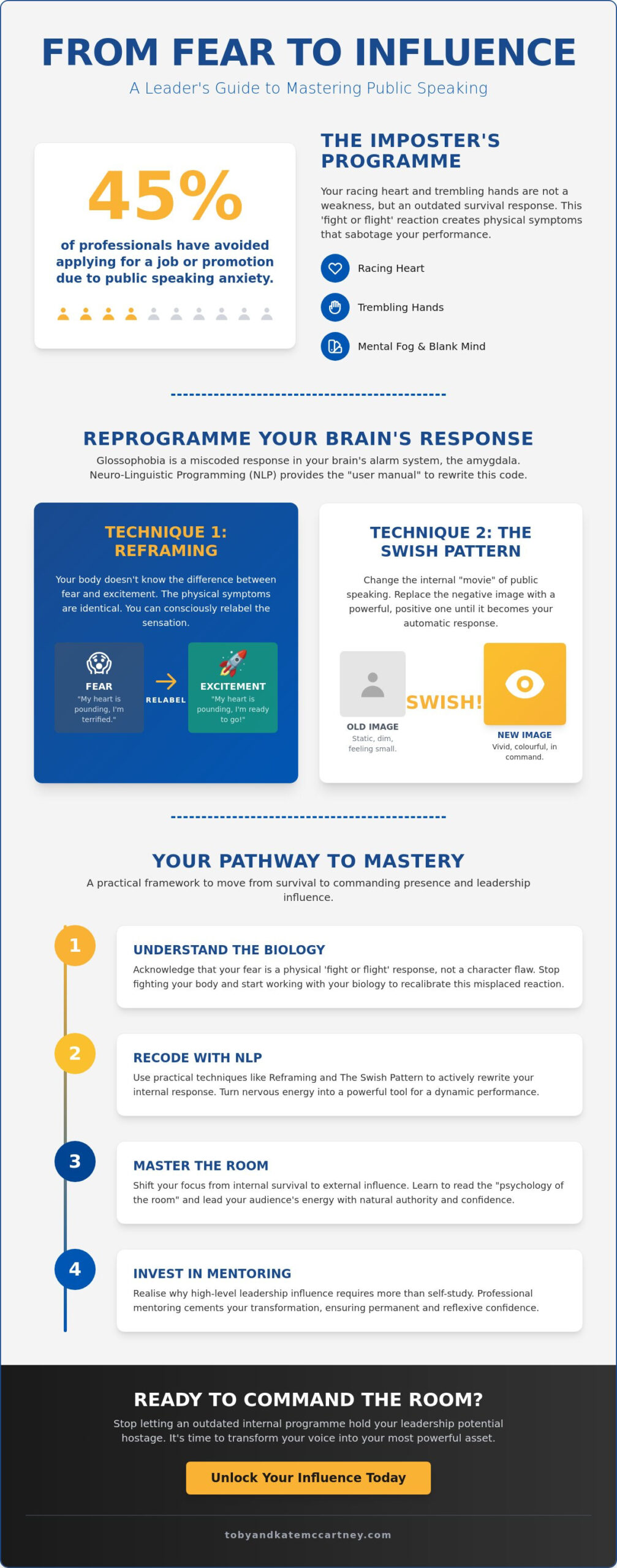
Your racing heart and trembling hands aren’t signs of weakness; they’re merely the result of an outdated internal programme that’s holding your leadership potential hostage. It’s a frustrating reality when you feel like an imposter despite your professional expertise, watching career-defining opportunities slip away because the thought of a boardroom presentation feels like a threat. You’ve likely spent years trying to manage your nerves, yet the physical shaking and mental fog remain. You aren’t alone; research shows that 45% of people have avoided applying for a job or promotion specifically because of this challenge.
It’s time to stop surviving your speeches and start commanding them. This master-level guide will show you exactly how to overcome fear of public speaking by using elite psychological shifts to dissolve glossophobia forever. You’ll learn how to transform that nervous energy into a powerful tool for influence and leadership. We’ll explore the specific pathways to rewrite your internal response, moving you from a state of dread to one where you feel calm, excited, and ready to unlock the higher-tier roles you deserve.
Key Takeaways
- Understand that glossophobia is a miscoded response in your amygdala and learn how Neuro-Linguistic Programming acts as a “user manual” to recode your confidence.
- Discover a practical, step-by-step framework to overcome fear of public speaking through physiological resets and vivid mental rehearsal techniques.
- Shift your focus from survival to mastery by learning how to read the “psychology of the room” and lead your audience’s energy with natural authority.
- Realise why high-level leadership influence requires more than self-study and how professional mentoring cements your permanent transformation.
The Psychology of Glossophobia: Why Your Brain Triggers Fear
Understanding The Psychology of Glossophobia is the first step in reclaiming your authority. At its core, this fear is a physiological ‘fight or flight’ response triggered by being the centre of attention. Your brain doesn’t see a room full of colleagues; it sees a pack of predators watching your every move. This isn’t a character flaw. It’s a survival mechanism gone into overdrive. Whilst most people feel a flutter of ‘normal nerves’ before a presentation, disabling anxiety is a different beast entirely. It’s the kind of fear that makes you want to vanish. If you want to overcome fear of public speaking, you must first accept that this behaviour is simply a learned response; it’s a piece of mental software that can be rewritten.
The amygdala, your brain’s alarm system, is notoriously bad at distinguishing between a physical threat and a social one. In its quest to keep you safe, it misinterprets a boardroom as a life-threatening environment. This misinterpretation happens because, for our ancestors, being stared at by a group often preceded an attack. Your amygdala is still using that ancient map. It doesn’t understand that these people are actually your peers, waiting for your insight. This is why you feel that familiar surge of dread. You aren’t ‘broken’. You’re just experiencing a highly efficient, yet misplaced, biological reaction that needs recalibrating.
The Biological Blueprint of Speaking Anxiety
When the alarm sounds, an adrenaline flood hits your system. Your heart races to pump blood to your limbs, and your throat tightens as your body prepares to shout for help or run. This leads to ‘cortical inhibition’, where your brain literally shuts down non-essential functions like complex speech to prioritise raw survival. It’s exactly why your mind goes blank just when you need to be at your most articulate. Your internal survival programme is prioritising safety over an eloquent delivery. Recognising this process allows you to stop fighting yourself and start working with your biology.
Breaking the Cycle of Avoidance
Every time you decline a presentation or stay quiet in a meeting, you reinforce the brain’s belief that public speaking is dangerous. This cycle of avoidance keeps you trapped in a loop of fear. To truly overcome fear of public speaking, you need to begin with incremental wins that re-centre your comfort zone. Even the world’s most influential figures in public speaking for leaders started exactly where you are. They didn’t have a ‘courage gene’; they simply learned how to manage the adrenaline and master the psychology of the room to project an image of total confidence.
Reprogramming the Mind: How NLP Dissolves Public Speaking Anxiety
You aren’t stuck with your current mindset. Think of Neuro-Linguistic Programming (NLP) as the long-awaited user manual for your brain. Whilst clinical Social Anxiety Disorder can feel like an immovable wall for some, public speaking anxiety is usually just a miscoded internal process. It’s a series of thoughts and images that lead to a predictable, albeit uncomfortable, result. If you want to overcome fear of public speaking, you must move beyond “coping” and start reprogramming the actual mechanics of your thoughts.
One of the most potent tools in the NLP arsenal is reframing. This technique allows you to change the meaning you attach to your physical sensations. Your body doesn’t actually know the difference between fear and excitement; the racing heart and heightened focus are identical in both states. By consciously relabelling that surge of adrenaline as “peak readiness” or “high-octane enthusiasm”, you stop being a victim of your nerves. You start using that energy to fuel a more dynamic performance. This level of psychological mastery is the core of our NLP practitioner certification UK, where we turn these theoretical concepts into reflexive, high-level skills.
Submodalities: Changing the Internal Movie
How do you “see” public speaking in your mind? For most, it’s a giant, looming image of a critical audience. NLP teaches us to manipulate these “submodalities”—the building blocks of our internal representations. The Swish pattern is a masterstroke of mental agility here. You take that old, grey, static image of you feeling small and “swish” it away, replacing it instantly with a vivid, high-definition movie of yourself commanding the room in full colour. By shrinking the “fear” image and making it dim whilst enlarging the “success” image, you rapidly reduce the emotional intensity of the thought. You’re effectively telling your brain which programme to run.
Anchoring Your Peak Performance State
Imagine having a “confidence button” you could press whenever you needed it. That is the power of a resource anchor. To create one, you recall a specific moment from your past when you felt completely unstoppable and full of certainty. As that feeling reaches its peak, you apply a unique physical trigger, such as pressing your thumb and forefinger together. You’re creating a neurological link between the physical touch and the emotional state. When you “fire” this anchor just before stepping into a meeting, your brain automatically floods your system with those same feelings of competence. It’s a practical, results-oriented way to maintain your centre whilst you’re the focus of everyone’s attention. If you’re ready to master these shifts, exploring one-to-one coaching can provide the personalised breakthrough you need to cement this new identity.
A Step-by-Step Guide to Overcoming Fear of Public Speaking
Mastery is a sequence, not a miracle. Whilst many believe that confidence is something you’re born with, the truth is far more empowering: it’s a skill you can build through a specific, repeatable protocol. To overcome fear of public speaking, you need a strategy that addresses both your biology and your psychology in real-time. This isn’t about ‘faking it until you make it’; it’s about systematically dismantling the fear response and replacing it with a state of peak performance.
Following A Step-by-Step Guide to Overcoming Fear ensures you aren’t leaving your success to chance. Start with a physiological reset. Use diaphragmatic breathing to signal safety to your nervous system. Next, engage in vivid mental rehearsal. See the room, feel the lectern, and hear the clarity in your own voice. Shift your language from ‘I have to do this’ to ‘I am privileged to share this’. This simple linguistic reframe moves you from a victim state to a leadership state. Finally, adopt a power pose and shift your focus entirely onto the audience. When your primary goal is to provide value to them, your self-consciousness naturally evaporates.
Preparation Beyond the Script
Memorising a script word-for-word is a recipe for disaster. It creates a brittle mental structure that shatters the moment you lose your place, leading to the dreaded ‘blanking’. Instead, utilise ‘The Pillar Method’. Identify three to five core concepts that form the foundation of your message. By knowing these pillars intimately, you allow for a flexible, natural delivery that feels authentic rather than rehearsed. You aren’t reciting; you’re leading a conversation. This approach also helps you prepare for the unpredictable, as you’re no longer tethered to a specific set of sentences.
The 60-Second Pre-Speech Ritual
The final minute before you speak is critical. To stay grounded, switch your focus to your peripheral vision. By softening your gaze and taking in the entire environment at once, you instantly calm the sympathetic nervous system and exit ‘tunnel vision’ fear. Combine this with a specific sequence of movements, such as straightening your spine and rolling your shoulders, and a ‘power sentence’. This is a short, punchy declaration of your identity as a capable communicator. It’s your final psychological anchor, ensuring you step onto that stage as an authority, not an observer. This ritual ensures you overcome fear of public speaking before you even utter your first word.
Beyond Survival: Mastering Presence and Influence as a Leader
Mastering the room is about more than just silencing your inner critic. Once you have used the tools mentioned earlier to overcome fear of public speaking, you move into the realm of elite influence. This is where you stop being a mere presenter and start being a true leader. It requires a deep understanding of the ‘psychology of the room’, where you actively read and lead the collective energy of your audience. You aren’t just delivering data; you’re shifting perspectives. By using precise tonality and deliberate tempo shifts, you command authority whilst maintaining a genuine connection. This level of mastery is especially vital in high-stakes environments, a core focus of our work in public speaking for CEOs.
True presence isn’t about being the loudest person in the room. It’s about the weight of your words and the certainty of your delivery. When you’ve moved beyond the ‘fight or flight’ response, you gain the mental bandwidth to notice the subtle cues from your audience. You see the nods of agreement, the furrowed brows of confusion, and the moments of deep engagement. This allows you to pivot your delivery in real-time, ensuring your message lands with maximum impact. You’re no longer reciting a script; you’re conducting a symphony of influence that moves people to action.
The Introvert’s Advantage in Public Speaking
Introverts often believe their quiet nature is a hindrance, yet it’s actually a secret weapon. Because introverts are naturally attuned to observation and listening, they can build a level of rapport that extroverts often miss. They use their innate skills to read the room’s temperature and adjust their delivery with surgical precision. By managing your energy and focusing on authentic connection rather than a ‘theatrical performance’, you can achieve a level of impact that feels both powerful and effortless. You don’t need to be an extrovert to overcome fear of public speaking and dominate the stage; you simply need to leverage your natural ability to observe and connect. If you want to go deeper on this, our comprehensive guide to public speaking for introverts reveals the exact NLP techniques to turn your quiet nature into your most powerful communication asset.
Vocal Authority and Body Language Mastery
Vocal authority is a learned skill that separates the amateurs from the masters. ‘Command Tonality’ involves a slight downward inflection at the end of your points, which subconsciously signals certainty and expertise to your listeners. Combine this with ‘The Stage Anchor’, where you physically move to different spots on the floor to anchor different emotional states in the minds of your audience. This creates a dynamic, multi-dimensional experience for everyone in the room. By purging low-status gestures, such as touching your neck or shuffling your feet, you project an image of total composure and high-level leadership. If you’re ready to move from survival to total mastery, our leadership training is the catalyst you need to unlock your full potential as a communicator.
Investing in Your Voice: Training for Lasting Confidence
Self-study is a powerful starting point, but it rarely leads to the deep, permanent transformation required for high-stakes leadership. Reading a book about swimming isn’t the same as diving into the water. To truly overcome fear of public speaking, you need more than just information; you need a guided neurological reset. This is why Toby and Kate McCartney have developed a unique methodology that goes beyond surface-level tips. We focus on the underlying mental programmes that dictate your response to being the centre of attention. It’s about changing who you are, not just what you do.
There’s a massive difference between attending a weekend ‘workshop’ and committing to a comprehensive ‘certification’. A workshop might give you a temporary boost, but a certification in communication mastery provides the tools for a lifelong shift in your identity. It’s the difference between a quick fix and a total system upgrade. By choosing to overcome fear of public speaking through professional development, you’re investing in a version of yourself that commands respect in any boardroom. You’re gaining access to a high-level secret weapon that most professionals never discover.
The McCartney Pathway to Mastery
Our public speaking programmes aren’t just about ‘how to stand’ or ‘where to look’. They integrate the cutting-edge principles of NLP to ensure that the changes you make happen at a subconscious level. This means your confidence becomes automatic. You’ll be learning amongst like-minded achievers in a high-energy environment that mirrors the professional world you’re aiming to lead. Leadership is, at its heart, a communication challenge. When you master your voice, you master your ability to lead. We provide the pragmatic strategies you need to unlock that potential rapidly.
Your Next Step: From Fear to Influence
It’s time to stop ‘managing’ your fear. Managing suggests you’re still carrying the weight of it, just holding it at bay. Instead, start mastering your potential. Your voice is your most valuable asset in the corporate world and beyond. We invite you to explore our various certification levels, from NLP Practitioner to Master Practitioner, for a total career and personal reset. This is your invitation to step into the light and claim your authority. Stop avoiding the stage and start owning it. Your voice is your power; it’s time to use it.
Claim Your Authority and Command the Room
You now have the blueprint to transform your relationship with the stage. Your anxiety is not a fixed part of your identity; it is simply a biological response that you can now recode with precision. By integrating the NLP strategies we’ve discussed, you can finally overcome fear of public speaking and begin your journey toward elite leadership influence. Mastery is no longer a distant dream. It’s a practical, attainable reality. You’ve learned to silence the amygdala, use anchoring for instant confidence, and shift your focus toward the value you provide your audience.
Since 2003, we’ve provided the specialised psychological shifts and world-class mentorship needed to turn professionals into visionary communicators. You don’t have to navigate this pathway alone. Our leadership experts and stage performers are ready to guide you through every breakthrough, ensuring your transformation is both rapid and permanent. Unlock your voice and lead with certainty—discover our Public Speaking Programmes today. The world is waiting to hear what you have to say. It’s time to step forward with conviction and claim the influence you deserve.
Frequently Asked Questions
Is public speaking anxiety a mental health condition?
Public speaking anxiety, or glossophobia, is primarily a physiological “fight or flight” response rather than a clinical mental health condition for the majority of people. Whilst it can be a subset of social anxiety disorder, most professionals experience it as a learned response to being the centre of attention. We treat it as a miscoded internal programme that can be rapidly rewritten through advanced communication psychology and NLP techniques.
Can I really overcome my fear of public speaking if I’m a lifelong introvert?
You can absolutely overcome fear of public speaking as an introvert; in fact, your natural inclination for observation is a massive advantage. Introverts often make more impactful speakers because they prioritise rapport and depth over theatrical performance. By leveraging your listening skills, you can read the room with a level of precision that extroverts often overlook, making your delivery feel more authentic and grounded. Explore our dedicated public speaking for introverts mastery checklist to discover the precise strategies designed for your unique communication style.
How long does it take to see results with NLP for public speaking?
Results with NLP are often immediate because the techniques work directly with your subconscious mind. Many participants in our public speaking programmes report a significant shift in their confidence after just one session or a few days of intensive training. Because we are recoding the neural “trigger” rather than just managing the symptoms, the change is both rapid and sustainable for your long-term career growth.
What should I do if I have a panic attack during a presentation?
If you feel a panic attack beginning, immediately pause and switch your focus to your peripheral vision. By softening your gaze and taking in the entire room, you signal safety to your nervous system and exit the “tunnel vision” of fear. Take a deep, diaphragmatic breath and shift your attention back to the value you’re providing the audience. This grounds you in the present moment and restores your composure.
How do I stop my voice from shaking when I’m nervous?
A shaking voice is usually caused by shallow breathing and tension in the throat muscles. To stabilise your tone, focus on deep, abdominal breathing before you begin and use a “command tonality” with a slight downward inflection at the end of your sentences. This grounds your voice and subconsciously signals certainty to both your audience and your own nervous system, helping you overcome fear of public speaking in real-time.
What is the best way to handle difficult questions from the audience?
The best way to handle challenging questions is to pause, acknowledge the query with total composure, and then bridge back to your core “pillars”. Don’t feel rushed to answer immediately; a thoughtful pause projects authority rather than hesitation. If you don’t have the specific data to hand, offer to follow up after the session. This maintains your status as a professional leader whilst ensuring accuracy.
Can public speaking training help with general social anxiety?
Public speaking training acts as a powerful catalyst for reducing general social anxiety because the psychological tools are entirely transferable. Techniques like anchoring and reframing help you manage your internal state in any social or professional setting. As you learn to command a stage, you naturally find that your confidence in high-stakes meetings and networking events increases exponentially, leading to a total personal reset.
How do I find my own ‘natural’ speaking style rather than sounding like a robot?
You find your natural style by abandoning word-for-word scripts and embracing a structured yet flexible delivery method. When you focus on core concepts rather than memorised sentences, your personality is free to emerge. Authenticity comes from being present with your audience and allowing your natural conversational rhythm to guide your delivery. This ensures you sound like a leader who is sharing a message, not a robot reciting data.