
What if the invisible wall blocking your team’s success isn’t a lack of talent, but the very language you use to lead them? You’ve likely felt the frustration of watching gifted individuals operate in silos, or seen brilliant strategies wither amongst a staff that’s resistant to change. It’s exhausting to push for results when the collective momentum feels stuck in second gear. You know your people are capable of more, yet the bridge between potential and performance remains frustratingly out of reach. Building a high performance team culture in 2026 requires more than just traditional management; it demands a mastery of the psychological drivers that underpin every interaction.
You’re about to discover that engineering an elite environment isn’t about better spreadsheets or more frequent meetings. It’s about mastering the linguistic patterns and psychological shifts that transform group behaviour into a unified force. This article provides a leader’s NLP blueprint to help you dissolve resistance and spark immediate confidence within your organisation. We’ll explore how to use specific communication tools as a catalyst for growth, ensuring you have the master-level skill set to turn stagnant performance into a journey of attainable excellence.
Key Takeaways
- Learn why 2026 demands a shift from traditional management to the psychological engineering of team dynamics to achieve a state of collective flow.
- Master the linguistic patterns and internal belief systems required for building a high performance team culture that thrives on excellence.
- Understand how your internal state as a leader directly shapes your team’s reality through the power of congruence and non-verbal influence.
- Implement strategic pillars to align your team’s internal compass with a transcendent purpose that bypasses logic and fuels elite performance.
- Identify why professional NLP certification is the ultimate secret weapon for leaders who want to move from theory to practical mastery.
Defining High Performance: Beyond the Corporate Buzzwords in 2026
Forget the stale corporate definitions of the past decade. In 2026, high performance isn’t a metric on a spreadsheet or a set of reached targets; it’s a collective state of “flow” where the output of the group far exceeds the mere sum of individual talents. You’ve likely seen teams where every member is technically brilliant, yet they fail to ignite. This happens because they lack the psychological glue that binds individual effort into a singular, unstoppable force. To truly master building a high performance team culture, you must stop “managing” people and start “engineering” the psychological dynamics that drive them.
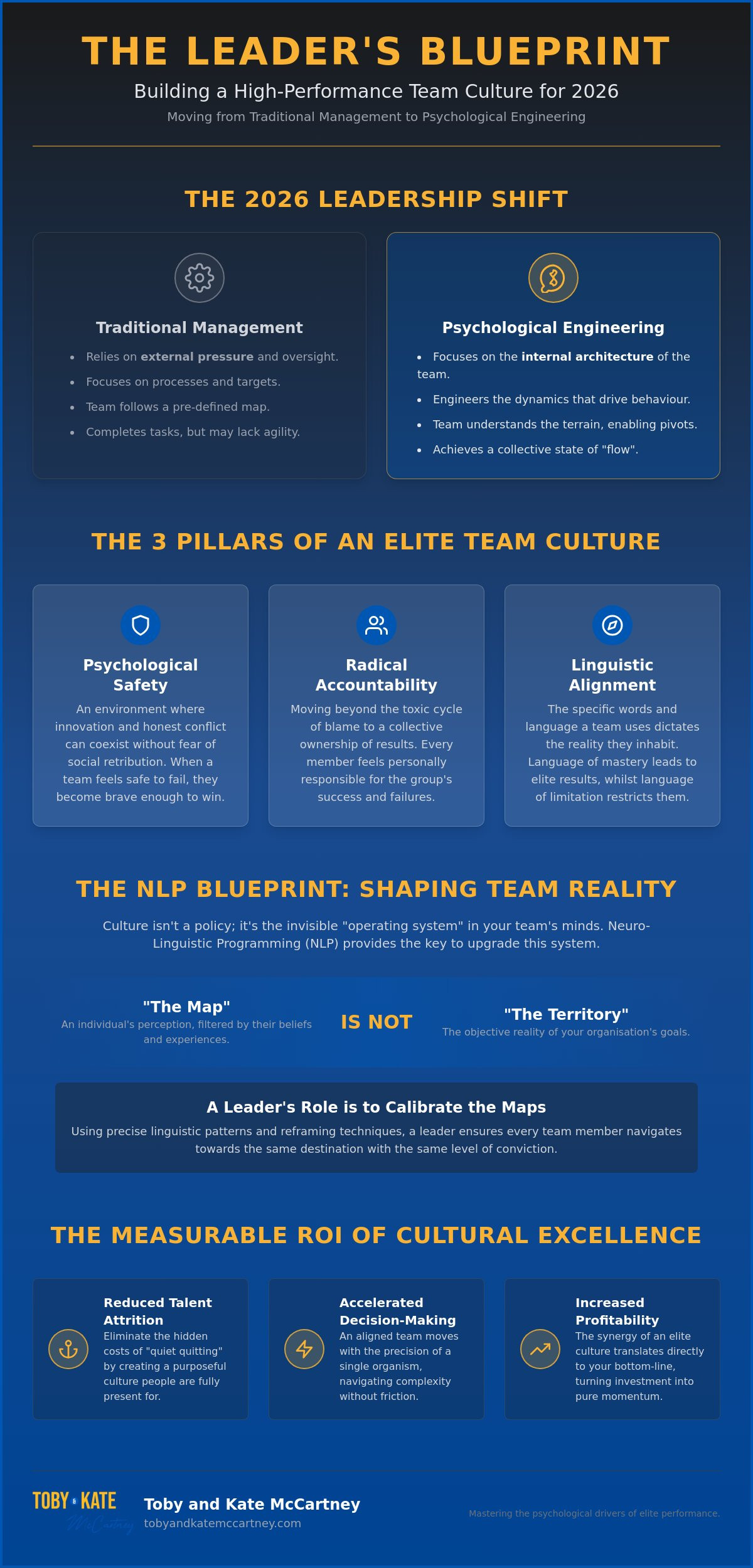
The landscape has shifted. Traditional management relies on external pressure and oversight, but psychological engineering focuses on the internal architecture of the team. A functional team might complete their tasks on time, but an elite culture thrives specifically when the pressure is highest. This distinction is vital. Whilst a functional group follows a map, an elite team understands the terrain so intimately that they can pivot instantly without losing momentum. According to the foundational concept of a High-performance team, these groups are characterised by a deep sense of purpose and a commitment to one another’s personal growth. High performance culture is a self-sustaining ecosystem of shared beliefs and precise communication.
The Core Characteristics of Elite Teams
The foundation of any elite group is unwavering psychological safety. This isn’t about being “nice”; it’s about creating an environment where radical innovation and honest conflict can coexist without the fear of social retribution. When your team feels safe to fail, they become brave enough to win. This leads directly to radical accountability. In these environments, we move beyond the toxic cycle of blame. Instead, there is a collective ownership of results where every member feels personally responsible for the group’s success. Finally, you must achieve linguistic alignment. The specific words your team uses amongst themselves dictate the reality they inhabit. If the language is one of limitation, the results will be limited. If the language is one of mastery, the results will be elite.
The ROI of Cultural Excellence
Investing in building a high performance team culture provides a measurable competitive advantage in the UK market. You’ll see a dramatic reduction in talent attrition as the hidden costs of “quiet quitting” vanish. When people feel part of a high-energy, purposeful culture, they don’t just stay; they’re fully present. Decision-making speeds also accelerate. In complex, high-stakes environments, an aligned team doesn’t need a dozen meetings to find a direction; they move with the precision of a single organism. Ultimately, there is a direct link between this synergy and your bottom-line profitability. You’re no longer paying for friction; you’re investing in pure, unadulterated momentum.
The NLP Blueprint: How Internal Beliefs Shape Team Reality
Most leaders treat culture as a collection of HR policies and mission statements. They’re missing the point. Culture isn’t what’s written on the wall; it’s the invisible “operating system” running in the minds of your staff. Neuro-Linguistic Programming (NLP) provides the master key to this system. It allows you to understand the cognitive software that drives every decision, conflict, and breakthrough in your office. When you master these psychological mechanics, building a high performance team culture becomes a predictable process rather than a game of chance.
A fundamental NLP principle is that “the map is not the territory.” Every person on your team perceives your corporate goals through their own unique filter of past experiences and personal values. If one developer sees a deadline as a challenge whilst another sees it as a threat, their outputs will never align. Your job as a leader is to calibrate these individual maps. By using precise linguistic patterns, you can ensure that every team member is navigating toward the same destination with the same level of conviction. This alignment is what separates elite organisations from those that merely survive.
You must also become an expert in the art of reframing. This isn’t about empty “positive thinking.” It’s about strategically changing the linguistic frame around a situation to alter its meaning. When a project fails, do you frame it as a “disaster” or as “essential data”? The words you choose dictate whether your team falls into a state of paralysis or enters a high-energy problem-solving mode. Dismantling the limiting beliefs that hold your department back, such as “we aren’t an innovative firm” or “the market is too volatile,” is the first step toward unlocking true potential.
Anchoring Success in the Workplace
Elite performance requires the ability to access peak states on demand. In NLP, we use “anchoring” to associate a specific internal state with an external trigger. You can create positive anchors during high-pressure meetings by consistently using specific tonal shifts or physical gestures when the team achieves a win. Over time, these triggers will automatically spark focus and creativity amongst your staff. Sensory acuity is equally vital. You must learn to read the subtle shifts in team morale, such as changes in breathing or posture, before they manifest as a drop in productivity.
Modelling Excellence
Why do your top performers succeed whilst others struggle? They have internal strategies that they likely aren’t even aware of. By using NLP modelling techniques, you can identify the specific mental sequences your best people use to solve problems or handle stress. Once you’ve mapped these patterns, you can “install” them across the entire team. This bridges the gap between average and elite behaviour. If you’re ready to master these advanced linguistic tools, exploring an NLP practitioner certification UK is the logical next step in your leadership journey. You might also consider how professional leadership training can refine your ability to communicate these new standards with absolute authority.
The Leader’s Shift: Moving from Management to Cultural Mastery
The culture you see in your department is a mirror. It reflects your internal state with startling accuracy. If you’re operating from a place of stress, indecision, or hidden frustration, your team will unconsciously adopt those same patterns. Mastery in building a high performance team culture begins with a personal breakthrough. You must move beyond the role of a supervisor and become the architect of the team’s psychological environment. A leader’s primary job in 2026 is to manage the team’s collective energy, not their tasks.
Congruence is your most potent tool for influence. It’s the total alignment between your verbal commands and your non-verbal signals. When you speak about innovation whilst your body language projects a fear of risk, your team will always believe your body. They’ll sense the mismatch and retreat into safety. Elite leadership requires you to embody the excellence you demand from others. This means your tone, posture, and micro-expressions must be as intentional as your strategic plans. Without this internal alignment, your attempts at cultural change will be viewed as mere corporate theatre.
Many leaders are trapped in a cycle of “firefighting.” They spend their days reacting to tactical crises, leaving no room for the strategic design of their department’s future. You must break this cycle. Shifting from tactical management to cultural architecture means you’re no longer just solving problems; you’re designing a system where those problems cease to exist. It’s about moving from the “what” of daily work to the “how” of human interaction. When you master the internal drivers of your staff, the tasks tend to take care of themselves.
The Leader as a Master Communicator
To lead without resistance, you must master the linguistic tools of influence. This involves using the “Milton Model” of language, which employs artfully vague patterns to bypass the critical mind and inspire deep-seated motivation. Conversely, when you need to eliminate ambiguity, you must deploy the “Meta Model.” These precision questions allow you to drill down into the specifics of a problem and drive focus where it’s needed most. If you want to sharpen these abilities, investing in advanced communication skills training is the most direct path to mastery.
Developing Emotional Resilience
Chaos is a constant in the modern workplace, yet your team looks to you for stability. Maintaining a “state of certainty” amongst organisational upheaval keeps your people grounded and productive. You must also learn how to “break state” when team morale begins to dip. If a meeting becomes bogged down in negativity, a sudden shift in the physical environment or a strategic reframe can reset the group’s emotional frequency. This level of psychological control is often refined through one-to-one mentorship, where you can develop the elite traits necessary to lead a high-performance organisation through any storm.
Five Strategic Pillars for Building a High Performance Team Culture
Engineering a culture of excellence requires more than just good intentions; it demands a structured framework that governs every interaction within your organisation. You’ve already mastered the internal shift required to lead, so now it’s time to install the structural pillars that support building a high performance team culture. These five strategic steps move beyond traditional management theory to provide a practical, NLP-driven blueprint for elite performance.
- Step 1: Establish a Transcendent Purpose. You must look past logical targets and hit the emotional “why.” When your team connects with a purpose that transcends simple profit, they access a deeper level of motivation that bypasses cognitive resistance.
- Step 2: Calibrate Team Values. Every individual has an “internal compass” that dictates their behaviour. Your task is to ensure these compasses point in the same direction, creating a unified force that moves with absolute precision.
- Step 3: Implement Feedforward Loops. Traditional feedback looks backward at mistakes. The NLP approach focuses on “Feedforward,” which directs the team’s attention toward future growth and the specific actions required to achieve it.
- Step 4: Cultivate a Language of Possibility. Words like “try” and “but” act as psychological brakes. “Try” presupposes failure, whilst “but” negates everything that came before it. Banishing these from your team’s vocabulary opens the door to a culture of “can” and “will.”
- Step 5: Reward Behaviours, Not Just Results. If you only celebrate the end goal, you miss the opportunity to reinforce the cultural DNA. By rewarding the specific behaviours that led to the win, you ensure those elite patterns are repeated.
Engineering Purpose and Values
Ditch the mission statement gathering dust on the wall. For a culture to thrive, purpose must be a lived, daily ritual. You achieve this by aligning individual career goals with the team’s overarching mission. When a staff member sees how their personal growth fuels the collective success, their commitment becomes unbreakable. You can uncover the “hidden values” of your team members by asking what truly drives them during high-pressure moments. This elicitation process allows you to weave their personal drivers into the fabric of the department, ensuring everyone is pulling in the same direction whilst feeling personally fulfilled.
Advanced Feedback and Growth
Conflict is inevitable, but it doesn’t have to be destructive. Using the “Perceptual Positions” technique, you can train your team to resolve disputes by seeing a situation from three distinct angles: their own, the other person’s, and a neutral observer’s view. This expands their map of the world and builds immediate empathy. Performance reviews should no longer be a box-ticking exercise; instead, frame them as “Personal Breakthrough” sessions that focus on unlocking the next level of mastery. If you’re a founder looking to implement these high-level shifts, our leadership training for small business owners UK provides the exact tools you need to scale your culture alongside your revenue.
Take the first step toward transforming your department by exploring our comprehensive leadership training for small business owners UK today.
Mastering the Art of Influence: Your Journey to Elite Leadership
You’ve seen the blueprint. You understand the psychological pillars. But knowledge alone won’t change your department’s DNA. To truly master building a high performance team culture, you must move from intellectual understanding to embodied mastery. Professional accreditation in NLP and leadership isn’t just a certificate; it’s your ultimate competitive advantage in a 2026 market that demands psychological depth. It’s the difference between a manager who follows a script and a leader who commands the room through sheer presence and linguistic precision.
The transition from “knowing” these techniques to “being” an empowering master of culture is where the real transformation occurs. Most leaders understand they should communicate better, yet few embody the level of influence required to shift a team’s collective belief system. Toby and Kate McCartney’s programmes are specifically engineered to facilitate this shift. They act as catalysts, taking you through a journey where high-level psychological tools become your second nature. This isn’t theoretical study; it’s a practical, results-oriented process designed for those who refuse to settle for anything less than excellence.
The Pathway to Mastery
Choosing the right level of training is essential for your professional development. Whether you begin with an NLP Practitioner Certification or advance to the Master Practitioner level, the focus remains on attainable excellence. Immersive, high-energy training is vital for creating the lasting neurological shifts that traditional seminars fail to provide. For leaders operating in high-stakes environments, executive coaching and mentoring offers a bespoke, one-to-one environment to refine your influence and strategy. This elite pathway ensures your growth remains as flexible and multi-modal as the challenges you face.
Commanding the Room
A leader who cannot command a room cannot sustain a culture. By integrating advanced public speaking skills into your leadership repertoire, you gain the ability to deliver your vision with absolute certainty. This isn’t about mere volume; it’s about the impact of a leader who can communicate with a sophisticated blend of power, empathy, and influence. When your verbal and non-verbal signals are perfectly aligned, you become a visionary innovator who people are eager to follow. It’s time to stop waiting for culture to happen and start engineering it. Step into your power and transform your team culture today.
Step into Your Future as an Elite Leader
You now possess the blueprint to move beyond traditional management and into the realm of psychological mastery. We’ve explored how your internal state as a leader acts as the primary catalyst for building a high performance team culture, and how the specific linguistic patterns you choose dictate the collective reality of your organisation. By implementing the strategic pillars of purpose, values, and feedforward, you’re no longer just supervising tasks; you’re engineering an ecosystem where elite performance is the only logical outcome.
The transition from understanding these tools to embodying them is where your true power lies. Toby and Kate McCartney offer a pathway to this mastery through professional NLP Trainer Training certifications and specialised public speaking for leaders. With decades of experience and a track record of measured success in corporate development, their programmes provide the practical shifts needed for attainable excellence. It’s time to stop settling for stagnant results and start leading with absolute influence. Unlock your team’s elite potential with Toby and Kate McCartney’s Leadership Training and become the visionary innovator your team deserves. Your journey to mastery begins today.
Frequently Asked Questions
What is the fastest way to build a high performance team culture?
The fastest route is to achieve personal congruence as a leader. When your verbal commands align perfectly with your non-verbal signals, you eliminate the cognitive dissonance that slows a group down. Building a high performance team culture starts with you embodying the excellence you expect, which triggers an immediate mirror effect amongst your staff.
How can NLP techniques help in managing difficult team members?
NLP allows you to stop reacting to “difficulty” and start understanding the underlying psychological map of the individual. By using the Meta Model to challenge vague objections, you can uncover the specific limiting beliefs driving the behaviour. This shifts the interaction from a frustrating power struggle to a precise calibration of values and goals.
Can a high performance culture be maintained in a remote or hybrid team?
Absolutely. Remote excellence depends on the precision of your linguistic anchors and the clarity of your digital communication. Without the benefit of physical proximity, you must be even more intentional with your sensory acuity. This means reading subtle vocal shifts and specific word choices during video calls to maintain high-energy alignment across the digital divide.
What is the difference between team management and team leadership?
Management focuses on the “what” of tasks, whilst leadership focuses on the “how” of human psychology. A manager organises spreadsheets and timelines; a leader engineers the collective energy and internal belief systems of the group. In 2026, the most successful organisations are those led by masters of influence rather than mere taskmasters.
How do I measure the success of a culture change initiative?
Success is measured by the visible shift in your team’s linguistic patterns and decision-making speeds. You’ll notice a dramatic reduction in friction and the disappearance of words like “try” or “but” from the office vocabulary. These subtle shifts indicate that building a high performance team culture has moved from a top-down project to a lived reality.
Is it possible to rebuild a toxic team culture using NLP?
It is entirely possible by treating the toxicity as a set of learned psychological patterns that can be uninstalled. You must first identify the core limiting beliefs that fuel the negativity. Once these are dismantled, you can use anchoring and reframing to install a new, empowering operating system that rewards radical accountability and psychological safety.
What are the common mistakes leaders make when trying to improve performance?
The most common error is trying to fix external symptoms whilst ignoring the internal drivers. Leaders often implement new software or reporting structures when the real issue is a lack of belief or misaligned values. Without addressing the psychological architecture, these external changes are simply temporary bandages on a structural problem.
How much time does it take to see a shift in team culture?
Shifts in team energy and communication can happen in a single meeting if the leader is sufficiently congruent. However, creating a permanent, self-sustaining ecosystem typically requires consistent application over several months. This journey is a process of constant calibration rather than a one-off event, ensuring the new excellence becomes hard-coded into the group’s DNA.