
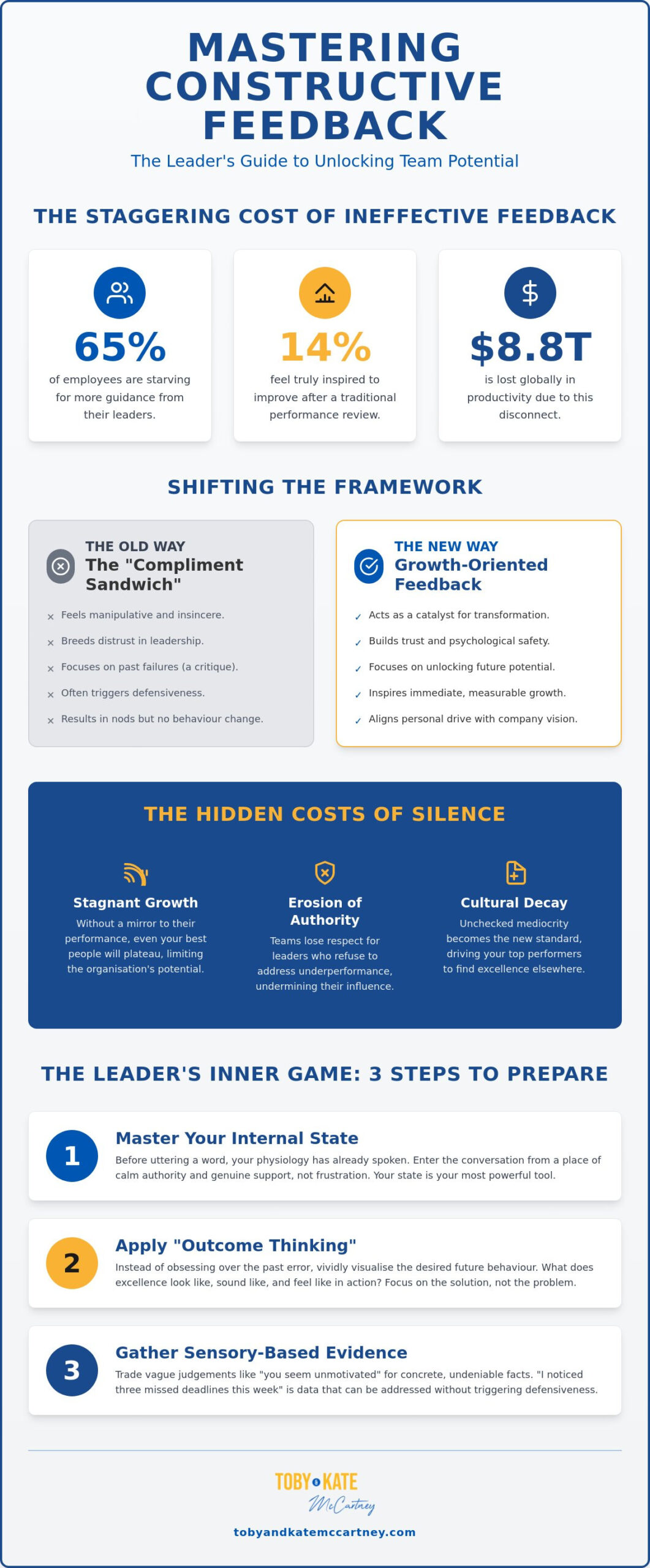
Did you know that whilst 65% of employees are currently starving for more guidance, only 14% feel truly inspired to improve after a traditional performance review? It is a staggering disconnect that costs the global economy an estimated $8.8 trillion in lost productivity. You likely recognise the tension; the desire to drive excellence often battles with the fear of triggering defensiveness or causing a scene. You want your people to thrive, yet you’re tired of feedback sessions that result in awkward nods but zero change in behaviour.
Mastering how to give constructive feedback to your team is the definitive “secret weapon” for any leader who refuses to settle for mediocrity. This is not about HR box-ticking; it is a sophisticated linguistic intervention designed to align a team member’s internal drive with your organisation’s highest vision. We will move beyond outdated methods to explore the psychological frameworks that turn difficult conversations into catalysts for high performance. You are about to discover the precise pathways to build a culture of trust, ensuring your guidance inspires immediate, measurable growth and unwavering excellence.
Key Takeaways
- Move beyond the outdated “compliment sandwich” and learn to treat feedback as a high-level catalyst for professional transformation rather than a critique of past failures.
- Master your internal state and use “Outcome Thinking” to visualise the desired behaviour change before you even begin the conversation.
- Gain linguistic precision on how to give constructive feedback to your team by using sensory-specific language and NLP reframing techniques to eliminate ambiguity.
- Navigate difficult emotional responses by understanding the “Amygdala Hijack” and using the “Agreement Frame” to maintain rapport without sacrificing standards.
- Build a culture of continuous excellence by transforming feedback into a loop; this includes modelling the behaviour you want to see through proactive upward feedback.
Beyond the Sandwich: Why Constructive Feedback is a Leadership Masterclass
Most leaders rely on the “compliment sandwich” as a psychological safety net. They tuck a critique between two slices of praise, hoping to soften the blow. But for high-achievers, this technique feels manipulative and breeds immediate distrust. It signals that you are uncomfortable with the truth. True leadership requires a fundamental shift in perspective. You must view the definition of constructive feedback not as a post-mortem of past failures, but as a proactive catalyst for professional transformation. It is the difference between looking at the scoreboard and coaching the next play.
When you shift your focus from “fixing problems” to “unlocking latent potential,” the entire energy of the conversation changes. You are no longer an auditor; you are an architect of growth. Learning how to give constructive feedback to your team is the primary way you align their individual trajectory with the organisation’s highest vision. Avoiding these conversations carries a heavy price that most leaders ignore until it is too late. The cost of silence includes:
- Stagnant Growth: Without a mirror to their performance, even your best people will plateau.
- Erosion of Authority: Teams lose respect for leaders who refuse to address the elephant in the room.
- Cultural Decay: Unchecked mediocrity becomes the new standard, driving your top performers to find excellence elsewhere.
The Psychology of Growth-Oriented Feedback
The human brain is wired to detect social threats with the same intensity as physical ones. When feedback feels like an attack, the recipient’s “threat” response shuts down the prefrontal cortex. You lose their logic and gain their defensiveness. However, when you frame the conversation as a “challenge” within a safe environment, you trigger neuroplasticity. This is the secret to how to give constructive feedback to your team effectively. It distinguishes between corrective feedback, which merely stops a bad habit, and developmental mentorship, which builds a new, superior one.
Aligning Feedback with Your Professional Identity
Your team does not want a passive manager who avoids conflict. They want an Empowering Master who cares enough to demand excellence. By delivering high-impact feedback, you reinforce the core values of your business and set the standard for what is possible. You are acting as a mirror that reflects not just who they are, but who they are capable of becoming. Constructive feedback is a precision tool for recalibrating professional trajectory.
The Inner Game: Preparing Your State Before the Conversation
Before you utter a single word, your physiology has already spoken. If you enter a feedback session carrying the weight of your own frustration, your team member will mirror that tension instantly. This is the “inner game” of leadership. To truly master how to give constructive feedback to your team, you must first master your own internal state. You cannot lead another person to a place of growth if you are stuck in a state of irritation or doubt.
Effective feedback begins with “Outcome Thinking”. Instead of obsessing over the error, visualise the desired behaviour change in vivid detail. What does excellence look like in action? By shifting your focus from the problem to the solution, you project a sense of calm authority that invites cooperation rather than resistance. You also need to trade vague judgements for sensory-based evidence. High-achievers don’t respond well to “I feel you’re unmotivated”. They respect data. Replace subjective labels with concrete observations; “I noticed three missed deadlines this week” is a fact they can’t ignore but can definitely improve upon.
Establishing rapport is your prerequisite for success. Without a foundation of trust, your words will fall on deaf ears. If you want to refine these high-level communication skills, our Leadership training programmes provide the linguistic tools to influence with precision. You are not just delivering information; you are building a bridge to a better performance.
NLP State Management for Leaders
Your internal state is your most powerful tool. Use NLP anchoring techniques to tap into a state of confidence and calm before the meeting begins. Stand tall, breathe deeply into your diaphragm, and occupy your space. This projects professional authority whilst remaining approachable. You must also practice “Calibration”. This is the art of reading the subtle shifts in your team member’s posture, skin tone, or breathing patterns. If you see them tightening up, you know you need to adjust your approach before you lose their engagement entirely.
Setting the Stage for Success
Environment matters. A sterile boardroom can feel like a courtroom; a neutral, quiet space feels like a workshop. Timing is equally critical. Follow the “24-hour rule” if emotions are high, but don’t wait so long that the event loses its relevance. Frame the meeting as an invitation for growth. When you invite someone to step into a higher version of themselves, they are far more likely to accept than if they feel they are being summoned for a reprimand. Mastery is about creating the conditions where success is the only logical outcome.
Linguistic Precision: Using NLP Models to Deliver Impactful Feedback
Words are the tools of your trade. If those tools are blunt, your impact will be minimal. Many leaders rely on the basic AID model (Action, Impact, Do), but they often fail because their language remains too abstract. To master how to give constructive feedback to your team, you must inject sensory-specific detail into every sentence. Instead of telling someone their “communication was poor,” describe exactly what you saw and heard. Did they speak over a colleague in the Tuesday briefing? Did they fail to respond to a high-priority client request within the agreed four-hour window? Specificity removes the room for argument and focuses the mind on the exact behaviour that needs to shift.
Reframing is another master-level skill in your arsenal. It involves taking a perceived weakness and viewing it through a different lens to reveal a functional strength. For example, a team member who is often labelled as “stubborn” might actually be “meticulously persistent” in the right context. By reframing the trait, you aren’t just criticising; you are showing them how to apply their natural tendencies more effectively for the business. You can then use “Pacing and Leading” to guide them toward a better outcome. First, you acknowledge their current reality to build rapport. Then, you gradually shift the conversation toward a solution-focused mindset. It’s a journey from where they are to where you need them to be.
The “As If” frame serves as a powerful psychological shortcut. Ask your team member to act as if they have already mastered the new skill or resolved the current challenge. What would they be doing differently? How would they be speaking to their colleagues? This bypasses their internal resistance and allows them to mentally rehearse success before they have to perform it in the real world. It turns a daunting change into an attainable reality.
Sensory-Based Feedback vs. Vague Interpretations
Vague nouns like “attitude,” “performance,” or “professionalism” are what we call nominalisations. They are static, heavy, and impossible to act upon because you cannot “do” an attitude. You can, however, change a verb. Replace these abstract concepts with active descriptions of observed behaviours. This ensures you never attach a negative identity label to the person, which only breeds resentment. The difference between “you are unprofessional” and “the language used in that client email lacked the required tone” is the difference between a personal attack and a clear professional instruction.
The Language of Influence
To truly influence, you must use “Clean Language” to avoid projecting your own biases onto the team member’s performance. Keep your questions focused on their internal map of the world. Always ask “How” instead of “Why”. “Why” often triggers a defensive search for excuses or justifications. “How” forces the brain into a creative, problem-solving state that looks toward the future. If you are ready to take these techniques to an elite level, exploring advanced communication skills training is your next logical step. Mastering how to give constructive feedback to your team requires more than just good intentions; it requires the linguistic precision of a master practitioner.
Dismantling Defensiveness: Navigating Difficult Emotional Responses
When you master how to give constructive feedback to your team, you are doing more than delivering data. You are navigating a complex biological system. The moment a team member feels criticised, they may experience what psychologists call an “Amygdala Hijack”. Their rational prefrontal cortex shuts down, replaced by a primal fight-or-flight response. In this state, logic is useless. You cannot argue with a brain that feels under siege. Your primary task is to de-escalate the emotional charge before you can ever hope to reach a resolution.
The “Agreement Frame” is your most potent tool for maintaining rapport during these high-stakes moments. It allows you to acknowledge their perspective without necessarily agreeing with their excuses. This isn’t about being “nice”; it’s about being effective. A simple linguistic shift can change the entire trajectory of the meeting. Replace the word “but” with “and”. When you say, “I hear you, but we need to improve,” the “but” erases everything that came before it. If you say, “I respect your perspective, and I also noticed the quality dropped,” you maintain the connection whilst holding the standard. You must remain grounded. Staying in your “Centre” when the other person becomes emotional or aggressive is the hallmark of an elite leader.
Handling Common Defensive Behaviours
Every team member has a default defensive posture. You must learn to calibrate your approach to match their specific “map” of the world. Recognising these patterns allows you to lead them back to a productive state:
- The Blamer: They will point to external factors or colleagues. Redirect the focus back to their personal power and the specific actions they can take to influence the next outcome.
- The Quiet Submitter: They nod and agree to everything but lack genuine commitment. Draw them out with open-ended “How” questions to ensure they have actually internalised the feedback.
- The Over-Explainer: They get lost in a loop of justifications. Interrupt the story with precision and bring the conversation back to the core sensory-based evidence you gathered earlier.
Recovery and Re-engagement
Even the best-laid plans can go off the rails. If the emotional temperature becomes too high, use the power of the strategic pause. There is no rule stating the conversation must finish in one sitting. Sometimes, the most professional move is to allow 24 hours for emotional processing before re-engaging. Your goal is always to re-establish rapport, ensuring the professional relationship remains intact and focused on future excellence. This level of emotional mastery is a core component of executive coaching and mentoring for those ready to lead at the highest level. If you are ready to transform your leadership impact, explore our One-to-One Coaching services to refine your influence and command.
Cultivating a Culture of Continuous Excellence
Feedback is a loop, not a linear event. If you deliver a masterclass in communication but never check in again, the impact evaporates. The “Follow-Through” session is where the transformation actually takes root. It’s your opportunity to recalibrate and ensure the new behaviour is sticking, turning a single conversation into a lasting shift in performance. This is a core part of how to give constructive feedback to your team; the conversation is just the starting line. You must also encourage “Upward Feedback”. By asking your team for their perspective on your leadership, you model the exact behaviour you expect from them. It builds a culture of mutual respect and radical transparency.
Transitioning from a “Manager” who dictates to a “Coach” who empowers is the ultimate leadership shift. This journey is significantly accelerated by gaining an NLP practitioner certification UK, which provides the psychological framework to understand human motivation at a deeper level. You’ll learn to celebrate “Micro-Wins”. When you reinforce positive changes immediately, you cement new neural pathways in your team members’ brains. Excellence becomes a habit, not a struggle. You are no longer just managing tasks; you are architecting a high-performance environment.
Integrating Feedback into Daily Operations
The era of the dreaded “Annual Review” is over. High-achieving teams require real-time, high-impact micro-interventions. You should organise your team meetings to make feedback a natural and favourite part of the week, rather than a rare and terrifying event. This creates a rhythm of constant improvement. Remember the golden rule of elite influence: praise publicly to build social proof and reinforce values, but always correct privately to maintain rapport and dignity. This balance builds a resilient team that isn’t afraid of the truth.
The Path to Leadership Mastery
True mastery requires you to develop your “Sensory Acuity”. This is the ability to spot subtle performance dips or shifts in team morale before they escalate into full-blown crises. It allows you to intervene with precision and grace. The best leaders are always the best students, committed to a lifelong journey of personal growth. You must be willing to refine your own internal maps if you want to lead others to new territories. Toby and Kate McCartney’s programmes provide the ultimate toolkit for this transformation, giving you the “secret weapon” skills needed to command any room. Mastering how to give constructive feedback to your team is just the beginning of your journey toward becoming an Empowering Master.
Step Into Your Power as an Influential Leader
You now possess the blueprint for professional transformation. Mastering how to give constructive feedback to your team is not a soft skill; it is a high-level intervention that separates the managers from the masters. By controlling your internal state, using sensory-specific language, and navigating the emotional terrain of the agreement frame, you turn every challenge into a catalyst for excellence.
Since 2003, Toby and Kate McCartney have acted as the premier national UK certification provider for leaders who demand more from themselves and their organisations. Our specialised NLP-based leadership curriculum is designed to give you the “secret weapon” of elite communication. It is time to move beyond theory and start seeing measurable shifts in your team’s output and culture.
Ready to master the art of influence? Explore our NLP Practitioner Certification today.
Your journey toward becoming an Empowering Master starts with a single decision. Step into your potential and lead your team to greatness.
Frequently Asked Questions
What is the best way to give feedback to a defensive employee?
The most effective approach is to establish rapport immediately and use the Agreement Frame to de-escalate their internal threat response. Acknowledge their perspective to lower their guard before moving into sensory-based evidence. By focusing on future outcomes rather than past blame, you shift the energy from a personal attack to a collaborative challenge. This ensures they remain in a logic-based state where they can actually process your guidance.
How do I give constructive feedback without sounding like I am micromanaging?
Focus your conversation on the “what” and the “why” rather than the “how”. Describe the required outcome and the specific impact of the current behaviour using sensory-specific language. Give your team member the autonomy to architect the solution themselves. When you master how to give constructive feedback to your team, you act as a mentor who sets the standard whilst trusting their professional competence to meet it.
Is the ‘Compliment Sandwich’ still an effective way to give feedback?
No, the compliment sandwich often breeds distrust amongst high-achievers who perceive it as a manipulative tactic. It dilutes the impact of your message and can leave the recipient confused about the actual priority. Instead, be direct, transparent, and focused on growth. High-performers respect honesty and clarity over sugar-coated critiques that obscure the real path to excellence. Your transparency is a sign of respect for their potential.
How often should I be giving constructive feedback to my team?
Feedback must be a continuous loop rather than an annual event. Research from 2026 indicates that 43% of highly engaged employees receive feedback at least once a week. Aim for real-time micro-interventions that reinforce positive habits and correct course immediately. This frequency builds a culture of constant improvement where growth becomes the standard daily operating procedure. Don’t wait for a formal meeting to celebrate a win or recalibrate a trajectory.
What should I do if a team member ignores my constructive feedback?
Shift the conversation to the meta-level of accountability and professional commitment. Address the fact that the previous feedback was not implemented as a separate performance issue. Use “Outcome Thinking” to ask what specific obstacles are preventing the change. If the behaviour persists after clear, sensory-based instruction, it may require a more formal leadership intervention or a deeper dive into their alignment with the organisation’s core values and vision.
Can I give constructive feedback to my boss or manager?
Upward feedback is essential for a healthy culture of excellence. Use the same principles of sensory-based evidence and outcome-focused language to ensure your message is professional and impactful. Frame it as a way to help them achieve their goals or improve the team’s overall output. Approach the conversation with professional authority, focusing on how a change in their behaviour would unlock greater potential within the department.
What is the difference between constructive criticism and constructive feedback?
Criticism often dwells on the person and the past, whilst feedback focuses on the behaviour and the future. Criticism can feel like a post-mortem of failure that triggers defensiveness. Constructive feedback is a precision tool for recalibrating a professional trajectory. It provides the data and the “As If” frame required for someone to step into a more capable version of themselves. It is a proactive investment in their future success.
How do I handle my own anxiety before a difficult feedback conversation?
Master your internal state through NLP anchoring and diaphragmatic breathing before the meeting begins. Visualise the successful outcome and the positive behaviour change you want to see. Remind yourself that avoiding the conversation is a disservice to the team member’s professional growth. When you know how to give constructive feedback to your team with precision, your anxiety naturally transforms into the focused energy of a mentor committed to excellence.