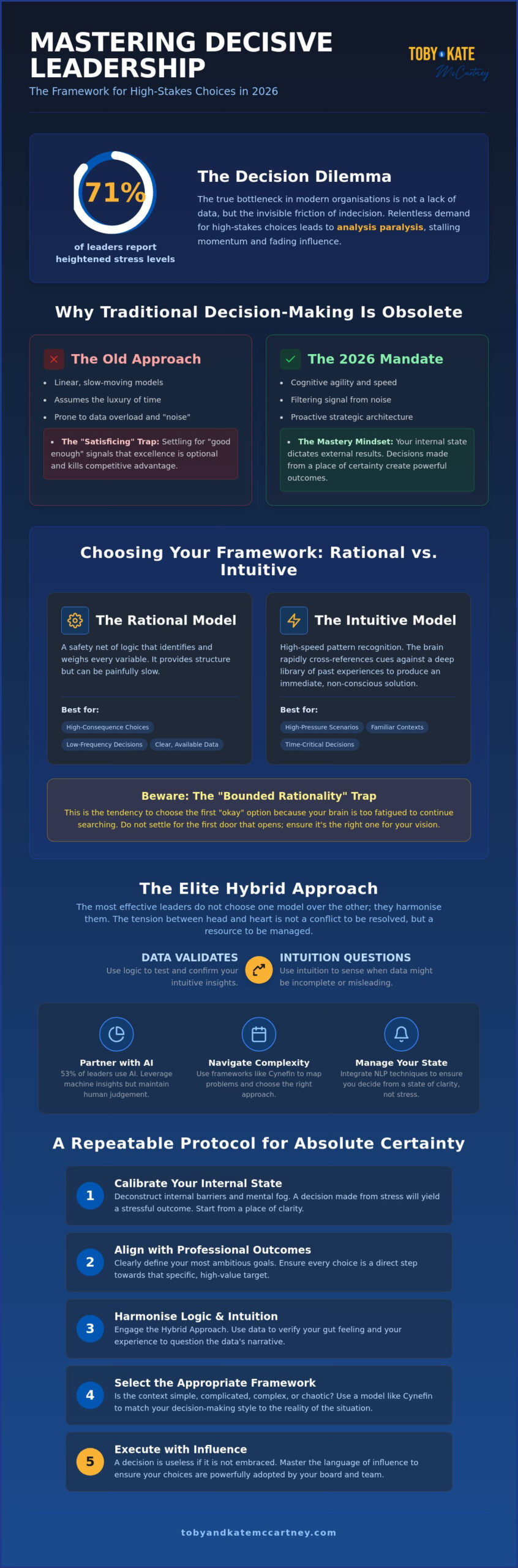
What if the true bottleneck in your organisation isn’t a lack of data, but the invisible friction of your own indecision? You likely feel the weight of being amongst the 71% of leaders reporting heightened stress levels; it’s a direct result of the relentless demand for high-stakes choices. When you’re trapped by analysis paralysis, your team’s momentum stalls and your influence begins to fade. To command respect in 2026, you need to master elite leadership decision making frameworks that turn complex variables into clear, actionable paths.
It’s frustrating to second-guess your intuition whilst under pressure, especially when your professional legacy is on the line. You need more than just a “feeling”; you require a repeatable protocol for speed and accuracy. This guide will provide you with the psychological and strategic frameworks necessary to make decisions with absolute certainty. We’ll examine how to align your personal values with your professional outcomes, ensuring your leadership remains both decisive and deeply influential.
Key Takeaways
- Break through the noise of data-driven overload and learn why “satisficing” is a silent killer of competitive advantage in the modern boardroom.
- Master the sophisticated leadership decision making frameworks that harmonise rational logic with the high-speed pattern recognition of your professional intuition.
- Gain a psychological edge by integrating NLP state management with the Cynefin Framework to navigate complexity with absolute certainty.
- Implement a repeatable five-step protocol designed to calibrate your internal state and ensure every choice aligns with your most ambitious professional outcomes.
- Elevate your authority by mastering the language of influence, ensuring your decisions are not just made, but powerfully embraced by your board and team.
Beyond the Boardroom: Why Traditional Decision-Making Fails in 2026
The world has shifted. The linear, slow-moving models of the past are now relics. By 2026, the sheer volume of data available to you hasn’t made deciding easier; it’s created a minefield of paralysis. You’re likely drowning in “noise” whilst searching for the “signal” that matters. This is where most leadership decision making frameworks fall short. They assume you have the luxury of time. They assume your brain isn’t already redlining from decision fatigue. You don’t need more data. You need a better filter.
Settling for “good enough” is a luxury you can’t afford. This habit, known as “satisficing,” is a silent killer of competitive advantage in a volatile market. When you settle, you’re not just choosing a safe option; you’re signaling to your entire organisation that excellence is optional. You must move beyond reactive problem-solving and step into the role of a proactive strategic architect. Your internal state is the foundation of this architecture. If you’re deciding from a place of stress, your external results will reflect that tension. Mastery starts with your internal chemistry.
For leaders seeking to apply these frameworks to drive organisational growth or manage complex turnarounds, scottlumley.com provides strategic business consulting to ensure long-term success.
The 2026 Context: AI, Speed, and Ambiguity
The integration of AI is no longer a future prediction; it’s your current reality. With 53% of leaders now using AI in strategic decision-making, the bottleneck isn’t the technology. It’s your cognitive agility. You must learn to partner with machine-generated insights whilst maintaining the human judgment that algorithms lack. Modern British leadership requires the ability to distinguish between rapid-fire data and actual wisdom. It’s about speed without haste. It’s about finding the signal amongst the static in an environment that never stops moving.
The Psychological Weight of Leadership Authority
The burden of the “final say” is heavy. It’s that silent pressure that keeps you awake at 2 am. You might even hear that “imposter” voice whispering that you’re just lucky, not capable. This psychological weight changes your behaviour. It makes you hesitant. Or worse, it makes you autocratic when you should be engaging in participative decision-making to leverage your team’s collective intelligence. To clear this mental fog, many elite achievers turn to executive coaching and mentoring. It’s the master-level skill set that allows you to deconstruct these internal barriers, reclaim your decisive authority, and lead with absolute certainty.
Rational vs Intuitive: Choosing the Right Framework for the Context
The tension between your head and your heart isn’t a conflict to be resolved; it’s a resource to be managed. In the high-velocity environment of 2026, relying solely on one mode of thought is a recipe for obsolescence. Whilst the Rational Model provides a safety net of logic, it can be painfully slow. It requires you to identify every alternative and weight every variable. This is your anchor for high-consequence, low-frequency choices where the data is clear and the timeline allows for deep analysis. However, most leadership decision making frameworks fail because they don’t account for the sheer speed of modern business. You need a more agile approach.
This is where the Intuitive Model and the Recognition-Primed Decision (RPD) model come into play. RPD is how experts make life-or-death choices in seconds. Instead of comparing options, you recognise a pattern from your experience, mentally simulate a solution, and act. It’s high-speed pattern recognition. You must also be wary of the “Bounded Rationality” trap. This is the tendency to choose the first “okay” option simply because your brain is too tired to keep searching. Don’t settle for the first door that opens; make sure it’s the right one for your vision.
This type of high-stakes pattern recognition is essential in fields where split-second accuracy is non-negotiable, much like the professional flight training provided by aeroglobalaviation.com, which prepares career-oriented students for precision under pressure.
When to Use Logic vs Intuition
Intuitive Decision-Making is a neurological process where the brain rapidly cross-references current environmental cues against a deep library of past patterns to produce an immediate, non-conscious solution. Use this for high-pressure, familiar contexts where you’ve built significant “mileage.” For low-risk, novel situations, lean back into logic. The most effective leaders use a “Hybrid Approach.” They use data to validate their intuition and their intuition to sense when the data is lying. Refining these internal protocols often requires a dedicated mentor to help you see your own blind spots. You can explore how professional leadership training can sharpen your decisive edge.
The Vroom-Yetton Decision Framework
Success isn’t just about the choice itself; it’s about who you bring on the journey. The Vroom-Yetton framework helps you decide the level of participation needed for any given choice. Sometimes, an autocratic “command and control” approach is necessary for rapid execution. Other times, you need deep collaboration to ensure team buy-in. You must avoid the “Consensus Trap” at all costs. This is where the desire for everyone to agree leads to a watered-down, mediocre outcome that satisfies no one. Your job is to lead, not just to facilitate. Use leadership decision making frameworks to determine when to listen and when to simply decide.
The Cynefin Framework: Navigating Complexity with Psychological Clarity
You’ve already identified the interplay between logic and intuition. Now, you need a map for the terrain itself. The Cynefin Framework is that map. It stands as one of the most transformative leadership decision making frameworks because it forces you to stop looking for “the” answer and start looking at the context. Most leaders fail because they misclassify the environment. They treat “Complex” problems as if they were merely “Complicated.” They try to use expertise and data to solve issues that actually require experimentation and emergent thinking.
This is where the “McCartney Layer” becomes your secret weapon. Traditional Cynefin is a logical exercise. Our approach adds NLP state management to the mix. You cannot accurately sense the world if your internal neurology is stuck in a “fight or flight” response. You must master your state before you can master the framework. The five domains; Simple, Complicated, Complex, Chaotic, and Disorder; are not just categories of problems. They are states of being. When you understand this, you stop being a victim of the environment and start becoming its architect.
Mastering the Complex Domain
In 2026, the “Complex” domain is where your legacy is built. There is no clear cause-and-effect here. You must use the “Probe-Sense-Respond” method. This means taking small, deliberate actions to see how the system reacts. It requires you to foster a culture of “safe-to-fail” experimentation amongst your team. You aren’t just making a choice; you’re evolving your organisation. This level of strategic fluidity is a core component of NLP master practitioner certification. It’s about aligning your identity with the reality of a world that is constantly in flux.
Escaping the Disorder Domain
Disorder is the dangerous middle ground where you don’t know which domain you’re in. This is where analysis paralysis lives. You recognise it by that heavy feeling of indecision. To break through, you must look at your Neurological Levels. Is your hesitation a lack of skill, or is it a limiting belief about your authority? Use rapid NLP techniques to reset your mindset instantly. Once you’ve cleared the internal “Disorder,” you can take one decisive action to move from “Chaotic” to “Complex,” where you can finally begin to architect a proactive strategy. This is how you use leadership decision making frameworks to maintain absolute authority whilst others are still trying to understand the problem.
Five Steps to Master Your Leadership Decision-Making Protocol
You’ve mapped the terrain of complexity and understood the dance between logic and intuition. Now, it’s time to build your own repeatable engine for authority. Elite leadership is not about being right 100% of the time; it’s about having a process that is so robust it commands respect even when the variables shift. By integrating leadership decision making frameworks into a daily protocol, you move from the stress of the unknown to the certainty of a master strategist. This five-step process ensures you never settle for “good enough” again.
Step 1: The Power of Well-Formed Outcomes
Most leaders start with a goal, but masters start with a sensory-specific outcome. You must define exactly what success looks, sounds, and feels like before you commit resources. This involves an “Ecological” check; you need to ask how this choice affects the wider organisation, your stakeholders, and your own personal values. If a decision doesn’t align with the whole system, it will eventually fail. A decision without an outcome is merely a reaction. When you define the end state with absolute clarity, the path to get there becomes a matter of tactical execution rather than guesswork.
Step 2: State Management and Calibration
Deciding from a state of fear is the fastest way to compromise your legacy. You must calibrate your internal state to ensure you’re choosing from a place of vision. Use techniques like “Centring” to find your focus amongst the chaos of a boardroom crisis. You can even employ a “Circle of Excellence” to anchor yourself in a state of peak confidence before a major choice. This internal work is the foundation of external influence. Once your state is aligned, you can use advanced communication skills training to articulate the “Why” behind your choice, ensuring your team is inspired rather than just instructed.
The remaining steps of your protocol turn this internal clarity into external momentum:
- Step 3: Categorise the Context: Use the Cynefin domains to decide if you need to probe, sense, or simply act.
- Step 4: Execute with Certainty: Identify the “Point of No Return.” Once you cross it, commit fully. Hesitation after a decision is made is more damaging than the decision itself.
- Step 5: Review and Recalibrate: Every choice is a data point. Build a feedback loop to review the results and sharpen your intuition for the next challenge.
Mastering these steps requires more than just reading; it requires a shift in your fundamental leadership identity. If you’re ready to move from reactive choices to proactive mastery, exploring high-level leadership training is your next logical step towards absolute authority.
Elevating Your Influence: The McCartney Approach to Decisive Leadership
Making the choice is only half the battle. You can have the most sophisticated leadership decision making frameworks in the world, but if you can’t inspire your team to follow that choice, your authority is an illusion. The “Sell” is where your strategic architecture meets human psychology. It’s about moving from a logical conclusion to a shared vision. This is the gap that many academic models ignore, yet it’s exactly where business leadership training UK focuses. You aren’t just deciding; you’re leading a journey. Your decision-making is a direct reflection of your identity as a master of influence.
In the 2026 landscape, your value isn’t found in your ability to process data. AI can do that. Your value lies in your ability to hold a vision whilst others are lost in the noise. When you use these frameworks, you aren’t just solving problems; you’re architecting the future of your organisation. This requires a shift from reactive management to proactive mastery. It’s about knowing that every choice you make is a brick in the foundation of your professional legacy. You must own the outcome before it even manifests.
Commanding the Room After the Choice
Once you’ve crossed the point of no return, your delivery must be unshakeable. Any hint of hesitation will be picked up by your board and team. You need to present your choice with a level of certainty that makes others feel safe in your direction. Use NLP reframing techniques to handle objections before they even surface. If a stakeholder sees a risk, reframe it as a necessary pivot for growth. This is where public speaking for leaders becomes your most potent weapon. It’s the difference between delivering a report and commanding a room. You aren’t just giving information; you’re transferring certainty.
Your Pathway to Leadership Mastery
Mastery isn’t a destination; it’s a daily practice. Integrating leadership decision making frameworks into your routine requires a fundamental shift in mindset. You must move from being a practitioner who follows rules to a master who embodies the principles. This journey often starts with an nlp practitioner certification UK. It provides the foundational tools to rewire your internal dialogue and recalibrate your state at will. It’s time to stop reacting to the world and start architecting it. Step into your power. Become the Empowering Master your organisation needs in 2026. The path is clear; the choice to walk it is yours.
Step Into Your Decisive Authority
The landscape of 2026 demands a leader who can cut through the static of data overload with absolute certainty. You now have the map to navigate complexity and the internal protocols to master your own intuition. By implementing these leadership decision making frameworks, you aren’t just making choices; you’re architecting a legacy of influence and respect. It’s time to move beyond the fatigue of analysis paralysis and reclaim your position as a visionary strategist. Your authority is a reflection of your internal state.
Toby and Kate McCartney have been national UK leaders in NLP and Public Speaking certification since 2003. With over two decades of elite mastery, they offer specialised leadership training designed for measurable success. This is your opportunity to bridge the gap between theoretical knowledge and professional mastery. Unleash your potential and master the psychology of leadership with Toby and Kate McCartney. Your team is ready for a leader who decides with conviction; it’s time to become that person. Step into your power and lead with unshakeable certainty.
Frequently Asked Questions
What is the best decision-making framework for a CEO?
The most effective approach for a CEO is a hybrid one that matches the framework to the specific environment. You should use the Cynefin Framework to identify if a situation is simple or complex, then apply the Vroom-Yetton model to decide how much team input is required. It’s about having a versatile toolkit that allows you to lead with both logical precision and sharpened intuition.
How does NLP help with leadership decision-making?
NLP is the secret weapon for managing your internal state during high-pressure moments in the boardroom. It provides the tools to move from a state of reactive stress to one of proactive vision in mere seconds. By mastering your neurology, you ensure that your leadership decision making frameworks are operating on a foundation of absolute clarity rather than hidden biases or fear.
Can I use these frameworks for personal decisions as well as business?
Yes, absolutely, because these protocols are built on universal psychological principles that govern all human behaviour. Whether you are deciding on a major corporate acquisition or a significant personal life change, the need for a “Well-Formed Outcome” remains the same. Aligning every choice with your personal values and checking for “systemic ecology” ensures long-term satisfaction and success in every area of your life and career.
How do I stop second-guessing my decisions once they are made?
You must implement a strict “Point of No Return” protocol for your organisation. Once the decision is made, your focus must shift entirely from the choice to the execution of the plan. Second-guessing is often a result of a poorly calibrated internal state. Use NLP anchoring techniques to lock in your certainty, allowing you to move forward with the unshakeable confidence your team expects from you.
What is the difference between a complicated and a complex decision?
Complicated decisions are essentially puzzles that can be solved with expert analysis and linear logic. Complex decisions are more like weather systems; they are unpredictable and require you to “Probe-Sense-Respond” to see what happens next. In a complex domain, cause and effect are only visible in hindsight, so you must take small, safe-to-fail steps to understand the system’s reaction before committing your full resources.
How can I involve my team in decisions without losing authority?
Authority is actually strengthened by clarity and transparency, not by isolation from your team. Use participative models to gather diverse perspectives whilst clearly defining your role as the final decision-maker from the start. When your team feels their expertise is valued, their buy-in and respect for your authority increase. This doesn’t diminish your power; it leverages the collective intelligence of your organisation to produce a superior strategic outcome.
What role does emotional intelligence play in these frameworks?
Emotional intelligence acts as the essential filter for every choice you make in your professional life. It is the foundation of all effective leadership decision making frameworks because it allows you to recognise your own cognitive biases and manage your internal state under fire. Without this self-awareness, even the most sophisticated logical model can be hijacked by unconscious stress or emotional reactivity, leading to compromised outcomes.
How do I make fast decisions during a chaotic crisis?
In a chaotic crisis, your primary goal is to establish order through immediate, decisive action. Don’t waste time searching for the “perfect” solution whilst the situation is still volatile and dangerous. Act to stabilise the environment first. Once you’ve stopped the immediate bleeding, you can transition the problem into the “Complex” domain and begin a more measured, strategic approach to the situation as it evolves.