
Rapport isn’t built by performing the “right” version of yourself. Building rapport with clients and colleagues starts with paying attention, responding genuinely and adapting without pretending to be someone you’re not. That matters when a conversation feels stiff, a communication style is unfamiliar or you’re unsure how to find common ground.
If you worry that trust-building might sound scripted or manipulative, it makes sense to value authenticity. Strong professional relationships grow through everyday behaviour: listening carefully, following through and respecting another person’s perspective. These are learnable skills, not tricks reserved for naturally confident communicators.
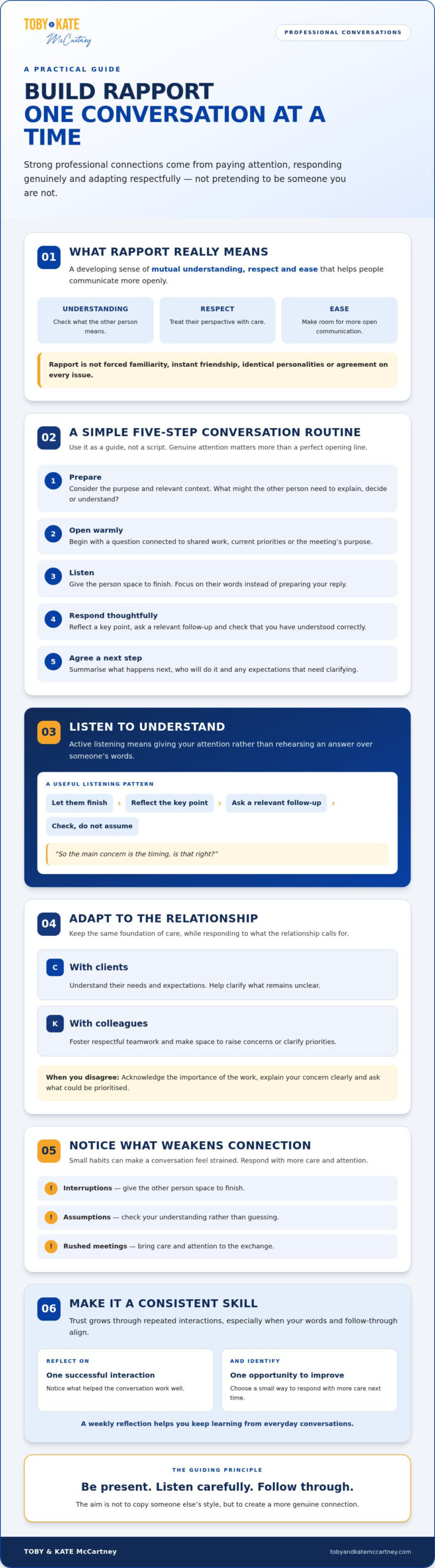
This practical guide shows you how to start and sustain more purposeful conversations, whether you’re speaking with a client, a colleague or someone whose approach differs from yours. You’ll learn ways to listen actively, adapt respectfully across in-person and remote interactions, and build trust through consistency. The aim isn’t to copy someone else’s style. It’s to create a more genuine connection, one conversation at a time.
Key Takeaways
- Build rapport through mutual understanding, respect and ease, not forced familiarity.
- Use a simple sequence: prepare, open warmly, listen, respond thoughtfully and agree a clear next step.
- Adapt your approach to the relationship: understand clients’ needs and expectations, whilst fostering respectful teamwork with colleagues.
- Notice how interruptions, assumptions and rushed meetings can weaken connection, then respond with more care and attention.
- Strengthen your skills by reflecting on one successful interaction and one opportunity to improve each week.
What does building rapport with clients and colleagues really mean?
Some professional conversations feel strained even when both people have good intentions. You might be trying to help whilst the other person is focused on deadlines, cautious about a decision or simply communicating differently. Rapport doesn’t mean every exchange feels effortless. It’s a developing sense of mutual understanding, respect and ease that helps people communicate more openly.
That understanding grows through small, observable actions: listening without rushing to reply, checking you’ve understood someone’s point and treating their perspective with care. For a broader overview of the concept, see What is rapport? Rapport can take time to develop. It doesn’t depend on instant friendship, identical personalities or agreement on every issue.
Genuine rapport is the trust created by attentive, respectful communication, not the appearance of charm or scripted agreement. Building rapport with clients and colleagues isn’t about performing a technique. It’s about being present and responding thoughtfully to the person and situation.
How is rapport different from simply getting on with someone?
Getting on well can mean you enjoy someone’s company. Rapport is also possible when a conversation involves feedback, disagreement or firm expectations. Warmth helps, but rapport doesn’t require you to seek approval, avoid difficult topics or soften every point until it loses meaning.
Imagine a colleague proposes a deadline you think is unrealistic. Acknowledge the importance of the work, explain your capacity concern clearly and ask what could be prioritised. You may not agree on the original plan, but respectful listening and honest discussion can preserve the connection.
Why does rapport matter in professional relationships?
When people feel heard and respected, it can be easier to ask a question, share relevant context or clarify what they need. That makes conversations more useful. A colleague may feel able to raise a concern before it becomes harder to address; a client may be more comfortable explaining which expectations remain unclear.
Rapport can support clearer collaboration, but it doesn’t guarantee agreement, a sale or a particular performance outcome. Its practical value is that it creates better conditions for people to understand one another and decide what to do next. Trust grows through repeated interactions, especially when your words and follow-through align.
How to build rapport with clients and colleagues in everyday conversations
Good conversations don’t depend on having the perfect opening line. A simple routine can help you stay attentive and purposeful, whether you’re meeting a client or catching up with a colleague. Use it as a guide, not a script. Building rapport with clients and colleagues works best when your attention is genuine.
- Prepare: Consider the purpose of the conversation and any relevant context. What might the other person need to explain, decide or understand?
- Open warmly: Use their name naturally if appropriate, and begin with a question connected to shared work, current priorities or the meeting’s purpose.
- Listen: Give them space to finish. Focus on what they’re saying instead of preparing your reply whilst they speak.
- Respond thoughtfully: Reflect a key point, ask a relevant follow-up and check that you’ve understood correctly.
- Agree a next step: Summarise what happens next, who will do it and any expectations that need clarifying.
Prepare, open, listen, respond and agree the next step: a practical routine for conversations that build understanding. Names, remembered context and curious questions can help someone feel recognised, but they aren’t boxes to tick. Use details only when they’re relevant, and ask because you genuinely want to understand.
How can active listening create a stronger connection?
Active listening means giving the other person your attention rather than rehearsing your answer over their words. When they finish, summarise the point that matters most: “So the main concern is the timing, is that right?” Then ask a follow-up based on what they’ve shared. If you’re unsure, check rather than assume: “When you say the plan needs more flexibility, what would that look like for your team?”
What should you say to start a professional conversation?
Choose an opener that fits the relationship and setting: “How is the handover going?” for shared work, “What’s your main priority this week?” for a colleague, or “What would you most like us to clarify today?” for a client. Then make the transition clear: “Thanks, that’s helpful. Shall we look at the questions you wanted to cover?” This respects their time whilst moving beyond small talk.
Rapport isn’t one-size-fits-all. Harvard Business School explores the nuances of rapport in the workplace, a useful reminder to stay curious about how communication is experienced rather than assuming everyone responds alike.
If you want to develop broader communication skills through structured learning, explore advanced communication skills training. NLP training or one-to-one coaching can also provide a route for deliberate practice and reflection. Find out more about NLP training and one-to-one coaching.
Building rapport with clients versus colleagues: what should change?
The foundations stay the same: listen, show respect and do what you say you’ll do. The emphasis shifts with the relationship. Clients need confidence that you understand their needs and are clear about what you can deliver. Colleagues need dependable collaboration, respectful feedback and awareness of how your actions affect the team.
| Rapport principle | With clients | With colleagues |
|---|---|---|
| Understand context | Ask about goals, constraints and what a useful outcome would look like. | Understand responsibilities, priorities and how the work connects across the team. |
| Communicate clearly | Clarify expectations, scope and timing. Be transparent about what you can deliver. | Share relevant information in a way that supports coordination and decisions. |
| Build trust | Follow through on commitments and update the client if plans change. | Be reliable, give feedback respectfully and consider team dynamics. |
| Respect boundaries | Keep the relationship professional and focused on the agreed work. | Respect personal space, time and role boundaries whilst working collaboratively. |
In both contexts, rapport isn’t overfamiliarity. You don’t need to share personal details or blur professional roles to create a positive working relationship. Warmth and respect can sit alongside clear limits.
How do you build rapport with clients without overpromising?
Start by asking what the client wants to achieve, which constraints matter and how they’ll recognise a useful outcome. Then explain plainly what you can deliver and when. If something is uncertain, say so and agree how you’ll confirm it. Persuasive language might create a good first impression, but reliable follow-up gives the client a sound basis for trust.
How do you build rapport with colleagues across different roles?
Adapt the level of detail to the task and the person’s role, but don’t assume someone’s preferences based on their job title. Ask what information would help, respect their time and recognise the expertise they bring. If feedback is needed, be specific about the work and its impact, then invite their perspective. This supports collaboration without avoiding honest conversations.
If you’re developing your leadership approach alongside everyday communication, leadership training may provide a relevant route for structured development. The central skill remains practical: adjust your approach to the relationship, keep expectations clear and let consistent behaviour earn trust.
What gets in the way of rapport, and how can you respond?
Trying too hard to create an instant connection can have the opposite effect. Copying someone’s gestures or agreeing with their opinions doesn’t automatically create trust. If your interest feels performed, or your agreement isn’t genuine, the other person may notice a mismatch between what you say and how you behave.
Connection can also fray through ordinary habits: interrupting, making assumptions, rushing a meeting or failing to follow through. A missed commitment may matter more than a polished conversation, particularly if it leaves someone uncertain about what happens next. Rapport is strengthened less by performing the perfect response than by showing consistent respect in the moments that count.
If you notice tension, pause before pushing on. Try this reset:
- Notice the shift: Acknowledge that the conversation seems to have become difficult or unclear.
- Ask an open question: Invite the other person to explain what matters to them.
- Acknowledge the impact: Recognise how an interruption, delay or misunderstanding may have affected them, without becoming defensive.
- Agree a next step: Decide what you’ll do, who’s responsible and when you’ll check in again.
These actions won’t resolve every disagreement. They can make it easier to understand what has gone wrong and choose a constructive way forward.
Can you build rapport with someone whose communication style differs from yours?
Yes, but start with curiosity rather than a guess based on personality labels or job roles. Ask whether they’d prefer the detail now, time to reflect or a direct discussion of the decision. Then adapt your pace or level of detail whilst keeping your own judgement intact. Respectful flexibility isn’t imitation. It’s finding a clear way to communicate without pretending to be someone you’re not.
How can you rebuild rapport after a misunderstanding?
Address the issue promptly, using observable details rather than assigning motives. For example: “I sent the revised figures after our meeting, but they weren’t included in the final version. Can you tell me how you saw it?” Listen to their account, then acknowledge any impact your actions had, even if that wasn’t your intention. Agree one realistic action, such as confirming key changes in writing, and follow through consistently. Confidence is rebuilt through evidence over time, not a single apology.
Communication habits can be developed through deliberate practice and reflection. If you’d like structured support to strengthen yours, explore NLP training and one-to-one coaching.
How to make rapport-building a consistent professional skill
Good intentions matter, but lasting progress comes from noticing what you do in real conversations and practising deliberately. To make building rapport with clients and colleagues a consistent skill, set aside a few minutes each week to reflect on your interactions. Keep it practical, not judgemental.
- One interaction that went well: What did you do that helped the conversation feel clear or constructive? Name the behaviour, such as leaving space for someone to finish or confirming an action before the meeting ended.
- One opportunity to improve: Where might you have made a different choice? Pick one behaviour to practise next week, such as paraphrasing a key point or clarifying expectations before agreeing to a task.
Focus on one change at a time. That gives you a clear opportunity to practise, notice how it affects the exchange and decide whether to keep refining it.
How can you tell whether your rapport-building is improving?
Look for observable actions, not just whether someone seemed friendly or agreed with you. Did you listen without interrupting? Did you check that you’d understood their concern? Did you confirm who would do what next? You can also ask a trusted colleague for specific feedback: “Was my explanation clear?” or “Did I leave enough space for your view?” Useful feedback points to behaviour, not general approval.
When can training or coaching help you build rapport?
Self-reflection can reveal a pattern, but it isn’t always easy to spot your own habits. Peer feedback, coaching or structured training can give you a supported space to examine how you communicate, consider alternatives and practise new approaches. NLP training and one-to-one coaching are options for people seeking more structured development, without promising a particular outcome.
For a leadership-focused development pathway, leadership training and mentoring may be relevant. Choose an approach that fits your goals, then apply what you learn in everyday conversations. Small, considered changes can help you communicate with greater awareness over time.
If you’re ready to develop your approach further, explore NLP training and one-to-one coaching options for structured communication development.
Make your next conversation count
Professional trust isn’t built through a perfect line or instant connection. It grows when you stay attentive, adapt respectfully and follow through on what you’ve agreed. That’s the heart of building rapport with clients and colleagues: creating space for clearer, more confident conversations without sacrificing your authenticity.
Start small. In your next conversation, choose one behaviour to practise, such as checking you’ve understood someone’s priorities or confirming the next step before you part. Then reflect on what helped and what you’d adjust. Consistent practice turns communication awareness into a skill you can draw on across different professional relationships.
Toby and Kate McCartney offer NLP certification pathways, public speaking programmes and professional coaching, alongside leadership training and mentoring. Explore the options and consider which could support your professional development: explore NLP training and coaching options.
You don’t need to transform every interaction at once. Bring curiosity and care to the next one, and build from there.
Frequently Asked Questions
What is rapport in a professional relationship?
Rapport is a developing sense of mutual understanding, respect and ease in communication. It doesn’t mean you must agree, become friends or abandon professional boundaries. Instead, it grows through attentive conversations and dependable behaviour over time. You can have rapport with someone whilst giving feedback, discussing a concern or holding a different view, provided you communicate with consideration and follow through on what you’ve agreed.
How do you build rapport with clients?
Build rapport by learning about a client’s priorities before suggesting a solution. Listen carefully, check your understanding and clarify what can be delivered, by when and what the client expects. Be honest if something is uncertain, then follow through on agreed actions. Building rapport with clients and colleagues relies on consistent professional behaviour, not a single persuasive conversation. Trust develops across interactions as your words and actions align.
How do you build rapport with colleagues at work?
Show interest in colleagues’ perspectives, respect their time and expertise, communicate clearly and keep your commitments. Ask about working preferences rather than assuming what someone needs based on their role. Collaboration also grows through useful, respectful feedback: be clear about the work or issue, invite their view and agree what happens next. These everyday actions help create dependable working relationships without requiring everyone to share the same style or opinions.
Can you build rapport with someone who has a very different communication style?
Yes. Stay curious, ask open questions and check what would help instead of guessing. You might ask, “Would a concise summary or more detail be useful?” or “Would you like time to consider this before we decide?” Adjusting your pace or level of detail doesn’t mean imitating the other person or pretending to share their opinions. Keep your communication genuine, respectful and guided by your professional judgement.
What are common mistakes that damage rapport at work?
Interrupting, making assumptions, overpromising, neglecting follow-up and relying on scripted techniques can all weaken trust, even when your intentions are positive. If you notice a problem, pause and consider its impact. Ask the other person how they experienced the situation, listen without rushing to defend yourself, then agree a clear action. For example, if you missed an update, confirm when you’ll provide it and follow through.
How long does it take to build rapport with a client or colleague?
There’s no fixed timeline. The relationship, circumstances and each person’s previous experiences all shape how quickly communication feels comfortable. One conversation may create an early sense of ease, but dependable trust usually develops through repeated interactions and follow-through. Rather than expecting an instant connection, focus on being respectful, clear and reliable each time you speak. Give the relationship room to develop at a natural pace.
Is mirroring someone’s body language a good way to build rapport?
Noticing someone’s pace and non-verbal cues can help you communicate attentively, but deliberately copying their gestures may feel unnatural. Prioritise listening, appropriate eye contact and considerate responses instead. If someone seems unsure, ask a clear question rather than trying to influence them through a formula. Genuine rapport comes from mutual understanding and respect, not imitation. Adapt your communication with care, whilst remaining authentic and mindful of professional boundaries.
Can training help improve rapport-building skills?
Yes. Structured learning, practice and feedback can help you notice communication habits and explore different ways to respond. Training or coaching may suit you if you want guided development, though results depend on how you apply what you learn. Toby and Kate McCartney offer NLP Practitioner, Master Practitioner and Trainer Training certifications, alongside one-to-one coaching. Review their options and consider which may best fit your professional development goals.