
What if confidence isn’t something you have to wait for, but a skill you can build through deliberate practice? If nerves or self-doubt make presentations harder than they need to be, you’re not alone. The right public speaking coaching can help you make clearer choices under pressure and communicate with greater composure when the moment matters.
Support should fit your goals, rather than follow a generic script. You might be weighing one-to-one coaching against a group programme, or wondering whether practice will translate from a training setting to real meetings, presentations and virtual events. Those are useful questions to ask before you commit.
This guide explains what public speaking coaching can help you work on, how to assess your options and what to expect from a useful coaching process. You’ll learn how to match support to your experience and speaking goals, look for feedback you can apply at work, and decide whether a programme or individual coaching may suit you. The aim isn’t perfection. It’s a clearer, more confident and repeatable way to speak.
Key Takeaways
- Identify the speaking situations you want to handle more effectively before choosing your next step.
- Use your goals, feedback preferences and opportunities to practise to decide whether coaching, group training or independent practice may suit you.
- Assess a coach’s relevant experience and process, and ask how their feedback relates to your professional speaking context.
- Bring an upcoming presentation or speaking opportunity into your preparation so you can practise with a clear purpose.
- Explore Toby and Kate McCartney’s public speaking programmes and one-to-one coaching as possible ways to develop professional communication and presentation skills.
What can public speaking coaching help you change?
High-stakes speaking can challenge even capable professionals. You may know your subject well and still lose your thread in a meeting, rush through a presentation or struggle to hold listeners’ attention. The issue may not be your expertise. It may be how you organise and deliver your message under pressure.
Public speaking coaching is focused support for developing communication and presentation skills through practice, feedback and reflection. It can help you work on specific behaviours, such as structuring a message, using your voice effectively and adapting to an audience. The aim is to build skills you can use in presentations, meetings, pitches and professional events, not to promise you’ll never feel nervous or guarantee a particular outcome. For a broader introduction, explore the history, techniques and importance of public speaking.
Which speaking situations might coaching address?
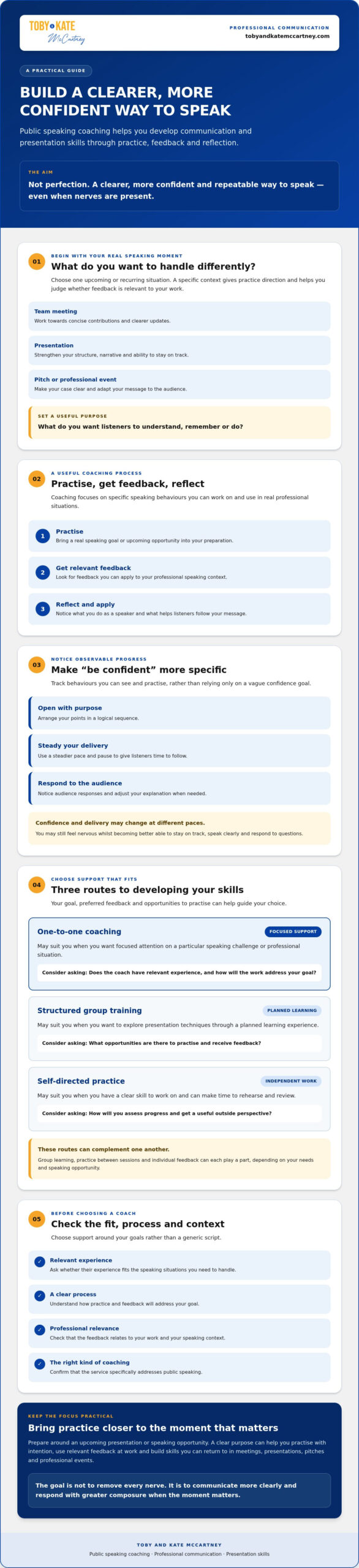
Start with a real situation you want to handle differently. Perhaps you rush through team meeting updates, struggle to make a client pitch persuasive, or lose your structure when a presentation is interrupted. Each context calls for a different emphasis: a meeting may require concise contributions, a pitch needs a clear case, and a presentation may benefit from a stronger narrative.
Choose one upcoming or recurring speaking moment to focus on. What do you want listeners to understand, remember or do? A specific goal gives practice direction and helps you judge whether feedback is relevant to your work.
What does progress in public speaking look like?
Track progress through observable behaviours, rather than relying on a vague goal to “be confident”. Depending on your aims, you might work towards:
- Opening with a clear purpose and arranging your points in a logical sequence.
- Using a steadier pace and pausing to give listeners time to follow.
- Noticing audience responses and adjusting your explanation when needed.
Confidence matters too, but it may not change at the same pace as your delivery. You could still feel nervous while becoming better able to stay on track, speak clearly and respond to questions. Likewise, feeling more confident doesn’t automatically mean your message is easy for others to follow. A grounded coaching process can help you notice both how you feel before and during a speaking opportunity and what you actually do as a speaker.
Public speaking coaching, training or practice: which support fits?
You don’t need to be a beginner or feel naturally nervous to develop your speaking skills. Experienced professionals may want to sharpen a pitch, lead meetings with more impact or make complex ideas easier to follow. The best support depends on your goal, the feedback you value and how much opportunity you have to practise.
| Option | May suit you if… | Consider asking… |
|---|---|---|
| One-to-one coaching | You want focused attention on a particular speaking challenge or professional situation. | Does the coach have relevant experience, and how will the work address your goal? |
| Structured group training | You want to explore presentation techniques through a planned learning experience. | What opportunities are there to practise and receive feedback? |
| Self-directed practice | You have a clear skill to work on and can make time to rehearse and review. | How will you assess progress and get a useful outside perspective? |
These options can complement one another. You might build foundations in a group programme, practise between sessions and seek individual feedback when a particular presentation or leadership opportunity calls for more focused attention. Harvard’s public speaking tips can also give you ideas to try as you practise.
When is one-to-one coaching a useful option?
One-to-one coaching may suit you if you want to work on a defined goal, such as structuring a high-stakes presentation or making meeting contributions more concise. Before choosing, check that the coach understands your speaking context and ask how practice and feedback fit into their approach. Confirm that their coaching specifically addresses public speaking, rather than assuming every coaching service does.
When might a group programme or regular practice suit you?
A structured programme can provide a framework for exploring communication and presentation techniques, while regular rehearsal gives you a chance to apply them. Ask how practice and feedback are included in the option you’re considering. Will you work with material relevant to your role? Will the guidance help you prepare for a real speaking situation?
If your role involves guiding a team or influencing decisions, explore this guide to public speaking for leaders to consider how your goals may differ. Toby and Kate McCartney offer public speaking programmes focused on professional communication and presentation skills, as well as one-to-one coaching. Explore their public speaking support and consider which option fits the speaking goal you have in mind.
How to assess a public speaking coach before choosing
A strong match starts with your speaking context, not impressive-sounding promises. A coach who understands boardroom presentations may approach your needs differently from someone whose experience centres on pitches, conference talks or team meetings. Look for relevant, verifiable experience and ask how their approach connects with the situations you face.
Clarity matters too. Before committing to public speaking coaching, make sure you understand what the work is designed to address, how practice and feedback may be incorporated, and how you’ll review progress. You could also compare coaching with community-based opportunities such as Toastmasters International, depending on the kind of learning and practice you’re seeking.
Questions to ask before starting coaching
Use an initial conversation to understand the process, not just to hear a list of promised benefits. Ask questions such as:
- Goals: What speaking situations or skills is this work intended to support?
- Experience: What relevant experience do you have with my type of presentation, audience or professional setting?
- Practice and feedback: If these are part of the approach, how are they incorporated, and what kind of feedback can I expect?
- Structure: What does a typical session involve, and what would I be expected to prepare or practise?
- Progress: How will we review what’s changing and decide whether the work remains useful?
Look for specific, understandable answers. You should be able to picture how the process relates to your goal, whether that’s presenting a proposal to senior colleagues or contributing more clearly in meetings.
How to judge whether the approach fits your needs
Compare a coach’s relevant experience with your actual speaking demands. If you need help with professional presentations, ask about relevant work rather than assuming general coaching experience is the same as public speaking expertise. Clear explanations of expectations, responsibilities and the proposed approach can help you decide whether the fit feels right.
Be cautious if the method remains vague, promises a particular outcome or claims to remove all nerves, or if you’re pressured to commit before you’ve had time to assess the offer. Confidence can be one of your aims, but it’s reasonable to ask how progress will be recognised in practice. Use this checklist to compare providers:
- Relevant: The coach can explain how their experience relates to your speaking situation.
- Practical: You understand how the skills, practice and feedback connect to your goal.
- Transparent: The process and expectations are clear before you commit.
- Collaborative: You have a way to review progress and discuss what needs to change.
If you’re considering one-to-one coaching, explore coaching with Toby and Kate McCartney and check whether the available coaching specifically addresses your public speaking goals.
How to prepare for public speaking coaching and apply what you learn
Useful progress starts with a real speaking goal and continues after a coaching conversation ends. Before public speaking coaching, choose a situation you can picture clearly, such as presenting a project update, pitching an idea or addressing a professional group. Bring an outline or describe the upcoming opportunity, including what you want your audience to understand. This gives the work a practical focus.
Set a practical goal for your next presentation
Turn a broad aim such as “feel more confident” into an observable behaviour you can practise. You might aim to pause between key points, state your recommendation near the beginning or look up from your notes when explaining a central idea. Choose a realistic opportunity to try it, rather than attempting to change everything at once.
Before practising, make a brief baseline note. What feels clear? Where do you tend to lose your thread or speed up? Record your observations without judging yourself. You’re gathering information to guide your next attempt, not grading your ability as a speaker.
Build a repeatable practice and review routine
Practise aloud using your outline, then notice where the message feels unclear, rushed or difficult to deliver naturally. If you receive feedback, choose one or two behaviours to focus on in your next rehearsal. Repetition lets you test adjustments; reflection helps you decide which ones serve your message and audience.
- Choose: Set one specific speaking goal for a real professional situation.
- Practise: Rehearse aloud and focus on a behaviour such as pacing or structure.
- Review: After the presentation, note what helped listeners follow your message and what you’d adjust.
- Refine: Carry one useful learning into your next speaking opportunity.
After a real presentation, consider whether your main points were easy to follow, whether your pace gave listeners time to absorb them, and how well you responded to audience cues. If possible, ask a trusted colleague for specific observations. Look for patterns across several opportunities rather than expecting one session to transform your performance. Progress can be gradual: clearer structure in one talk, steadier delivery in another.
If your goals extend beyond presentations to broader influence and professional communication, explore this guide to advanced communication skills training. For a practical next step, explore public speaking programmes and consider which support aligns with the goal you’ve identified.
Explore public speaking support with Toby and Kate McCartney
You’ve identified what you want to strengthen. Now find support that matches the challenge, rather than choosing an option simply because it sounds impressive. Toby and Kate McCartney offer public speaking programmes focused on communication and presentation skills for professional settings, alongside one-to-one coaching. These are different forms of support, so check which option relates to your speaking goal.
Find support that matches your speaking goals
If you want to address a specific challenge, such as presenting a proposal or contributing more clearly in meetings, ask whether the available one-to-one coaching specifically covers public speaking. If you want to develop presentation skills more broadly, a public speaking programme may be worth exploring. The right fit depends on your role, the speaking situations you face and how you prefer to learn.
Before deciding, confirm the programme format, availability and suitability directly with the provider. Ask what the programme covers, how it relates to professional communication and whether its approach aligns with the skills you want to develop. For coaching, clarify its focus and how the proposed work connects to your situation. Clear answers help you make an informed choice without assuming every option suits every speaker.
Take a clear next step towards stronger speaking
Make your enquiry specific. Write down one upcoming speaking challenge, what you want to communicate and the skill you’d like to develop. For example, you might need to explain a complex recommendation to colleagues or present an idea to a prospective client. Sharing that context gives you a practical basis for asking whether the available support fits.
You don’t need to have every detail mapped out before exploring your options. Bring your questions, describe the situation and find out what the provider can confirm about the approach. A useful next step gives you clarity, not pressure to commit.
If the support aligns with your goals, explore Toby and Kate McCartney’s public speaking programmes and coaching. Ask how the options relate to your needs, then choose the pathway that suits your next professional speaking opportunity.
Make your next speaking opportunity a step forward
Stronger speaking begins with a clear goal: identify the situation you want to improve, then choose support that fits your needs and preferred way of learning. Public speaking coaching, structured programmes and deliberate practice can each help you develop. Judge progress through observable skills, such as clearer structure, steadier delivery and better awareness of your audience.
Toby and Kate McCartney offer public speaking programmes focused on professional communication and presentation skills, alongside one-to-one coaching. If you’re considering coaching for a speaking goal, ask whether the available coaching specifically addresses it, and check the programme format and suitability before choosing.
Start by identifying one speaking challenge and the skill you want to build. Explore public speaking support and take your next step. A practical goal and support that fits can help you develop communication skills for real professional situations.
Frequently Asked Questions
What does a public speaking coach help you with?
A public speaking coach can help you develop communication and presentation skills, such as organising a message, delivering it clearly and responding to an audience. The focus should reflect your aims: you might want to make a proposal easier to follow or contribute more effectively in professional discussions. Ask what the coaching covers and how it relates to your speaking situation, as providers’ scope and approach can differ.
Can public speaking coaching help if I feel nervous presenting?
Public speaking coaching may help you practise specific delivery skills while managing the nerves you experience. You could work on preparing your opening, keeping to a clear structure or pausing rather than rushing. Coaching shouldn’t be presented as a guarantee that anxiety will disappear. If you’re considering support, explain what happens when you present and ask whether the coach’s approach is appropriate for your goals.
How do I choose a public speaking coach?
Check the coach’s relevant experience, proposed process and fit with your speaking context. Ask what goals the work supports, whether practice and feedback are included, and how progress is reviewed. Look for clear explanations rather than broad promises. Before committing, make sure you understand what’s expected of you and confirm that the coach has experience relevant to the type of speaking you want to improve.
Is public speaking coaching better than a training course?
Neither option is automatically better. The right choice depends on your goals and preferred way of learning. Individual coaching may suit a specific challenge that needs focused attention, while a structured course can provide a broader programme for developing presentation skills. Consider how each option handles practice and feedback. They can also complement each other, with course learning reinforced through rehearsal or individual guidance.
How long does public speaking coaching take?
There isn’t one set duration that applies to everyone. The time involved depends on your goals, the provider’s approach and how much practice you do between sessions. Ask what commitment is proposed, whether it can be adjusted and how you’ll assess progress. A clear goal, such as improving the structure of a particular presentation, can help you discuss a relevant pathway without assuming a guaranteed timeline.
What should I expect in a public speaking coaching session?
The content depends on the coach and agreed goals, so confirm the format beforehand. A session might involve discussing a speaking challenge, working on relevant communication skills or reviewing practice, if these are part of the provider’s approach. Bring an outline or details of an upcoming presentation to make the conversation specific. Ask what preparation is expected and how feedback will be given.
Can public speaking coaching help with work presentations and meetings?
It can be relevant to professional settings if the coach’s experience and service match your needs. Presenting a project, explaining a recommendation and speaking up in a meeting each call for different communication choices. Describe the situation you want to improve and ask whether the support addresses it. Toby and Kate McCartney offer public speaking programmes focused on professional communication and presentation skills, as well as one-to-one coaching.