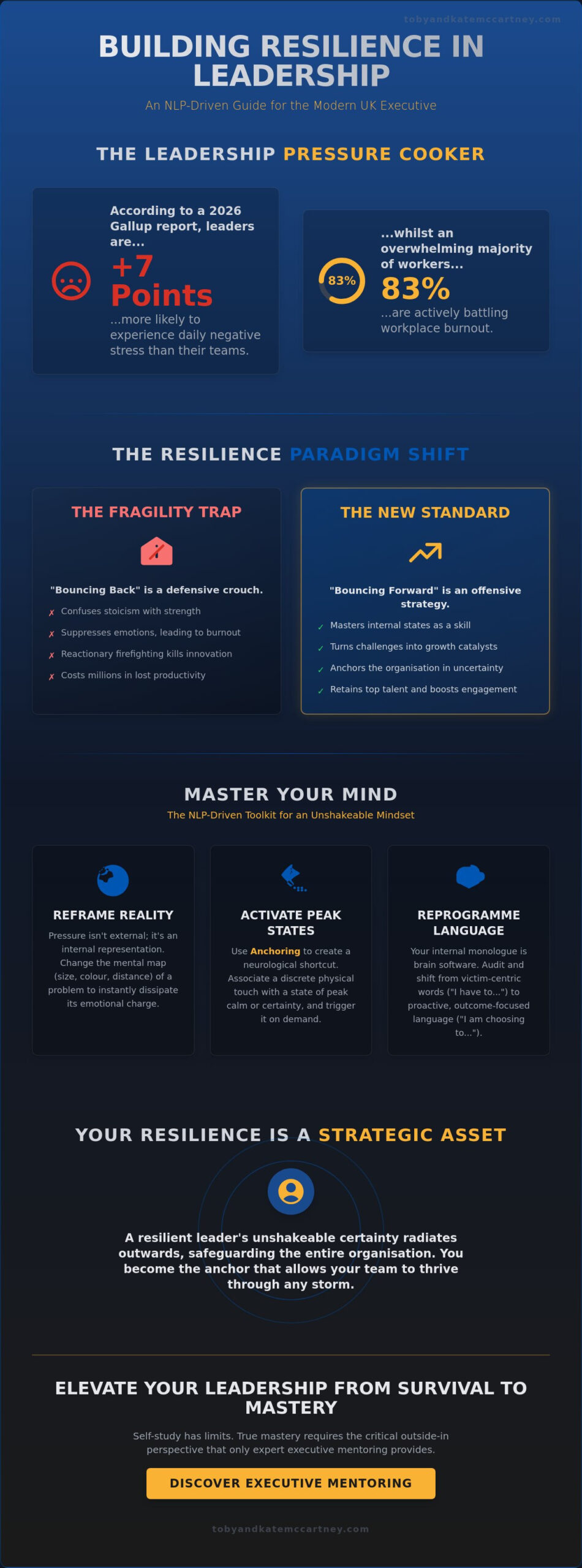
A 2026 Gallup report reveals that whilst you are likely more engaged than your team, you are also seven points more likely to experience daily negative stress. You’ve felt that weight. The decision fatigue that sets in by mid-afternoon, the silent fear that showing a crack in your armour might destabilise the office, and the frustration of a mind that won’t switch off when you finally get home. You know that building resilience in leadership is no longer a luxury skill. It’s the foundation of your professional survival in a landscape where 83% of workers are battling burnout.
This isn’t about “toughing it out” or masking your exhaustion. I’m going to show you how to master the internal psychology of pressure and lead with unshakeable certainty using a definitive NLP-driven checklist. You’ll discover how resilience isn’t a trait you’re born with, but a cognitive architecture you can build. We’ll explore the exact linguistic reframing techniques and state-management systems you need to stay calm under fire, regain clarity, and project massive influence during any crisis.
Key Takeaways
- Shift your perspective from merely “bouncing back” to a “bounce forward” strategy that turns every organisational challenge into a catalyst for growth.
- Decode the psychology of pressure by mastering your internal representations and the state-behaviour loops that govern your decision-making.
- Access a high-performance system for building resilience in leadership through daily state priming and a rigorous linguistic audit of your internal monologue.
- Leverage the science of mirror neurons to project a contagious sense of calm, using calibration and rapport to safeguard your team against burnout.
- Recognise the limit of self-study and learn how executive mentoring provides the critical outside-in perspective needed for true leadership mastery.
Beyond Bouncing Back: Redefining Resilient Leadership in 2026
In 2026, the old definition of “getting back to normal” is dead. If you’re waiting for the storm to pass so you can return to how things were, you’ve already lost the game. True psychological resilience in the modern boardroom isn’t a defensive crouch; it’s an offensive strategy. It’s your ability to maintain absolute clarity and peak influence whilst the world around you is in flux. You don’t just bounce back to where you started. You bounce forward, evolved and sharper than before. This is the new standard of excellence.
Many executives fall into the “fragility trap.” They confuse stoicism with strength. They grit their teeth, suppress their emotions, and call it resilience. That’s not resilience; it’s a countdown to a breakdown. From an Neuro-Linguistic Programming (NLP) perspective, building resilience in leadership is about mastering your internal states. It’s not a fixed personality trait you’re born with. It’s a series of neurological pathways you choose to activate. You are the architect of your own mental environment. When you change your internal representation of a crisis, you change your ability to lead through it.
Resilience as a Strategic Asset for UK Leaders
In the UK’s volatile market, your mental state is a line item on the balance sheet. High-stakes decision-making requires a brain that isn’t hijacked by cortisol. When you lead from a place of unshakeable certainty, you don’t just improve your own performance; you anchor your entire organisation. Your resilience directly impacts staff retention. People don’t leave companies; they leave leaders who can’t handle the heat. This makes building resilience in leadership your most potent “secret weapon” for keeping top talent engaged whilst competitors struggle with stagnant workforces.
The Cost of the ‘Fragile’ Leadership Model
The “stiff upper lip” approach is costing UK businesses millions in lost productivity and sick leave. When you ignore the signs of burnout, you transition from visionary leadership to reactionary firefighting. You start making “safe” choices instead of bold, transformative ones. This lack of resilience creates a trickle-down effect of stress that paralyses your team and kills innovation. By the time you notice the drop in engagement, the financial damage is already done. You must move from being a victim of circumstance to a master of influence. Your leadership should be a catalyst for growth, never a bottleneck caused by internal pressure.
The Psychology of Pressure: Building an Unshakeable Mindset
Pressure is not an external force that acts upon you. It is a hallucination created in the theatre of your mind. Every challenge you face is filtered through your internal representations; the mental maps of pictures, sounds, and feelings you use to perceive reality. If your internal map of a board meeting is loud, looming, and chaotic, your nervous system will respond with a stress state. This triggers the State-Behaviour loop. Your internal feelings dictate your leadership actions. To succeed in building resilience in leadership, you must learn to edit these mental maps before they dictate your results.
Anchoring is your neurological “secret weapon” for high-stakes environments. It allows you to trigger a specific, resourceful state, such as calm or absolute certainty, on demand. By associating a physical touch or a specific word with a peak emotional experience, you create a shortcut to your best self. Imagine entering a difficult negotiation and being able to access total composure with a simple, discrete gesture. You stop being a spectator to your own stress and start becoming the director of your emotional experience.
The language you use, both internally and externally, acts as the software for your brain. Using victim-centric language like “I have to” or “This is a disaster” programmes your mind for fragility. Resilient leaders use proactive, outcome-focused language. They treat every setback as a data point rather than a defeat. By consciously choosing your words, you re-programme your neurological response to pressure and project an aura of unshakeable influence to your team.
Mastering Your Internal State with NLP
You can literally shrink the perceived size of your problems using NLP submodalities. If a looming deadline feels overwhelming, notice how you represent it in your mind. Is it a giant, colourful image? Mentally push that image away, turn it black and white, and make it tiny. You will find that the emotional charge dissipates instantly. This is about taking the remote control of your own brain. For those seeking a deeper level of mastery over these psychological tools, exploring specific NLP techniques for leadership is a vital step in your development journey.
The Power of Reframing Setbacks
Reframing is the art of changing the meaning of an event to change the response it produces. Shift from a “problem frame” to an “outcome frame” by asking what you want to achieve rather than dwelling on what went wrong. This cognitive shift is essential for building psychologically healthy workplaces where innovation thrives under pressure. When you lead with outcome thinking, failures become feedback. You move from a state of paralysis to a state of action. If you are ready to dismantle the stress triggers that hold you back, our leadership training programmes offer the precision needed for a total professional transformation.
The Leadership Resilience Checklist: 10 Essential Daily Practices
Resilience is not a concept you understand. It is a discipline you perform. To achieve elite performance in 2026, you must move beyond theory and into the daily application of cognitive mastery. The following checklist provides the tactical “how” for building resilience in leadership, ensuring you remain the most resourceful person in any room. These ten practices are designed to be integrated into your existing schedule, transforming your routine into a training ground for unshakeable influence.
- Morning State Priming: Before you touch your phone or check a single email, spend five minutes consciously choosing your emotional state. Visualise the day’s biggest challenges and see yourself navigating them with total composure.
- Linguistic Audit: Monitor your internal monologue. Every time you catch yourself using “victim” language like “I’m stuck” or “They are making this difficult,” immediately rephrase it to “I am choosing my next move” or “I am discovering their motivations.”
- Physical Anchoring: Utilise the anchoring technique we discussed. Fire your confidence anchor before every high-stakes interaction to flood your system with resourceful neurochemistry.
- Strategic Disconnection: Protect your cognitive energy by scheduling ninety-minute “deep work” blocks. During these times, all notifications are silenced. You are the master of your attention, not a slave to the “ping.”
- Outcome Review: End your day by identifying three specific “wins.” This programmes your subconscious to seek out success patterns whilst you sleep, rather than ruminating on unresolved problems.
Cognitive Habits for Mental Toughness
Success between back-to-back meetings requires a “Mental Reset.” Spend two minutes closing your eyes and clearing your internal screen. Use “Perceptual Positions” to resolve conflicts; mentally step into the shoes of your opponent, then move to a neutral observer’s perspective. This shift provides the data you need to lead with objectivity. For public speaking, step into your “Circle of Excellence,” a mental space where you have previously stored your most powerful moments of confidence and charisma.
Physical and Emotional Regulation
Your physiology and your mindset are one system. You can literally act your way into a resourceful state by changing your posture, breathing, and eye position. When you feel a cortisol spike, use a pattern interrupt. Shift your focus to a distant point in the room and lengthen your exhale. This signals your nervous system to stand down. Protecting your sleep and nutrition is not a personal choice; it is a leadership duty. A depleted leader is a fragile leader. If you are ready to move from survival to total mastery, our One-to-One Coaching provides the bespoke strategy required to sharpen these elite skills.
Cultivating a Resilient Culture: Leading Teams Through Uncertainty
Your emotional state as a leader is not a private matter. It is a broadcast signal that every member of your team receives through the science of mirror neurons. When you walk into a room, your neurological frequency dictates the atmosphere. If you are operating from a place of frantic reactivity, your team will mirror that anxiety, killing productivity and stifling innovation. Building resilience in leadership requires you to become a conscious broadcaster of certainty. By mastering your own internal state, you provide a stable anchor for everyone around you, allowing them to remain focused whilst the external environment fluctuates.
Elite leaders don’t wait for an exit interview to understand their team’s health. They use the NLP skills of Rapport and Calibration to spot the micro-behaviours of burnout before they manifest as a crisis. By observing subtle shifts in physiology, tone of voice, and language patterns, you can intervene early with precision. Combine this with the Well-Formed Outcome framework to ensure team goals are sensory-specific and achievable. This replaces vague, stressful targets with a clear, resilient roadmap that keeps motivation high even during high-stakes periods. For managers looking to deepen this capacity for human influence, leadership coaching for managers provides the psychological re-coding needed to transition from task management to true team mastery.
Psychological Safety as a Resilience Buffer
Conflict often stems from the assumptions we make about another person’s “map of the world.” You can reduce these misunderstandings by using Clean Language. By asking neutral, non-leading questions like “What kind of support is that?” or “Is there anything else about this challenge?”, you allow your team to express their reality without fear of judgement. This creates a genuine no-blame culture where errors are treated as essential feedback loops rather than failures. During organisational restructuring, this level of psychological safety acts as a shock absorber, maintaining morale whilst others are faltering.
Communication Strategies for High-Stakes Periods
When fear ripples through a team, you need more than a pep talk. You need the precision of Sleight of Mouth patterns to handle objections and reframe anxieties instantly. If a team member claims a project is “impossible,” you must have the linguistic flexibility to shift their focus toward the resources they currently possess. Mastering the Charisma Pattern allows you to deliver difficult news whilst maintaining absolute trust. You don’t just share information; you lead your team through a shift in perspective that inspires action. If you are ready to equip your management team with these elite communication tools, our leadership training programmes deliver the psychological depth required for modern cultural transformation.
Elevating Your Leadership Journey: From Survival to Mastery
Knowledge is a starting point, but it is never the ultimate destination. You can read every book on the shelf about psychological grit, yet true transformation only occurs when you move from intellectual understanding to neurological embodiment. In a 2026 corporate climate where only 40% of leaders believe their organisations possess high-quality leadership, simply surviving the day is a losing strategy. You must step into a new identity. Whilst building resilience in leadership provides the essential foundation for your professional survival, mastery is what allows you to dominate your market and lead with effortless grace.
Self-study often reaches a plateau because you cannot see the blind spots in your own internal representations. You need an executive mentor to provide the “outside-in” perspective required to dismantle your habituated stress responses. When you combine bespoke mentoring with an NLP practitioner certification UK, you gain access to the ultimate leadership toolkit. You stop managing your stress and start mastering your influence. This is the shift from being a spectator of your own career to becoming the primary architect of your professional legacy.
Personal Breakthrough Coaching for Leaders
A personal breakthrough session is a precision strike against the neurological blocks holding you back. It identifies the limiting beliefs that act as a silent handbrake on your career acceleration. The ROI of investing in one-to-one mentorship is measured in the speed of your results. If you are repeating patterns of frustration or hitting a ceiling in your influence, you are ready for elite-level intervention. This is a journey for the achiever who demands rapid, permanent shifts in their capability. For founders and business owners looking to understand the full landscape of structured development options, exploring the top leadership training for small business owners UK programmes available in 2026 can provide a vital framework for choosing the right pathway.
The Path to NLP Leadership Excellence
Transitioning from a resilient executive to an influential NLP-certified coach represents the pinnacle of professional development. It enables you to replicate your success within your team, fostering a culture where building resilience in leadership becomes a shared organisational strength. The bespoke programmes offered by Toby and Kate McCartney integrate hard-edged business strategy with deep psychological mastery. You don’t just learn a new set of skills; you undergo a total professional rebirth. Discover how our Leadership Training can transform your impact today and claim your place amongst the elite achievers of 2026.
Step Into Your Future as an Unshakeable Leader
You have moved beyond the outdated concept of merely “bouncing back” from pressure. You now understand that building resilience in leadership is a deliberate act of neurological design. By mastering your internal representations and auditing your daily linguistic patterns, you’ve gained the precise tools needed to maintain clarity whilst others are losing theirs. True influence starts within your own mind; once you master your state, you can lead your team through any level of uncertainty with absolute conviction.
Since 2003, we’ve helped high-level achievers bridge the gap between survival and total mastery. Our accredited NLP Trainer Training and specialised programmes in high-stakes public speaking provide the “outside-in” perspective that self-study simply cannot reach. You have the potential to be the stable anchor your organisation needs in 2026 and beyond. Ready to lead with unshakeable certainty? Explore our Business Leadership Training programmes today.
The journey toward elite influence is a choice. You’ve already taken the first step by expanding your awareness. Now, it’s time to apply these daily practices and watch as your professional reality shifts to match your new internal strength. Go out and lead with certainty.
Frequently Asked Questions
What is the difference between mental toughness and leadership resilience?
Mental toughness is often about grit and the ability to endure discomfort, whilst leadership resilience is the strategic capacity to adapt and evolve through pressure. Toughness can sometimes lead to a “brittle” state where a leader eventually snaps. Resilience, particularly from an NLP perspective, is about flexibility. It ensures you don’t just survive the challenge but use it as a catalyst to “bounce forward” into a more capable version of yourself.
Can NLP really help me build resilience faster than traditional coaching?
NLP often delivers faster results because it works at the neurological level rather than just the cognitive level. Traditional coaching frequently focuses on “what” you should do, which requires significant willpower to implement. NLP re-programmes “how” you perceive stress and manage your internal states. This makes your resilient responses automatic and effortless, allowing for rapid professional shifts that stay with you long after the training ends.
How do I help my team become more resilient during a company restructure?
You help your team by first mastering your own internal state, as your “frequency” is contagious through mirror neurons. Use “calibration” to spot early signs of burnout and apply the “Well-Formed Outcome” framework to give your staff clear, sensory-specific targets. This reduces the ambiguity that often fuels anxiety during a UK restructure. Clear, proactive communication helps your team feel like participants in the change rather than victims of it.
Is resilience in leadership a skill that can be taught, or is it an innate trait?
Building resilience in leadership is absolutely a teachable skill set based on mastering your cognitive architecture. Whilst some individuals may have a naturally calm temperament, anyone can learn to manage their internal representations and physiological responses. It is a discipline of state management that we have taught to elite achievers since 2003. Resilience is a muscle that grows stronger through the consistent application of specific psychological tools and daily practices.
What are the first signs that a leader’s resilience is starting to fail?
The earliest signs are usually a shift from visionary thinking to reactionary firefighting. You might notice yourself becoming irritable during low-stakes meetings or feeling a sense of “decision fatigue” before lunch. Physically, your body might stay in a “high-alert” state with shallow breathing and persistent shoulder tension. If you find it impossible to switch off after a high-pressure day, your neurological stress response is likely stuck in a loop that needs interrupting.
How much time does it take to see results from resilience training?
You will often feel a significant shift in your internal state after your very first NLP session. Techniques like “anchoring” or “submodality shifts” can change your emotional response to a stressor in minutes. However, for these resourceful states to become your new “default” setting, it typically requires 21 to 30 days of consistent daily practice. Our bespoke programmes are designed to ensure these new pathways are deeply embedded for long-term leadership mastery.
Can I use the leadership resilience checklist for my personal life too?
Yes, the neurological principles behind building resilience in leadership are completely universal. Whether you are navigating a difficult board meeting or a challenging family situation, the ability to manage your state and reframe setbacks is equally powerful. Mastering these techniques often leads to improved well-being and more influential communication in all areas of your life. The same “secret weapon” that wins you the contract will also help you remain present and calm at home.
What is the most effective NLP technique for immediate stress relief in a meeting?
The “Pattern Interrupt” combined with a discrete physical “Anchor” is the most effective tool for an instant reset. If you feel your stress levels rising, briefly shift your eye gaze to a neutral point in the room to break the internal loop. Simultaneously, fire your pre-set confidence anchor by touching a specific point on your hand. This floods your nervous system with a resourceful state, allowing you to regain your clarity and influence in seconds.