
Why do some leaders command immediate respect the moment they enter a room, whilst others struggle to be heard above the noise of a standard board meeting? You likely know the frustration of delivering a clear strategy only to feel the room’s energy dip, or the exhaustion that follows a day of managing conflicting personalities. It’s a common hurdle in high-stakes environments where traditional management often falls short. To bridge this gap, elite performers turn to specific NLP techniques for leadership to master the psychological architecture of influence and rapport.
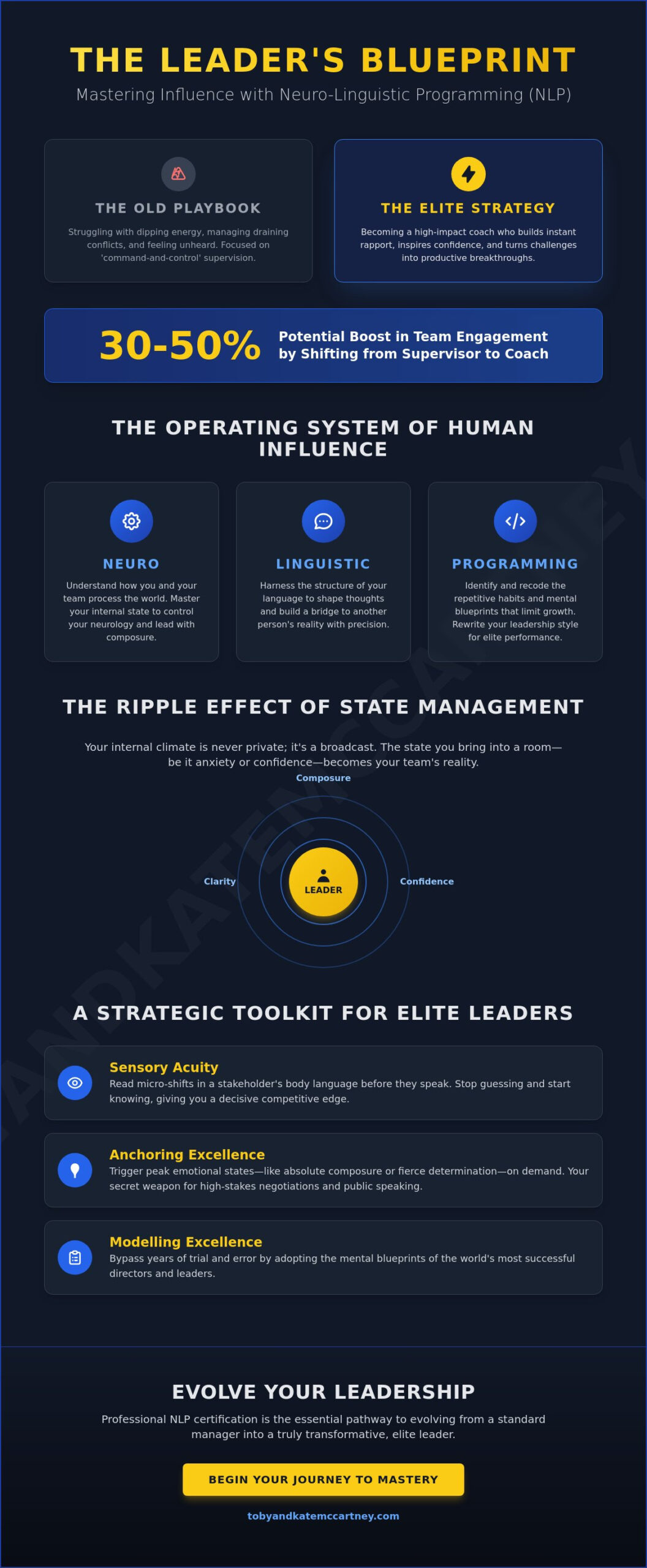
By the time you finish this guide, you will understand how to harness Neuro-Linguistic Programming to rewrite your leadership identity and achieve emotional mastery under pressure. We’ll explore the strategic shift from being a ‘command-and-control’ supervisor to becoming a high-impact coach; a transition that research suggests can boost team engagement by 30 to 50 percent. You’re about to discover the secret weapon of communication that allows you to build instant rapport with stakeholders and turn draining conflicts into productive breakthroughs. Let’s begin your journey toward becoming a visionary strategist who leads with precision and power.
Key Takeaways
- Master the psychological architecture of influence to move beyond traditional management and rewire your leadership behaviour for elite performance.
- Learn to command your internal state to create a powerful ripple effect that inspires confidence and composure across your entire organisation.
- Harness specific NLP techniques for leadership to build strategic rapport and develop the sensory acuity needed to read micro-shifts in team dynamics.
- Transition from problem-focused reactions to an outcome-focused framework that reframes every challenge into a strategic opportunity for growth.
- Discover why professional NLP certification is the essential pathway to evolving from a standard manager into a truly transformative, elite leader.
The Psychology of Influence: Why NLP is the Modern Leader’s Secret Weapon
Stop viewing leadership as a series of spreadsheets and task lists. It’s time to step into the architecture of excellence. Most managers focus purely on what they say; elite leaders focus on how the brain hears it. This is where Neuro-linguistic programming (NLP) becomes your ultimate advantage. It is the study of how human beings structure their experience and, more importantly, how you can influence that structure to drive world-class performance. It isn’t just a toolkit. It is the operating system for human influence.
Why does traditional leadership training fail so often? It’s simple. Most courses teach you the “what” without addressing the underlying neurological patterns that drive “how” people actually behave. You can’t fix a software glitch by shouting at the monitor. You need to access the source code. By mastering NLP techniques for leadership, you gain the ability to recode the mental blueprints that dictate team culture and individual motivation. You move beyond managing tasks to mastering the very psychology of your organisation.
This focus on the psychological architecture of a business is central to the work at Intact Academy, an international institute that specialises in executive and team coaching to drive lasting organisational change.
The 2026 leadership landscape demands this shift. As AI takes over diagnostics and data, your value lies in your ability to connect, inspire, and persuade. Research shows that 94% of employees would stay longer at a company that invests in their development. However, 70% of that learning is lost without the right psychological reinforcement. NLP bridges this gap by ensuring your communication lands with precision and sticks. To further support your team’s adaptation to new technologies, you can learn more about Achieve With Nate Movement and their personalised digital confidence coaching.
Decoding the Neuro-Linguistic Connection in Business
The ‘Neuro’ element is your gateway to understanding how you and your team process the world through your senses. It’s about your internal state. If you aren’t in control of your own neurology, you cannot lead others. ‘Linguistic’ refers to the structure of your language and how it shapes the thoughts of those around you. It’s more than vocabulary; it’s the bridge to another person’s reality. Finally, ‘Programming’ is the process of identifying and recoding the repetitive habits that limit your growth. You aren’t stuck with your current leadership style. You can rewrite it.
The ROI of Psychological Mastery
Mastery isn’t a “soft skill”. It is a commercial imperative. When you apply NLP techniques for leadership, you reduce the friction of conflict and accelerate the speed of rapport. Imagine the competitive edge gained from sensory acuity. This is the ability to notice micro-shifts in a stakeholder’s body language before they’ve even spoken. You stop guessing and start knowing. By modelling excellence, you bypass years of trial and error. You adopt the mental blueprints of the world’s most successful directors. This is how you achieve an elite level of influence that others can only envy.
Mastering the Internal Game: NLP State Management for High-Stakes Leadership
Your state is the hidden engine of your performance. It’s the sum of your thoughts, feelings, and physiology at any given moment. Elite leaders understand that their internal climate is never private; it’s a broadcast. This ripple effect means your anxiety or confidence becomes the team’s reality. Mastering NLP techniques for leadership starts with the realisation that you are responsible for the energy you bring into the room. If you enter a high-stakes negotiation feeling defensive, you’ve already lost. You must organise your internal world before you can hope to lead the external one.
When you master your state, you stop being a victim of your environment. You become the architect of it. This isn’t about “positive thinking”. It’s about the precision-engineered control of your neurology. By consciously choosing your state, you ensure that your decisions are born from clarity rather than stress or fear. This psychological foundation is also the cornerstone of building resilience in leadership, ensuring you can sustain peak performance even when the pressure is relentless.
Anchoring Excellence: Accessing Peak States on Demand
Anchoring is your psychological shortcut to peak performance. It allows you to trigger a specific emotional state-like absolute composure or fierce determination-at will. For high-stakes public speaking or board negotiations, this is your secret weapon. To create a leadership anchor, follow these steps:
- Identify the desired state, such as unshakeable confidence or calm authority.
- Recall a vivid memory where you felt this state intensely. Relive the sights, sounds, and feelings.
- At the peak of that intensity, apply a unique physical trigger, such as pressing your thumb and forefinger together.
- Release the trigger, break your state, and repeat the process until the touch alone evokes the feeling.
A Resourceful State is the non-negotiable prerequisite for every leadership decision you make. We also need to address “unproductive anchors.” Think about the specific sound of an email notification that makes your stomach drop. That’s an anchor you didn’t choose. By collapsing these triggers and replacing them with resourceful responses, you reclaim control of your professional environment. If you want to dive deeper into these psychological shifts, working with a professional leadership mentor can accelerate your results.
Perceptual Positions: The Secret to Strategic Empathy
Strategic empathy isn’t about being “nice”; it’s about having better data. Most managers get stuck in their own perspective, but elite leaders use NLP techniques for leadership to view a situation through three distinct lenses:
- The 1st Position: You see through your own eyes, focused on your objectives, needs, and values.
- The 2nd Position: You step into the shoes of the stakeholder. What are they afraid of? What drives their behaviour? You gain the “data” of their experience.
- The 3rd Position: You become the detached, objective observer. You look at the interaction between the first two positions without emotion.
This third position is crucial for conflict resolution. It provides the objective clarity needed to navigate complex office politics or intense negotiations. This 360-degree view ensures you don’t just react; you strategically pivot based on a complete map of the psychological landscape.
Beyond Communication: Rapport, Modelling, and the Language of Influence
True leadership isn’t about popularity. It’s about influence. Whilst average managers aim to be liked, elite leaders use NLP techniques for leadership to build strategic bridges that drive results. This begins with sensory acuity. It is the ability to notice the micro-shifts in a team member’s physiology-a slight change in breathing or a subtle tightening of the jaw-that signals their true internal state. When you can read the room with this level of precision, you stop guessing. You start leading with absolute certainty. You move beyond surface-level conversation and begin to influence the underlying psychological patterns that dictate team performance.
Modelling is your shortcut to this elite level of success. Instead of spending decades through trial and error, you can identify the specific mental blueprints and behaviours of the world’s most successful directors. By modelling their internal strategies, you can install those same excellence patterns within yourself. This isn’t imitation; it’s the strategic acquisition of mastery. It allows you to accelerate your growth at a pace that traditional training simply cannot match.
Strategic Rapport: Mirroring, Matching, and Leading
Authentic rapport is the currency of influence in British business culture. It’s more than just physical mirroring. To truly command a room, you must match a person’s values and their ‘Meta-Programs’-the deep-seated filters they use to process information. Once you’ve established this deep connection, you can use the ‘Pace-Pace-Lead’ formula. You start by pacing their current reality. You acknowledge their concerns and match their energy. Once the bridge is built, you lead them toward your vision. It’s a seamless transition that turns resistance into enthusiastic alignment.
The Meta-Model: Precision Language for High-Performance Teams
Corporate vague-speak is the enemy of execution. Team reports are often filled with deletions, distortions, and generalisations that hide the root cause of project delays. The Meta-Model is your linguistic scalpel. By using specific NLP techniques for leadership, you can ask precision questions that cut through the fluff. When a team member says, “The project is failing,” you don’t panic. You ask: “Specifically, which part is failing, and compared to what standard?”
This level of clarity does more than solve problems. It expands your team’s ‘Map of the World’. By challenging their linguistic limitations, you unlock their creativity and empower them to see solutions they previously ignored. You transition from a manager who gives orders to a leader who facilitates breakthroughs. This is the hallmark of a high-performance culture where communication is clear, persuasive, and always focused on the outcome.
Implementing NLP: A Strategic Framework for Leading High-Performance Teams
Knowledge alone doesn’t create elite leaders. Integration does. Most executive training programmes offer theories that evaporate the moment a crisis hits. To truly excel, you must embed NLP techniques for leadership into your daily operational rhythm. This means moving beyond reactive management and adopting a strategic framework that prioritises outcomes over obstacles. You aren’t just solving problems; you’re architecting a culture of continuous excellence where every setback is processed as valuable data for the next breakthrough.
The transition from a standard manager to an NLP-empowered leader requires a shift in your internal filter. You must master the “Hierarchy of Ideas.” This allows you to “chunk up” to maintain a big-picture vision that inspires your team, whilst “chunking down” to the granular details of execution when precision is required. By fluidly moving between these levels, you ensure that your strategic vision never loses its practical edge. For those stepping into management roles without formal preparation, our dedicated leadership training for managers UK skills guide provides the essential psychological tools to bridge that gap.
Outcome-Based Thinking: The 5 Questions for Every Meeting
Stop wasting time in meetings that dwell on “why” things went wrong. Shift your team’s neurology toward the future by using the Outcome Framework. Before any project begins, or when a meeting stalls, ask these five questions:
- What do we want? Define the positive outcome specifically.
- How will we know we have it? Identify the sensory evidence-what will you see, hear, and feel?
- What resources do we have? Audit your internal talents and external tools.
- What is the context? Clarify where, when, and with whom this outcome is relevant.
- What is the first step? Identify the immediate call to action to build momentum.
Reframing: Changing the Meaning to Change the Result
Your team’s performance is dictated by the meaning they attach to events. Reframing is the leader’s primary tool for resilience, allowing you to instantly shift the team’s focus from the weight of a problem to the potential of a solution. Content Reframing involves finding the hidden value in a perceived failure. For instance, a “failed” product launch becomes a high-speed market research phase that saved the company from a £100,000 mistake later. Context Reframing involves moving a “stubborn” employee into a role where their persistence and refusal to back down become their greatest assets, such as in high-stakes contract auditing.
By creating a feedback loop that reinforces excellence rather than punishing errors, you build a high-performance environment that thrives on psychological safety and innovation. If you’re ready to master these frameworks in a professional setting, our leadership training programmes provide the immersive environment needed for true integration.
Elevate Your Leadership: The Journey to NLP Mastery with Toby and Kate McCartney
You’ve explored the architecture of influence. You’ve seen how state management and precise language can redefine your professional impact. But there’s a profound difference between understanding NLP techniques for leadership and embodying them in every high-stakes interaction. Passive learning only takes you so far. To step into the elite tier of 2026 leaders, you must move from intellectual curiosity to professional mastery. This is the moment you stop being a manager who reacts to the corporate weather and start being the leader who creates the climate.
Self-study is just the beginning. True mastery requires the kind of immersive experience that recodes your baseline behaviours. The Toby and Kate McCartney approach is high-energy, results-oriented, and designed for those who refuse to settle for “good enough”. We provide a pathway that is both rigorous and transformative, ensuring that every technique becomes a natural extension of your leadership identity. Our certifications are recognised by the Association of Integrative Psychology (AIP) and are CPD accredited, providing you with a globally respected seal of excellence. It’s about attaining a level of skill that makes your influence feel effortless.
From Practitioner to Trainer: Your Path to Influence
The journey to elite leadership follows a specific, high-impact track. Each level builds upon the last to ensure your growth is sustainable and deep-rooted:
- The Practitioner Level: This is where you master your own internal game. You’ll learn the foundational NLP techniques for leadership that allow you to build instant rapport and command your own emotional state under pressure.
- The Master Practitioner Level: Move into advanced modelling and systemic leadership. This level includes our 7-day intensive training event at our villa in Turkey, where you’ll learn to identify and install the psychological patterns of world-class achievers.
- The Trainer Level: Become the source of excellence. At this stage, you aren’t just using NLP; you’re teaching it, becoming a catalyst for transformation across your entire organisation.
Step into Your New Identity Today
Your mind is your most valuable asset. In an era where AI handles the routine, your ability to influence, lead, and inspire is the only true competitive advantage. Don’t leave your growth to chance. Passive learning is a slow road to mediocrity. Immersive training is the fast track to the elite. 2026 is the year to invest in the psychological mastery that will define the rest of your career. Discover our NLP Practitioner Certification and start your journey today. It’s time to unlock your full potential and lead with unshakeable conviction.
Step Into Your Elite Leadership Identity
Mastering the psychology of influence is no longer a luxury; it is the definitive edge for the modern executive. You’ve discovered how to command your internal state, build strategic rapport, and use reframing to turn obstacles into breakthroughs. These NLP techniques for leadership represent the vital transition from standard management to elite mastery. They allow you to lead with a precision that others simply cannot replicate. You now possess the blueprint for a leadership style that is both authoritative and deeply empowering.
With over 20 years of transformative coaching experience, we understand the specific pressures of high-stakes leadership in the UK. Whether you require specialised public speaking programmes to command the boardroom or advanced NLP Trainer Training to inspire your entire organisation, the pathway to excellence is open to you. It’s time to stop observing the game and start architecting it. You have the inherent value and the drive to be a catalyst for significant professional shifts.
Unleash your leadership potential-explore our NLP Practitioner Certification today. Your journey to becoming an elite influencer starts with a single, decisive step toward your new identity. We’re ready to guide you toward a level of success that is as practical as it is profound. Step into your greatness and lead with conviction.
Frequently Asked Questions
How can NLP techniques improve my leadership style immediately?
NLP improves your leadership style immediately by giving you direct control over your internal state and sensory acuity. You’ll stop reacting to external pressures and start choosing your response with precision. By applying NLP techniques for leadership, you can enter any negotiation with unshakeable composure. This shift in energy is felt instantly by your team; it creates an environment of confidence and stability that traditional management often lacks.
Is NLP for leadership just a form of manipulation?
NLP is a tool for strategic influence and ethical communication rather than manipulation. It’s about creating win-win scenarios where the leader’s goals align with the team’s values. When you use these tools with integrity, you aren’t forcing behaviour. You’re removing the psychological barriers that prevent people from doing their best work. Authentic leadership requires the ability to connect deeply, and NLP provides the architecture for that connection.
What are the most effective NLP techniques for public speaking?
Anchoring and the Outcome Framework are the most powerful tools for commanding a stage. Anchoring allows you to trigger peak confidence at will, ensuring you never falter under the spotlight. Meanwhile, the Outcome Framework ensures your message is structured for maximum impact and clarity. You’ll move from just delivering information to driving a specific, desired change in your audience’s mindset and behaviour.
How does NLP help with conflict resolution in the workplace?
NLP resolves conflict by using Perceptual Positions to move beyond a single point of view. It allows you to step out of your own perspective and see the situation through the eyes of the other party or a neutral observer. This objective clarity dissolves the emotional charge of the disagreement. It turns a draining argument into a strategic problem-solving session where both parties feel heard and understood.
Can NLP help me build better rapport with my board of directors?
You can build exceptional rapport with your board by matching their specific Meta-Programs and core values. Boards often operate on high-level strategic filters. If you speak their language of big-picture outcomes, you’ll find your proposals are accepted with far less resistance. This isn’t just about being liked; it’s about demonstrating that you understand their reality and are aligned with their ultimate objectives.
How long does it take to see results from NLP leadership training?
You will see immediate results in your personal composure and communication clarity from the very first session. Whilst foundational shifts happen quickly, true mastery of NLP techniques for leadership develops over the course of a dedicated certification pathway. Most leaders report a significant increase in team engagement and a measurable reduction in their own stress levels within the first few weeks of consistent application.
What is the difference between NLP and traditional executive coaching?
NLP focuses on the neurological “how” of behaviour, whilst traditional executive coaching often focuses on the “what” of goals and tasks. Traditional coaching might tell you to be more confident. NLP gives you the specific internal process to actually create that confidence. It’s the difference between being told where to go and being given the high-performance vehicle and the map to get there.
Is NLP certification necessary for business leaders?
Professional certification is essential for leaders who want to move beyond surface-level tricks to genuine psychological mastery. A Practitioner or Master Practitioner Certification ensures you have the depth of knowledge to handle complex human dynamics safely and effectively. It provides the credibility and the high-level skillset required to act as a catalyst for excellence within elite corporate environments.