
What if the tension currently slowing your team down is actually the secret weapon you’ve been waiting for to unlock their true potential? You’ve likely felt the weight of constant bickering and the nagging worry that your response might be perceived as too aggressive or perhaps not firm enough. Mastering conflict resolution for leaders in 2026 requires a fundamental shift from managing symptoms to understanding the deep psychological structures of human influence. It’s time to stop playing the referee and start acting as the catalyst for excellence.
This article promises to show you exactly how to use advanced NLP-driven techniques to transform workplace friction into professional breakthroughs that command respect. We’ll explore the journey of re-patterning difficult behaviours and mastering the psychology of influence. You’re about to step into a version of leadership where every disagreement becomes a pathway to greater impact and a more cohesive, high-performing culture. Prepare to turn your most challenging team members into your most productive assets whilst maintaining your authority with ease. This is your pathway to becoming a visionary strategist who thrives amidst complexity.
Key Takeaways
- Learn how to harmonise differing internal maps of reality to ensure your behaviour during a clash strengthens your long-term influence.
- Understand the psychological filters that drive tension and how to look beyond surface-level behaviours to the core values at play.
- Discover why traditional mediation fails and how to master conflict resolution for leaders by moving from temporary compromise to transformative psychological shifts.
- Acquire specific NLP-driven tools like Pacing and Leading to build instant rapport and uncover the positive intent behind team disagreements.
- Prepare to integrate these elite communication strategies into your daily leadership routine through advanced mentorship and executive coaching.
Why Conflict Resolution for Leaders is the Ultimate Test of Authority
True authority isn’t granted by a title; it’s forged in the moments when your team is at odds. In 2026, the benchmark for excellence has shifted. Leading in the UK now demands a high-EQ, psychologically-aware approach that moves beyond simple mediation. Effective conflict resolution for leaders is the ability to harmonise differing ‘internal maps’ of reality. We all perceive the world through unique filters of experience and belief; conflict arises when these maps clash. Your behaviour during these high-stakes moments determines your long-term influence. If you simply ‘manage’ the situation, you’re merely applying a temporary plaster to a deep wound. Transformative resolution, however, re-patterns the underlying communication, turning a moment of crisis into a foundation for lasting respect.
Redefining Workplace Friction as a Strategic Opportunity
Friction is often a signal that your current business structure has hit a ceiling. When team members disagree, they’re inadvertently highlighting flaws in processes or communication channels that you might have missed. Instead of viewing these clashes as a nuisance, see them as a catalyst for innovation. A well-navigated disagreement forces a team to articulate their ‘why’ and refine their ‘how’. It’s your opportunity to use high-stakes influence to bridge the gap between opposing views. By mastering this advanced communication skill, you can turn a flat ‘no’ into a collaborative ‘how’, ensuring that the resulting solution is more robust than any single individual could have devised alone.
The Hidden Cost of Avoidance in Executive Leadership
Many leaders fall into the trap of ‘keeping the peace’ to avoid uncomfortable conversations. Whilst this might feel easier in the short term, it’s a fast track to a toxic culture of resentment and whispered grievances. Unresolved tension acts like a parasite on your team’s collective focus, draining productivity and diverting energy away from your primary objectives. When you step back from these moments, you’re not being ‘kind’; you’re being negligent. Leadership avoidance is the primary driver of turnover. By failing to address the elephant in the room, you lose the respect of your highest performers who crave clarity and decisive action. Mastering the psychology of influence ensures you can step into these conversations with confidence and grace.
The Psychology of Disagreement: Understanding the ‘Internal Map’
In the world of Neuro-Linguistic Programming, we often say that the map is not the territory. This is a foundational principle for effective conflict resolution for leaders. It means that the reality we experience isn’t the objective world itself, but a mental representation filtered through our unique history, values, and beliefs. When two colleagues witness the same project delay, one might see a catastrophic failure whilst the other sees a vital learning opportunity. Neither is ‘wrong’ in their own mind. They’re simply operating from different internal maps. As a leader, your role is to act as the Master Cartographer. You don’t just judge the maps; you align them to find a route forward that serves the collective mission. This psychological depth is what separates the average manager from the transformative visionary.
Recognising Different Perceptual Positions
To navigate these clashing maps, you must master the art of shifting perceptual positions. The 1st Position is your own perspective; it’s where you feel your emotions and needs. The 2nd Position involves stepping into the shoes of the other person to understand their ‘map’ from the inside. Finally, the 3rd Position is the Observer; a detached, neutral viewpoint. Mastering this shift allows for instant empathy and clarity. During a heated board meeting, being able to step into the 3rd Position provides the secret to professional analysis. It removes the sting of personal attacks and lets you see the structural breakdown occurring in real-time. This detachment isn’t about being cold. It’s about maintaining the clarity required to lead when others are losing their heads. You become the calm centre of the storm, capable of seeing the path that remains hidden to those trapped in their own emotional responses.
How Filters and Beliefs Shape Team Behaviour
Underpinning every conflict are ‘meta-programmes’. These are the deep-seated mental filters that drive how your team processes information and makes decisions. Some people are ‘towards’ motivated, focusing on goals, whilst others are ‘away-from’ motivated, focusing on avoiding risks. When these communication styles clash, it isn’t a personality defect; it’s a structural mismatch. Identifying these patterns allows you to speak directly to someone’s internal logic, making your influence irresistible. For those ready to dive deeper into these psychological drivers, exploring an NLP Master Practitioner Certification offers the elite tools needed to decode team dynamics at a cellular level. It’s about moving from guessing why people act to knowing exactly how to re-pattern their responses for peak performance. If you want to truly command the room, you must understand the invisible architecture of the mind.
Tactical vs Transformative: Why Traditional Mediation Often Falls Short
Traditional mediation is often nothing more than a polite exercise in ‘meeting in the middle’. This is a tactical error that misses the psychological mark. In the McCartney ‘Mastery’ approach, we don’t look for a middle ground that leaves everyone lukewarm; we seek a higher ground that serves the ultimate mission. Most standard agreements collapse within three months because they only address the surface complaint without touching the underlying root belief. Effective conflict resolution for leaders isn’t about getting people to tolerate each other. It’s about re-aligning their psychological drivers so they genuinely want to collaborate. If you don’t shift the belief, the destructive behaviour will inevitably return.
Moving Beyond Surface-Level Compromise
Splitting the difference is a dangerous game that often results in a ‘lose-lose’ scenario where both parties harbour secret resentment. Traditional models tend to ignore the emotional subtext, treating professional adults as if they just need a temporary ceasefire. This surface-level fix is why tension persists long after the HR meeting ends. By utilising advanced communication skills training, you learn to identify the positive intent hidden behind the friction. You move from a state of managed tension to one of strategic synergy, where win-win outcomes become a psychological reality rather than just a corporate buzzword.
The Power of NLP-Driven Communication Patterns
The secret to resolving deep-seated clashes lies in bypassing the ‘critical factor’—that part of the mind that stays defensive and guarded during a disagreement. Traditional questions like “Why did you do that?” only trigger justifications and blame, forcing people to dig their heels in. Instead, switch to “How” questions that direct the brain towards solutions. “How can we structure this so both objectives are met?” Linguistic flexibility is a leader’s greatest asset, providing the psychological agility to adapt communication until the desired result is achieved. When you change the language pattern, you change the emotional state, turning a ‘difficult’ person into a productive team member without ever needing to pull rank.
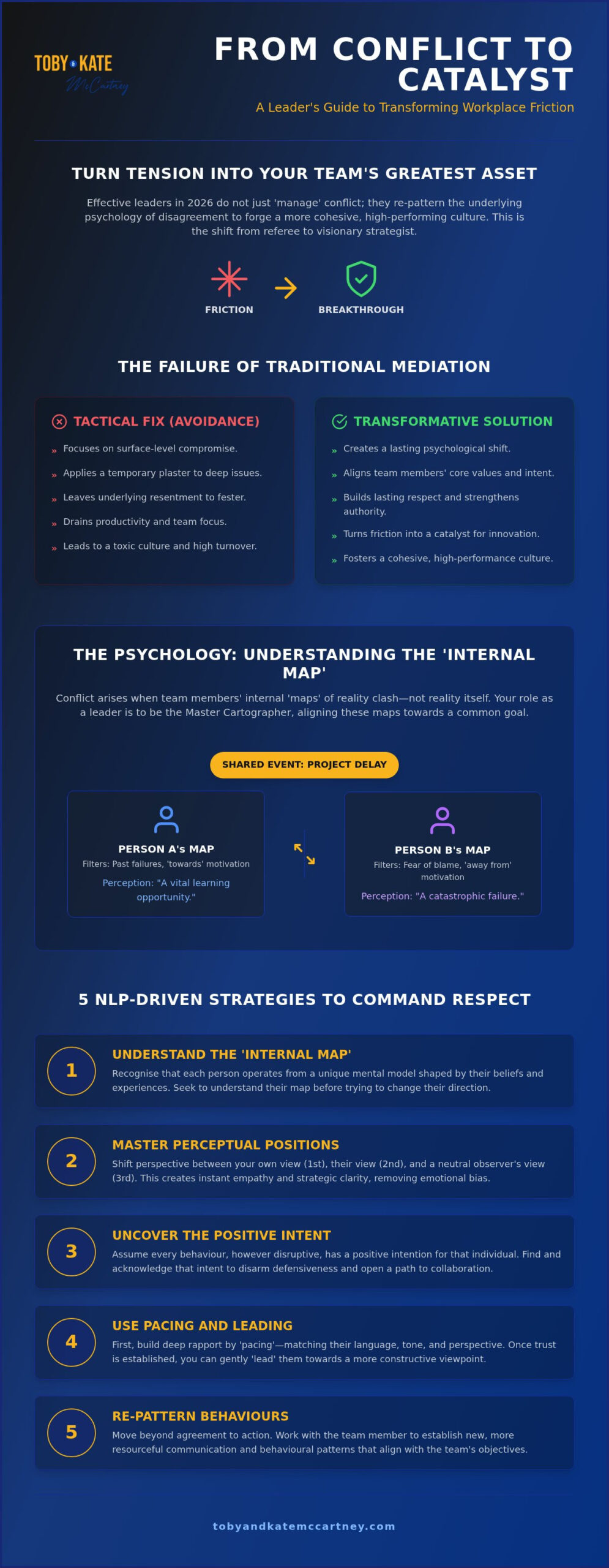
5 NLP-Based Strategies to Resolve Conflict and Command Respect
Stop trying to ‘fix’ your team members and start leading their psychological states. When you master these five strategies, conflict resolution for leaders becomes an elite skill set rather than a stressful chore. These techniques allow you to bypass resistance and guide your team toward a shared vision with surgical precision.
- Strategy 1: Pacing and Leading. You cannot lead someone if you aren’t first standing where they are. Match their energy, tone, and even their breathing patterns to build deep, subconscious rapport. Once you’ve ‘paced’ them, you can ‘lead’ them toward a calmer, more productive state.
- Strategy 2: The ‘What Else?’ Pattern. Conflicts often mask deeper issues. By asking “What else is important to you about this?”, you uncover the positive intent behind the friction, allowing you to address the root cause rather than the symptom.
- Strategy 3: Anchoring. This is the art of setting a specific emotional state. Before you enter a room, you must anchor yourself in a state of absolute confidence and calm.
- Strategy 4: Reframing. Change the frame and you change the game. This involves shifting how a situation is perceived so that a ‘problem’ becomes an opportunity or a vital lesson.
- Strategy 5: Future Pacing. Mentally rehearse the successful resolution with your team. By describing a future where the conflict is resolved and the team is thriving, you create a psychological ‘pull’ toward that outcome.
Master Your Internal State Before Intervening
Your internal state is the thermostat for the entire room. If you enter a heated discussion feeling drained or defensive, your team will mirror that behaviour. Use anchoring to trigger a state of ‘attainable excellence’ instantly. This is achieved by recalling a moment of total mastery and physically ‘triggering’ that feeling, perhaps through a specific breath or posture. Your physiology is your most potent tool; stand tall, breathe deeply, and occupy your space. Your state is far more contagious than your words during a crisis. If you remain unshakeable, the tension amongst your team will naturally begin to dissipate as they look to you for emotional cues.
Using Reframing to Shift Team Perspective
Reframing is about changing the context or the meaning of a behaviour. Context reframing involves moving a specific behaviour to a situation where it is actually useful. For instance, a team member’s ‘stubbornness’ might be reframed as ‘unwavering persistence’ when dealing with difficult clients. Meaning reframing changes what the conflict signifies for the project’s success. You might reframe ‘slow progress’ as ‘meticulous quality control’ that ensures a flawless launch. This doesn’t mean ignoring reality; it means choosing the most empowering interpretation of it. When you shift the meaning, you shift the energy of the entire team. Ready to master these elite communication tools? Explore our leadership training programmes to transform your influence today.
Elevating Your Leadership Journey with Expert Mentorship
Mastery of conflict resolution for leaders is not a destination; it is a continuous evolution of your professional identity. To truly command respect in 2026, you must move beyond the theoretical and integrate these psychological tools into your daily pulse. This level of expertise is a prerequisite for those seeking executive coaching and mentoring at the highest levels. When you work with a mentor who has already navigated the complexities of high-stakes influence, you gain more than just knowledge. You gain a refined perspective that allows you to see the invisible threads of human interaction. It’s time to transition from someone who simply ‘knows’ about NLP to a leader who embodies certified mastery in every conversation, ensuring your impact is felt long after you leave the room.
Integrating Conflict Mastery into Your Professional Identity
Elite leaders don’t wait for a crisis to practice their communication; they invest in their own psychological development continuously. By making these strategies part of your core behaviour, you develop an ‘unshakeable’ reputation that precedes you. People will know you as the leader who remains centred whilst others falter, turning chaos into a structured path forward. This personal shift creates a powerful ripple effect across your entire organisation. When you change how you respond to friction, you implicitly give your team permission to do the same. You aren’t just fixing a dispute; you’re architecting a culture of excellence where tension is transformed into momentum. This is the hallmark of a visionary who understands that their personal growth is the ultimate ceiling for their team’s potential.
Bespoke Coaching for Ambitious Leaders
Every industry carries its own unique pressures and communication hurdles. One-to-one mentorship allows you to customise these advanced NLP techniques for your specific team challenges and personal goals. Whether you’re managing board-level disagreements or navigating the complexities of a rapidly growing startup, bespoke guidance accelerates your progress in ways a textbook never could. You’ll learn to apply the ‘Master Cartographer’ mindset to your specific territory with surgical precision. For those ready to lead with absolute certainty and unlock their full potential, our Business Leadership Training UK provides the specialised pathway you need. Stop reacting to the world and start shaping it through the power of mastered influence. Your journey to mastery begins with the decision to step into your most capable self today.
Step Into Your Power as a Masterful Influencer
You’ve discovered that true authority isn’t about avoiding friction; it’s about mastering the internal maps that drive it. By shifting from tactical mediation to transformative psychological alignment, you turn every disagreement into a strategic breakthrough. Mastering conflict resolution for leaders means you no longer just manage tension; you lead the energy of the entire organisation with absolute certainty. Since 2003, we’ve empowered leaders through psychological mastery and accredited NLP Trainer Training to achieve exactly this level of professional excellence. The journey from being a reactive manager to an unshakeable visionary starts with a deep commitment to your own psychological development. It’s time to unlock your hidden potential and command the respect you deserve in every board meeting and team interaction. Take the first step towards leadership mastery with our NLP Practitioner Certification. Your future as an elite communicator is waiting for you to claim it. You have the inherent value; now it’s time to master the influence.
Frequently Asked Questions
What is the most effective conflict resolution style for leaders?
The most effective style is transformative collaboration, where you seek to align the differing internal maps of everyone involved. Instead of forcing a compromise that leaves both parties feeling lukewarm, elite leaders use a psychological approach to find a higher purpose. This ensures conflict resolution for leaders results in long-term synergy. You’re not just stopping a fight; you’re architecting a new way for the team to function together with shared values.
Can NLP really help in resolving serious workplace disputes?
NLP is a master-level tool for decoding the invisible drivers of human behaviour. It allows you to identify the specific filters and meta-programmes that cause people to clash. By re-patterning these underlying communication structures, you can resolve disputes that traditional HR methods often miss. It’s about moving beyond surface-level complaints to address the root beliefs. This ensures the resolution is both deep and permanent rather than a temporary ceasefire.
How do I handle a conflict between two high-performing employees?
When high-performers clash, it’s often due to competing visions of excellence. Start by validating their positive intent for the project. Use reframing to show how their differing perspectives are actually complementary assets. By shifting them from a competitive frame to a collaborative one, you harness their combined energy for innovation. Your role is to act as the Master Cartographer, showing them a map where both of their territories can coexist and thrive.
Is it better to intervene in a conflict immediately or wait?
Timing is a strategic choice, but your internal state is more important than speed. If the situation is escalating and damaging morale, intervene once you’ve anchored yourself in a state of calm authority. Waiting too long allows resentment to fester, whilst acting too soon in a reactive state can worsen the friction. Aim to step in when you can lead the team’s emotional state toward a solution, ensuring the intervention is controlled.
How can I remain neutral when I am personally involved in the conflict?
Use the NLP concept of perceptual positions to step into the third position, the neutral Observer. This mental shift allows you to view the situation with detached clarity, as if you were a consultant watching the interaction from the outside. It removes the emotional sting and lets you see the structural breakdown. By mastering this shift, you maintain your professional authority and ensure the resolution is based on strategic outcomes rather than personal feelings.
What are the common mistakes leaders make during conflict resolution?
The biggest mistake is splitting the difference, which often leaves both parties feeling unheard and resentful. Another common error is ignoring the emotional subtext and focusing only on the surface complaint. Leaders often fail to manage their own state before intervening, which causes them to mirror the team’s stress. Effective conflict resolution for leaders avoids these traps by addressing root causes and maintaining a high-energy, authoritative presence throughout the entire process.
How do I deal with a team member who is consistently argumentative?
Don’t fight their energy; pace it. Use pacing and leading to match their intensity before guiding them toward a more constructive tone. Often, consistent argumentativeness masks a deep-seated need for certainty or significance. By identifying the positive intent behind their behaviour, you can redirect that passion into high-stakes problem-solving. It’s about re-patterning their response so they feel valued whilst contributing to the team’s collective focus rather than disrupting it.