
The difference between a manager who maintains the status quo and a leader who defines the future isn’t their job title; it’s their mastery over the unseen psychology of the room. Do you ever feel like your vision is clear, yet your influence during high-stakes meetings remains muted? You aren’t alone. Most executives find themselves bogged down in day-to-day operations whilst their true potential for strategic impact remains untapped. It’s a common struggle. But it’s one you can overcome by embracing high-level transformational leadership training to shift your focus from management to mastery.
This article is your pathway to a new level of professional authority. You’ll discover the psychological and tactical skills required to command the boardroom, influence high-level decisions, and transform your leadership behaviour through the power of NLP. You’ll learn to speak with certainty and drive measurable organisational growth. We’ll explore the shift from operational “doing” to visionary “leading,” providing you with a secret weapon for the 2026 corporate landscape. It’s time to step into a more capable version of yourself and claim the respect your expertise deserves.
Key Takeaways
- Learn why the synthesis of visionary thinking and psychological mastery is the non-negotiable differentiator for C-suite success in 2026.
- Discover how to cultivate a strategic mindset that prioritises long-term ROI over daily operational tasks.
- Identify the specific triggers that signal you are “stuck in the weeds” and use transformational leadership training to pivot back to high-leverage priorities.
- Master the “Internal First” approach to leadership, ensuring your mindset shift precedes any tactical changes for lasting organisational growth.
- Uncover how the “Empowering Master” methodology uses NLP to help you command the boardroom and speak with absolute certainty.
What Is Transformational Leadership Training? The 2026 Standard
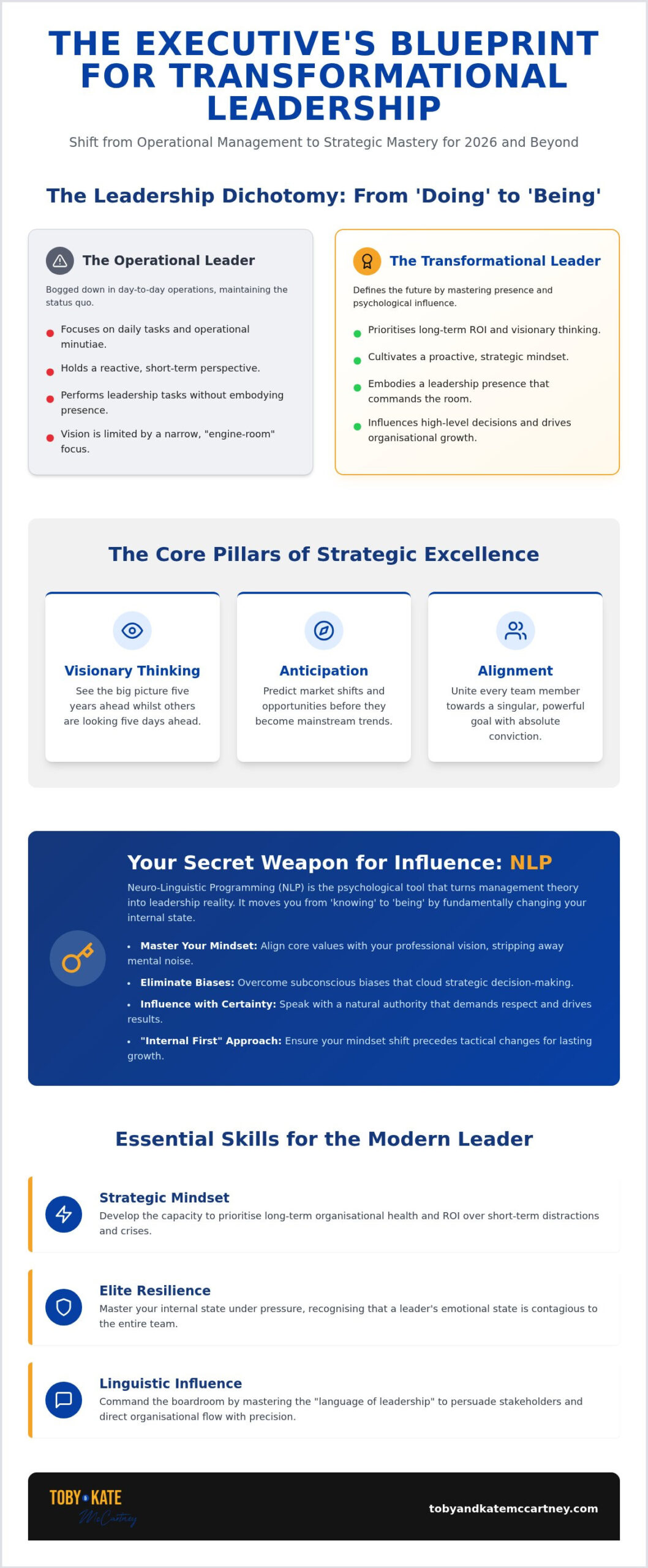
Leadership isn’t a checklist. It’s an identity. In 2026, the C-suite differentiator isn’t technical skill; it’s the capacity to command a room through presence and psychological mastery. This is the new standard. Effective transformational leadership training focuses on the synthesis of visionary thinking and deep-seated influence. You aren’t just learning to manage; you’re learning to be. What is Transformational Leadership? It’s a framework where your internal state dictates your external strategic impact. If your mind is cluttered with operational minutiae, your strategy will be limited by that same narrow focus. To lead at the highest level, you must master the psychology of the room and the psychology of yourself.
The shift from “operational doing” to “strategic being” is the most significant hurdle for senior leaders. It’s the difference between being the engine and being the navigator. When you are stuck in the engine room, you can’t see the horizon. Elite transformational leadership training forces you to step back. It challenges you to stop performing leadership tasks and start embodying a leadership presence. This transition is essential for anyone aiming for a C-suite role in 2026, where the ability to influence high-level decisions is more valuable than any operational output.
The Core Pillars of Strategic Excellence
To lead at the highest level, you must master three distinct areas that separate the elite from the average. First, visionary thinking allows you to see the big picture whilst your competitors are still squinting at the details. You need the clarity to look five years ahead when others are looking five days ahead. Second, anticipation gives you the edge to predict market shifts before they become mainstream trends. Finally, alignment ensures every member of your team moves towards a singular, powerful goal with absolute conviction. These aren’t just “soft skills.” They are the psychological bedrock of measurable organisational growth.
Why Traditional Models Fail Without NLP
Most management theories are built for a world that no longer exists. They are too rigid for the high-pressure, volatile environments of the mid-2020s. Subconscious biases often cloud strategic decision-making and risk assessment without the leader even realising it. This is where Neuro-Linguistic Programming (NLP) becomes your secret weapon. By aligning your core values with your professional vision, NLP helps you strip away the mental noise. It’s about changing your mindset before you change your tactics. When you master your internal state, you naturally speak with a certainty that demands respect and drives results. You stop trying to convince people and start naturally influencing them.
Essential Skills Developed in Transformational Leadership Training
Leading an organisation through a volatile market requires more than just grit. It demands a specific set of non-negotiable psychological tools. Elite transformational leadership training equips you with the ability to cultivate a “Strategic Mindset.” This is the capacity to prioritise long-term ROI and organisational health whilst your competitors are distracted by short-term noise. You’ve got to develop a lens that sees opportunity where others see crisis. You can’t achieve this level of impact if you’re constantly reactive. You must move from the front lines to the command centre.
Resilience is the silent engine of this transformation. As a leader, your emotional state is contagious. If you’re stressed, your team will be too. Learning to manage your internal state under pressure isn’t just a personal benefit; it’s a strategic necessity. Toby and Kate McCartney’s approach to these skills involves immersive, high-energy training. It’s designed to move you beyond “knowing” into “doing.” This is where you unlock your elite performance and start leading with a sense of self-worth that commands immediate respect in any environment.
Advanced Communication and Linguistic Influence
Commanding a boardroom requires mastering the “language of leadership.” It’s not just about the words you choose, but the psychological structures behind them. By integrating advanced communication skills training into your repertoire, you gain the ability to persuade stakeholders with surgical precision. NLP patterns allow you to overcome resistance during periods of intense organisational change. You stop fighting against the current and start directing the flow. This level of linguistic influence is your master key to impact. It ensures your vision isn’t just heard, but actively embraced by those who hold the power to implement it.
Decisiveness and Analytical Thinking
The 2026 standard for C-suite roles involves making high-stakes decisions with limited information. You won’t always have the luxury of a full data set. Essential Skills Developed in Transformational Leadership Training include the ability to balance analytical insights with a refined “gut feel.” This isn’t guesswork. It’s the synthesis of experience and sharpened intuition. NLP helps you tap into the psychology of certainty, allowing you to project confidence even when the path ahead is ambiguous. When you act with this level of conviction, you eliminate hesitation within your team. If you’re ready to refine these instincts, our leadership training provides the pragmatic strategies needed to bridge the gap between management and mastery.
Transformational vs. Operational Leadership: Knowing When to Pivot
Are you leading the charge or just managing the chaos? If you’re a senior leader in the UK, the pressure to produce immediate results can often pull you back into the engine room. This is the operational trap. You’re “stuck in the weeds” when you spend more time fixing today’s problems than designing tomorrow’s triumphs. To master transformational leadership training, you must adopt the “CEO Mindset.” This means your energy is reserved for high-leverage tasks that move the needle. Every hour you spend on a task your team could handle is an hour stolen from your organisation’s future.
Use a diagnostic checklist to assess your current focal points. If you answer “yes” to more than two of these, you’re likely over-managing and under-leading:
- Is your diary dominated by technical “how-to” meetings?
- Do you feel a sense of guilt when you aren’t “busy” with tasks?
- Is your team waiting for your sign-off on minor operational details?
- Is your primary focus on preventing failure rather than driving innovation?
The Operational Trap: Why Leaders Get Stuck
Solving immediate problems provides a fast dopamine hit. It’s satisfying to cross a task off your list. However, strategic thinking is a slow burn. It requires patience and a high tolerance for ambiguity. Many leaders struggle with a fear of delegation, believing that if you want it done right, you must do it yourself. This mindset is a growth killer. It limits your strategic output and creates a bottleneck. Understanding The Psychology of Influence helps you realise that your value lies in your vision, not your volume of work. Transitioning from a manager to a leader requires a dedicated shift, often best achieved through executive coaching and mentoring.
Balancing the Short-Term and the Long-Term
Maintaining operational stability whilst driving strategic change is a delicate act. You can’t just ignore the present. Instead, use “Strategic Sprints” to focus on high-impact 90-day goals. This approach allows for modern leadership behaviour that is both agile and visionary. When communicating strategic shifts to an operationally-focused team, always start with the “why.” Connect the long-term vision to their daily reality. This creates alignment and reduces the friction often caused by change. You aren’t just giving orders; you’re building a movement within your organisation. You’ve got to let go of the small stuff to claim the big wins.
How to Organise and Implement Your Leadership Journey
To support this balance, many executives look to accredited training from Yellowhouse to master the programme and portfolio management frameworks that underpin successful organisational transformation.
Elite performance isn’t an accident. It’s the result of a deliberate, structured journey. You can’t just wish for more influence; you have to build the psychological architecture to support it. This is where transformational leadership training moves from theory to reality. Most leaders fail because they try to change their tactics without changing their internal state. We call this the “Internal First” approach. By mastering your own mind, you create a foundation that makes strategic impact inevitable. It’s about aligning who you are with what you do.
Mentorship and peer-level feedback are the fuel for this growth. You need a mirror to see the blind spots in your own leadership behaviour. Without an external perspective, you’re just reinforcing old habits. Integrating strategic thinking into your daily professional routine requires discipline. It’s not a one-off event. It’s a series of small, identity-level shifts that compound over time to create a formidable presence.
Step 1: Master Your Internal State
Tactics are useless if you’re operating from a place of stress or doubt. You need the ability to reset your mindset before you even walk into the boardroom. Using NLP techniques, you can anchor states of absolute confidence and clarity on demand. This isn’t just about feeling better. It’s about developing an “Unshakeable Leader” persona through identity-level shifts. When you change your internal representation of a high-stakes situation, your external behaviour follows naturally. You stop reacting and start leading.
Step 2: Refine Your Influence and Public Speaking
Your vision is only as powerful as your ability to articulate it. There is an unbreakable link between public speaking for leaders and strategic authority. If you can’t pitch a vision that wins hearts and minds instantly, you’ll always struggle to gain buy-in from stakeholders. You must organise your message for maximum impact and minimal friction amongst peers. This requires a sophisticated understanding of linguistic influence. You aren’t just presenting data; you’re selling a future that people want to be part of.
Step 3: Continuous Mastery and Certification
The journey doesn’t end with a single seminar. In the competitive landscape of 2026, an NLP master practitioner certification is the ultimate credential for leaders. It proves you’ve mastered the psychology of excellence and possess a master-level skill set. Formal accreditation provides a rigorous framework for your growth whilst building a network of high-performing strategic peers. This community becomes your long-term support system. It offers the high-level “secret weapon” insights that keep you ahead of the curve. If you’re ready to start this journey, our leadership training provides the pragmatic roadmap you need to claim your place at the top.
The Path to Elite Leadership with Toby and Kate McCartney
Toby and Kate McCartney act as the catalysts for your professional shift, moving you from a state of management into a state of mastery. They don’t just teach leadership; they facilitate a total transformation of your identity. Their unique “Empowering Master” approach combines the weight of authoritative expertise with a nurturing, results-oriented mentorship style. By choosing this transformational leadership training, you’re gaining access to a master-level skill set that has been refined since 2003. It’s about more than just business; it’s about unlocking the elite performance that resides within you.
For the busy executive, time is the most precious commodity. The McCartney programmes are designed as multi-modal, flexible journeys that fit into a high-stakes professional life. Whether you are leading a multinational or refining your presence as an entrepreneur, these learning pathways bridge the gap between psychological theory and measurable organisational growth. You aren’t just learning concepts. You are implementing pragmatic strategies that yield immediate results in the boardroom.
Bespoke Leadership Training and Mentorship
Personalised one-to-one coaching offers a tailored experience for CEOs and high-level founders who require a confidential space to sharpen their strategic edge. For those leading smaller organisations, the leadership training for small business owners UK programmes provide a structured roadmap to professional authority. Every session is designed to instill a sense of self-worth and immediate confidence. The McCartney guarantee is one of attainable excellence, ensuring that your investment in yourself translates into tangible power and influence within your industry.
Your Next Step Towards Strategic Mastery
It’s time to step into a more capable version of yourself. Strategic mastery isn’t a destination you reach by chance; it’s a choice you make today. Breaking old, limiting patterns requires immediate, decisive action. You’ve seen the framework and understood the psychology. Now, you must decide if you’re ready to command the room with absolute certainty. You can book a personal consultation or join the next certification cohort to begin your own elite development process. The horizon is waiting for a leader with your vision. Don’t let another operational hurdle stand in the way of your strategic impact. Your journey to becoming an empowering master starts with a single, bold decision.
Step Into Your Future as a Visionary Leader
The transition from a manager who handles tasks to a leader who shapes industries requires a fundamental shift in your internal architecture. You’ve seen how the synthesis of visionary thinking and psychological influence defines the elite standard for excellence in 2026. By moving away from the operational weeds and adopting a CEO mindset, you reclaim your most valuable asset: your strategic focus. Elite transformational leadership training isn’t just about learning new tactics; it’s about embodying a persona that commands respect and drives measurable growth.
With over 20 years of measurable success, Toby and Kate McCartney provide the high-level certifications, including NLP Trainer Training, needed to master the psychology of influence. Their Empowering Master persona acts as a catalyst for professional shifts, instilling immediate confidence whilst providing the pragmatism required for boardroom success. It’s time to stop reacting to the present and start designing the future. You have the potential to lead with absolute certainty and impact. Start your journey to leadership mastery with Toby and Kate McCartney today and claim the authority your expertise deserves.
Frequently Asked Questions
What are the three most important strategic leadership skills for 2026?
Visionary thinking, anticipation of market shifts, and psychological alignment are the three pillars for success in 2026. These skills allow you to look beyond immediate operational hurdles and predict trends before they become mainstream. Mastering these ensures you aren’t just reacting to change but actively directing it. It’s about seeing the horizon whilst others are squinting at the details. This foresight is what separates elite performers from the average.
Can transformational leadership skills be learned, or are they innate?
These skills are absolutely learnable through structured development and intentional practice. Whilst some people possess natural charisma, true leadership mastery comes from understanding the psychology of influence and communication. High-quality transformational leadership training provides the pragmatic roadmap needed to shift your identity from manager to visionary. It’s a journey of growth rather than a fixed personality trait. You have the power to reprogram your leadership behaviour at any stage of your career.
How does NLP improve strategic thinking in a business context?
Neuro-Linguistic Programming (NLP) helps you identify and reprogram the subconscious biases that often cloud decision-making. It provides tools to align your internal values with your professional vision, ensuring your strategy is driven by clarity rather than habit. By mastering your internal state, you develop a high-level secret weapon for making high-stakes decisions with absolute certainty. It’s about changing your mindset before you change your tactics, making your strategic impact far more potent and precise.
What is the difference between a transformational leader and a tactical manager?
A tactical manager focuses on the “how” of solving today’s problems, whilst a transformational leader focuses on the “why” of the organisation’s future direction. Managers keep the engine running; leaders navigate the ship towards new horizons. The shift involves moving from operational doing to strategic being. Leaders use their influence to inspire teams and drive measurable growth, whereas managers primarily use authority to enforce existing processes and maintain the status quo.
How long does it take to develop advanced transformational leadership skills?
Development is an ongoing journey, but significant shifts often occur within 6 to 18 months of intensive study. For instance, a comprehensive NLP development pathway can span 18 months to achieve Master Practitioner and Trainer levels. The speed of your transformation depends on your commitment to breaking old, limiting patterns and implementing new behaviours in real-world boardroom scenarios. Immediate action is the catalyst for turning these elite skills into a permanent part of your professional identity.
Is public speaking coaching necessary for transformational leadership?
Yes, because your vision is only as powerful as your ability to articulate it with absolute certainty. Public speaking is the primary tool for commanding a room and winning hearts and minds instantly. Without the ability to pitch a vision persuasively, even the most brilliant strategy will fail to gain the necessary buy-in from stakeholders. It’s a non-negotiable skill for any leader who wants to drive significant organisational change and inspire a community of achievers.
How can I balance strategic planning with daily operational demands?
You must adopt a “CEO Mindset” and ruthlessly delegate operational tasks that don’t require your specific strategic input. Use techniques like “Strategic Sprints” to dedicate focused time to long-term goals whilst maintaining daily stability. Transformational leadership training teaches you to identify the triggers that pull you into the operational weeds. It provides the mental discipline required to stay focused on high-leverage activities, ensuring you spend your time on tasks that actually move the needle for your organisation.
Why is emotional intelligence considered a core transformational leadership skill?
Emotional intelligence allows you to navigate the complexities of modern workplace dynamics and foster psychological safety within your team. Leaders with high EQ can read the room, understand the nuances of human influence, and manage their own internal states under intense pressure. This self-mastery ensures that your presence remains a source of confidence for others during volatile periods. It’s the psychological bedrock that allows you to connect with, and ultimately lead, diverse groups of people toward a singular goal.