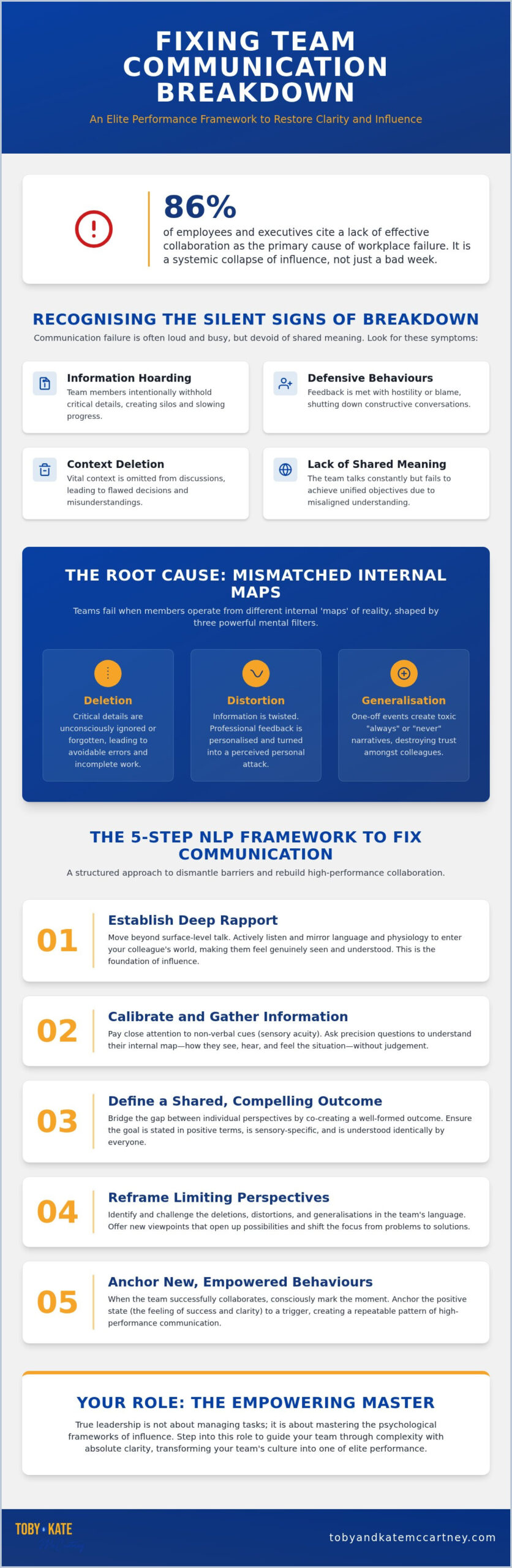
Did you know that 86% of employees and executives cite a lack of effective collaboration as the primary cause of workplace failure? When resentment builds and knowledge hoarding becomes the norm, you aren’t just facing a bad week; you’re witnessing a systemic collapse of influence. Learning how to fix communication breakdown in a team is the difference between a stagnant group and an elite, high-performance culture. It’s about mastering the internal maps that drive every human interaction.
You’ve likely felt the frustration of defensive behaviours during difficult conversations or watched whilst your best talent retreats into silence. It’s draining, it’s costly, and it feels like you’re constantly fighting an invisible friction. You deserve a team that operates with absolute precision. I promise to provide the psychological frameworks and assertive strategies required to bridge the communication gap and restore elite performance. We’ll explore how to dismantle defensive barriers and implement high-level influence techniques that turn impact into your team’s new standard.
Key Takeaways
- Recognise the silent symptoms of breakdown, such as information hoarding and defensive body language, whilst they are still manageable.
- Shift your perspective to see communication as a quest for “shared meaning” rather than simply the act of talking.
- Discover a high-impact, 5-step NLP framework detailing how to fix communication breakdown in a team and restore elite performance levels.
- Audit your team’s linguistic health to bridge the gap between surface-level talk and deep-structure understanding.
- Step into the role of an Empowering Master to lead your team amongst complex challenges with absolute clarity.
Recognising the Silent Signs of a Team Communication Breakdown
Most leaders mistake silence for the only sign of trouble. In reality, a communication breakdown is often loud, busy, and completely devoid of shared meaning. You might see your team talking constantly whilst failing to achieve a single unified objective. This happens because communication isn’t just about the transmission of data; it’s about understanding workplace communication as a psychological process where meaning is often lost in transit. When you’re investigating how to fix communication breakdown in a team, you have to look for the “silent” symptoms that traditional management ignores. These include information hoarding, defensive body language, and the systematic deletion of critical context. These behaviours aren’t just irritants; they are the gears of a failing engine.
Traditional team-building days at a local activity centre won’t solve this. Those events focus on surface-level rapport, yet they leave the underlying psychological filters untouched. You cannot fix a structural linguistic issue with a round of laser tag. A communication breakdown is a misalignment of internal maps that dictates team behaviour. To bridge this gap, you must step into the role of an Empowering Master who understands the mechanics of influence and precision.
The Cost of Deletion, Distortion, and Generalisation
Human brains use three primary filters to manage information: deletion, distortion, and generalisation. When deletion occurs, critical details of a project plan simply vanish from a team member’s awareness, leading to avoidable errors. Distortion occurs when a colleague personalises professional feedback, turning a simple process correction into a perceived personal attack. Generalisation creates toxic “always” or “never” narratives amongst colleagues, such as “Marketing never delivers on time.” Mastering these filters is the first step in learning how to fix communication breakdown in a team at a professional level. These filters ensure that even the clearest instructions are mangled before they can be acted upon. Gaining a broader perspective on how different languages structure meaning can help you recognise these patterns; read more about Korean grammar to see how another system manages linguistic clarity.
Why ‘Inherited’ Team Behaviours Persist
Communication styles often become anchored in a team’s culture over years. New managers often struggle to break these patterns because they are fighting legacy assumptions that predate their arrival. A fresh start requires more than a new rota or a revised meeting schedule. It demands a fundamental shift in linguistic patterns to reset the team’s rapport and break the cycle of dysfunctional inherited behaviours. You must challenge the existing anchors to create a space where elite performance becomes the only acceptable standard. True leadership is about guiding your team through a transformative journey toward absolute clarity.
The Root Causes: Why Smart Teams Stop Talking Effectively
Many consultants will tell you that communication fails because of a broken process or outdated software. They’re wrong. Process is merely a skeleton; your team’s internal maps provide the lifeblood of every interaction. When you are investigating how to fix communication breakdown in a team, you must realise that conflict isn’t usually about the “what,” but the “how” of perception. Smart teams stop talking effectively when they stop sharing the same reality. They retreat into individual silos, driven by internal filters that distort the collective mission.
High-stakes pressure often acts as the catalyst for this retreat. Under stress, an individual’s sensory acuity narrows. Instead of observing the nuances of a colleague’s intent, they start reacting to their own internal anxieties. This creates a “Rapport Gap” where team members stop influencing each other and start competing for psychological safety. Conflicting values amongst team members then create invisible barriers. If one person values speed whilst another values precision, they aren’t just disagreeing on a deadline; they’re clashing at a foundational level of their identity.
Mismatched Internal Maps of Reality
In the world of NLP, we operate from the principle that “the map is not the territory.” Your team members don’t react to reality itself; they react to their own internal map of that reality. These maps are built on sensory preferences. A Visual team member needs to “see” the big picture to feel confident. An Auditory colleague needs to “hear” the logic and sequence. A Kinaesthetic member needs to “grasp” the feel of the project. When a leader fails to align these maps, briefings are misunderstood and resentment grows. Achieving attainable excellence requires you to bridge these different worlds so everyone moves toward the same goal with absolute certainty.
The Breakdown of Trust and Rapport
Rapport is the ability to enter someone else’s world and make them feel understood. It’s the essential lubricant of any high-performance culture. When rapport breaks down, trust evaporates. Colleagues begin to take professional feedback personally rather than focusing on the facts. They see a critique of a process as a critique of their worth. This is where influence dies and defensive behaviours take over. To reverse this, leaders must gain the tools to decode these hidden signals and rebuild the connection from the ground up.
Mastering these dynamics is the secret weapon of elite leaders. You can’t just hope for better results; you have to engineer them. To bridge this gap effectively, many top-tier professionals seek advanced communication skills training to master the art of influence. If you’re ready to step into this level of mastery, our Leadership training provides the psychological frameworks needed to transform your team’s culture and restore impact.
Evaluating Your Current Strategy: Functional vs Dysfunctional Patterns
Leaders often mistake activity for progress. You might see a flurry of emails and Slack messages, but is your team actually understanding each other? To truly understand how to fix communication breakdown in a team, you must first audit your team’s linguistic health. This involves moving beyond “surface-level” talk, which is merely the exchange of data, and reaching a “deep-structure” understanding where intent and outcome align perfectly. Managing a conversation is a basic management task; mastering the influence within it is a master-level skill set. It requires you to challenge the status quo and step into a more capable version of yourself.
A functional strategy focuses on the quality of the connection, not just the quantity of words. You must look for linguistic deletions in briefings or generalisations that mask specific project risks. When you identify these patterns, you move from being a passive observer to an active catalyst for change. This shift is what separates the elite leader from the average manager. It is about unlocking the potential already present within your team whilst removing the psychological friction that slows them down.
Systems Failure vs Connection Failure
Is your breakdown due to a lack of tools or a lack of psychological safety? Many organisations throw more software at a problem that is fundamentally human. If your team members are hoarding knowledge, they are using it as a defensive mechanism. They are protecting their value because they don’t feel secure in the collective rapport. You must evaluate whether you are unintentionally rewarding individual “heroics” over collaborative clarity. Identifying these subtle cultural anchors often requires the external perspective provided by executive coaching and mentoring, which serves as an elite pathway to leadership mastery.
The ‘Difficult’ Team Member Myth
Stop believing the myth that some people are simply unmanageable. That is a passive stance that gives away your power. Reframe “difficult behaviour” as a specific communication style that hasn’t yet been met with the correct linguistic response. Every behaviour has a positive intention for the individual, even if the impact on the team is negative. By changing your own communication filters and state, you can change the team’s response. You have the power to neutralise toxic narratives and restore rapport amongst even the most fractured groups by mastering your own influence.
The 5-Step NLP Framework to Fix Team Communication
Don’t settle for passive reflection or vague team-building games that provide nothing but temporary relief. To truly understand how to fix communication breakdown in a team, you need an assertive, high-impact framework that resets the group’s psychological state. This isn’t about theory; it’s about shifting dynamics in real-time. By applying the “Meta-Model” to clear the fog of deletion and distortion, you regain control of the narrative. These techniques are the bedrock of an NLP practitioner certification UK, providing you with the master-level tools to command any room and lead with conviction. It’s time to step into a more capable version of yourself.
Step 1 & 2: Establishing Rapport and Sensory Acuity
Lower defensiveness instantly by matching and mirroring your team’s energy. If they are in a high-pressure state, meet them there before leading them to a calmer, more productive space. You must also develop the sensory acuity to spot a breakdown before it erupts into conflict. Watch for the subtle shift in breathing or the micro-expressions of frustration amongst your staff. Practise active curiosity. Instead of dictating, ask questions that invite clarity and reveal the hidden filters blocking progress. This proactive stance prevents small misunderstandings from becoming systemic failures whilst ensuring your influence remains absolute.
Step 3 & 4: Using Precision Language and Re-framing
Ambiguity is the enemy of execution. Apply the Meta-Model by asking “Who specifically?” or “How specifically?” whenever a briefing feels vague. This forces the brain to reconnect with the deep-structure of the information, removing the guesswork that leads to resentment. Re-frame conflict as “feedback” to shift the emotional state of the room. A disagreement isn’t a wall; it’s data about a process that needs adjustment. Precision language acts as a secret weapon for clearing project bottlenecks by ensuring every team member is operating from the same set of facts. For those looking to refine their team’s written precision, vocational training from the College of Media and Publishing provides the tools necessary for absolute clarity in communication.
Change only lasts if it’s anchored into the team’s daily rhythm. Create positive anchors for your meetings, perhaps through a specific opening ritual or a shared linguistic trigger that signals a move to solutions-mode. You want this new communication style to become the default pathway for the group. Consistency is key. For those at the helm of growing companies, leadership training for small business owners UK is essential to sustain these shifts whilst scaling. You are the catalyst for this transformation; own the process and watch the results follow.
Ready to master these influence techniques and lead your team to attainable excellence? Explore our NLP certification programmes to become the Empowering Master your business deserves.
Leading the Shift: Becoming an Empowering Master Communicator
You are the pivot point. To truly understand how to fix communication breakdown in a team, you must first look in the mirror and master your own internal state. Your team’s external reality is often a reflection of your own communication filters and emotional poise. You aren’t just a manager; you are the catalyst for a cultural revolution. Mastering your own psychological state ensures that your intent is never lost in translation. This is about stepping into a more capable version of yourself and leading from a place of deep conviction.
Transitioning from mere management to true empowerment requires a master-level skill set. It’s about moving beyond the “what” and mastering the “how” of human influence. To reach the pinnacle of this journey, many visionary leaders progress to an NLP master practitioner certification. This provides the ultimate level of influence, allowing you to dismantle complex psychological blocks and inspire attainable excellence in every interaction. You become the “secret weapon” your organisation needs to thrive amongst modern challenges.
Commanding the Room with Certainty
Advanced communication skills allow you to handle high-stakes talks with absolute poise. When the pressure is on, your team looks to you for stability and direction. By understanding the “structure of excellence” in others, you can tailor your message to resonate with every individual map in the room. This level of confidence isn’t just for the boardroom or the stage. There is a direct link between the techniques found in public speaking for leaders and the daily influence you exert over your team. You become a leader who commands attention through clarity, not just volume.
Your Journey to Influence and Impact
Fixing a communication breakdown isn’t a one-off task on a checklist. It is a lifelong commitment to professional mastery. The long-term ROI of investing in elite NLP and leadership training is found in the restored rapport and precise information sharing that defines a high-performance culture. You have the potential to be a catalyst for significant professional shifts within your organisation. Step into your potential. Lead with impact. The pathway to becoming an Empowering Master is open to those ready to take the first step toward total influence and elite team performance.
Step Into Your Role as an Empowering Master
You now possess the psychological blueprint to transform your team’s culture. Learning how to fix communication breakdown in a team isn’t about minor tweaks; it’s about a total shift in linguistic precision and sensory acuity. By dismantling the filters of deletion and distortion, you’ve moved from being a passive observer to an active catalyst for elite performance. This is your moment to claim the authority you deserve.
Since founding our practice circa 2003, we’ve focused on delivering measurable success through elite NLP training designed for high-level professional shifts. We’ve empowered leaders across the UK to achieve attainable excellence by mastering the hidden structures of human influence. It’s time to stop managing friction and start driving impact with absolute certainty.
Master the Art of Influence: Explore Our NLP Practitioner Certification Today
Your journey toward total leadership mastery begins with a single, assertive choice. Step into your potential and lead your team to the top.
Frequently Asked Questions
What are the first signs of a communication breakdown in a professional team?
The earliest indicators are often subtle shifts in linguistic health, such as information hoarding or the deletion of critical context during briefings. You might notice defensive body language or a sudden rise in “always” and “never” generalisations amongst colleagues. These signs suggest that the “shared meaning” within the group is fracturing. Addressing these cues early is the only way to prevent a total collapse of productivity and team morale.
How can NLP techniques help resolve conflicts amongst difficult team members?
NLP techniques allow you to bypass surface-level friction by addressing the underlying psychological filters that drive conflict. By understanding how to fix communication breakdown in a team at a structural level, you can use “re-framing” to turn personal attacks into neutral feedback. This shift changes the emotional state of the room, allowing “difficult” individuals to reconnect with the group’s objectives without feeling their personal identity is under threat.
Why do traditional team-building exercises often fail to fix communication issues?
Traditional exercises focus on temporary rapport through games whilst ignoring the deep-seated linguistic patterns that cause friction. A day at a local activity centre doesn’t address the “Rapport Gap” or the mismatched internal maps that dictate how people interpret instructions. Without mastering the mechanics of influence and precision language, any “feel-good” factor from team-building evaporates the moment the team returns to their high-pressure daily environment.
How can a leader improve rapport with a team that has become defensive?
Improving rapport starts with “matching and mirroring” the team’s energy to lower their psychological barriers instantly. You must shift from assertive management to active curiosity, asking questions that validate their perspective before leading them toward a solution. This process builds a bridge between your internal map and theirs. It demonstrates that you understand their world, which is the essential first step in restoring trust and elite performance.
What is the ‘Meta-Model’ in NLP and how does it help team clarity?
The Meta-Model is a set of linguistic tools designed to challenge deletions, distortions, and generalisations in speech. It helps team clarity by forcing speakers to move from vague “surface-level” statements to specific “deep-structure” facts. By asking precision questions like “How specifically?” or “Who specifically?”, you eliminate the ambiguity that leads to project bottlenecks. It acts as a secret weapon for any leader seeking absolute precision in their briefings.
How long does it take to see measurable results after fixing communication patterns?
Measurable results often appear within the first few high-stakes meetings once you implement a structured NLP framework. Whilst full cultural transformation is a journey, the shift in team state and the reduction in clarification time can be seen almost immediately. You’ll notice a decrease in defensive behaviours and a rise in precise information sharing. Consistency is vital to ensuring these new communication pathways become the default for the group.
Can one-to-one leadership coaching help me handle a notoriously difficult team?
Yes, one-to-one coaching provides the elite-level skill set required to navigate complex group dynamics with absolute poise. It allows you to master your own internal state and communication filters, which in turn changes how your team responds to you. By working with an expert mentor, you gain the psychological edge needed to neutralise toxic narratives and restore rapport amongst even the most fractured or resistant teams.
What is the difference between managing a team and influencing their communication?
Managing a team focuses on process and task completion, whilst influencing their communication focuses on the psychological drivers of human interaction. Influence is a master-level skill that allows you to shape the “shared meaning” and rapport within the group. It requires you to step beyond being a supervisor and become an Empowering Master who understands the structure of excellence. Mastery of influence ensures that impact remains the norm.