
What if the reason you’re currently struggling isn’t a lack of skill, but a mismatch of identity? Transitioning into leadership is often sold as a simple promotion, yet for many, it feels like a professional crisis. You’ve likely encountered the primary leadership challenges for new managers already. Perhaps you’re feeling like a “fake” when you give directions, or you’re drowning in burnout because you’re still doing the team’s work whilst trying to manage their output. It’s an exhausting cycle that leaves you questioning your authority and your future.
You deserve to lead with conviction and ease. This guide will show you how to transcend common managerial hurdles by mastering the psychological shift from individual contributor to high-impact leader. We will explore the art of commanding respect without falling into “bossy” stereotypes and reveal how to use influence as your secret weapon. By the end, you’ll understand how to achieve team targets whilst reclaiming your work-life balance through the power of internal mastery and elite communication.
Key Takeaways
- Recognise why your technical expertise can become a liability and learn how to navigate the profound identity shift from doing the work to leading the people.
- Master the psychological tools of influence to conquer the most common leadership challenges for new managers whilst building a culture of high performance.
- Gain the confidence to re-organise relationships with former peers and deliver difficult feedback without compromising your authority or team morale.
- Discover how to overcome the “Control-Mastery” trap by treating delegation as a psychological breakthrough that unlocks your team’s true potential.
- Understand why elite leadership is a continuous journey and how professional mentoring can provide the “secret weapon” you need for long-term success.
The Identity Crisis: Why the Transition to Management is a Psychological Hurdle
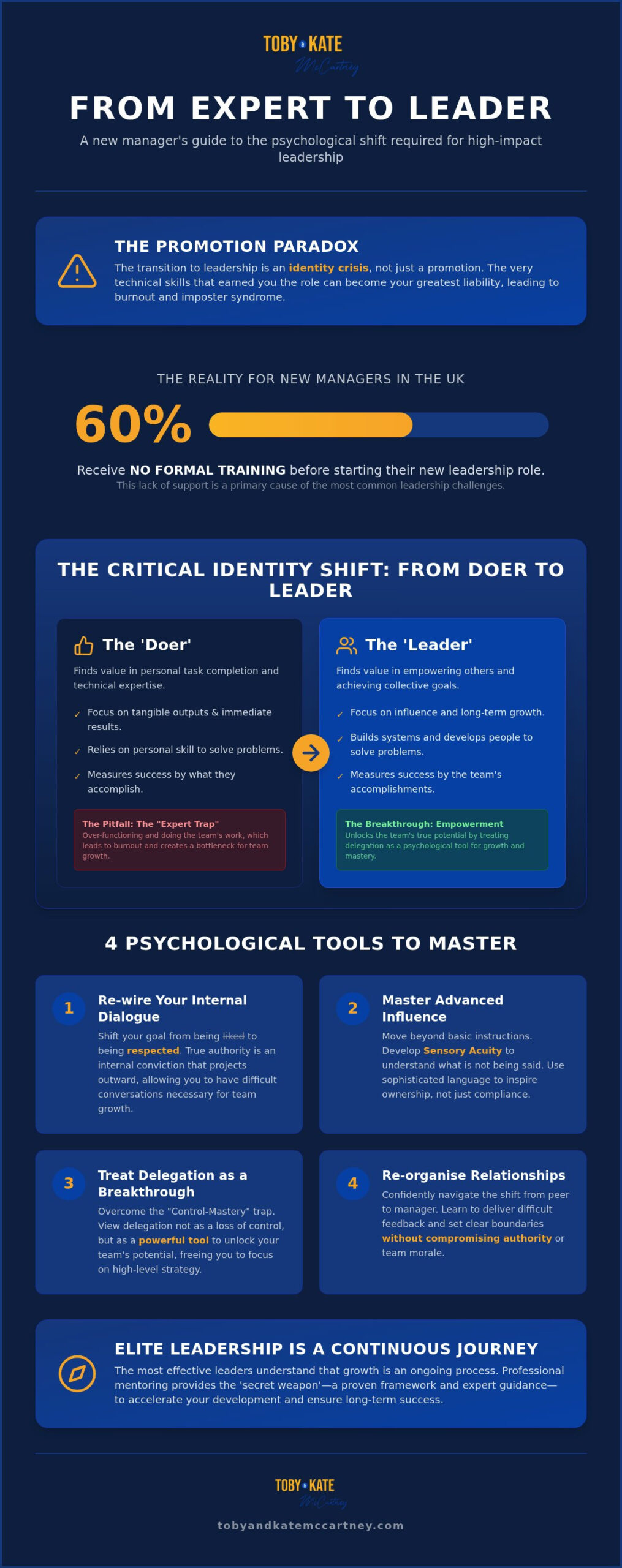
The promotion felt like a victory. The reality? It often feels like a mistake. You’ve spent years honing technical skills, yet suddenly, those very talents have become your greatest liability. This is the core of the leadership challenges for new managers. The shift isn’t just about a new job title; it’s a total psychological overhaul. Whilst your old role rewarded “doing”, this new role demands “being”. You must move from the comfort of tangible outputs to the complex world of human influence.
Gaining a foundation in understanding leadership theory provides essential context, but the lived experience is often dominated by imposter syndrome. In the UK, research suggests that 60% of new managers receive no formal training before starting their roles. This lack of support fuels the nagging feeling that you’re a “fake” in a position of authority. You aren’t failing because you lack talent. You’re struggling because you haven’t yet re-framed your professional identity for this new landscape.
This process of re-framing often requires a deeper exploration of self, which is why many leaders find value in the insights of Toria Candi Brown when looking to align their personal identity with their professional purpose.
The “Individual Contributor” Trap
Doing the work feels safe. It’s predictable. You tick a box and feel a hit of dopamine. Management, however, offers no such immediate gratification. You might spend all day coaching a team member and see no result for weeks. It’s easy to retreat into what you know. The “Expert Trap” is a psychological pitfall where new managers over-function by performing technical tasks themselves to feel valuable, rather than empowering their team to deliver. This over-functioning doesn’t just exhaust you; it creates a bottleneck that prevents your team from developing their own mastery. Breaking this addiction to immediate task completion is essential for your survival as a leader.
Re-wiring Your Internal Dialogue for Authority
Your internal dialogue dictates your external impact. If you’re constantly seeking “likability”, you’ll avoid the difficult conversations necessary for growth. You need to transition to earning “respect”, which requires a fundamental shift in your limiting beliefs. True authority doesn’t come from a title. It’s born from the internal conviction that you are exactly where you need to be. Using NLP techniques allows you to anchor confidence before team meetings, ensuring you project authority even when you feel uncertain. By consciously re-organising your mental map, you can overcome the most daunting leadership challenges for new managers and step into your role as a pragmatic strategist. It’s time to stop being the person who does the work and start being the person who inspires the excellence.
Developing this level of internal conviction often involves addressing the underlying psychological patterns that can hinder progress. For those seeking to deepen their self-awareness and emotional stability during such transitions, Inner Wisdom Psychotherapy offers evidence-based approaches to help individuals navigate the complex psychological demands of their professional lives.
Mastering Advanced Communication and Influence
Most management guides tell you to “be clear” or “listen more”. Whilst that’s decent advice for a novice, it barely scratches the surface of true leadership. To conquer the most persistent leadership challenges for new managers, you must realise that communication isn’t just about exchanging information. It’s about the response you elicit. If your team is disengaged or your instructions are met with “quiet quitting”, the issue lies in your influence strategy. This is why advanced communication skills training is no longer optional. It’s the master key that allows you to move from simply giving orders to using sophisticated language patterns that inspire ownership and drive performance.
The Power of Sensory Acuity and Rapport
Great leaders see what others miss. Sensory acuity is the ability to notice the subtle cues that signal team stress or disengagement before they become HR issues. A slight shift in a colleague’s breathing or a change in their vocal tone during a briefing tells you more than their words ever will. By matching and mirroring these micro-behaviours, you can build instant rapport amongst diverse personality types. This isn’t about mimicry. It’s about creating a subconscious alignment that fosters deep trust. When you master this, you’ll start hearing what is *not* being said in team meetings, allowing you to navigate high-stakes one-to-ones with a level of precision that commands immediate respect.
Influencing Upwards: Managing Your Own Manager
Your ability to lead is often dictated by how well you manage the people above you. One of the critical leadership challenges for new managers is finding your voice within the executive hierarchy. You must present your team’s successes in a way that captures executive attention and aligns with the company’s broader vision. Using NLP master practitioner certification principles, you can begin to decode the “meta-programs” of your stakeholders. Do they respond to big-picture ideas or granular data? Are they motivated by moving towards a goal or moving away from a risk? Understanding these internal drivers allows you to tailor your message so it lands with maximum impact every time.
Mastering these nuances transforms you from a supervisor into a strategist. It’s about developing the internal certainty to lead in every direction. If you feel ready to accelerate this journey, our leadership training offers the elite tools required to master the art of human influence.
Navigating Conflict and Performance Management
Conflict is not a sign of failure; it is a prerequisite for growth. If your team never disagrees, they aren’t innovating; they’re merely complying. One of the most visceral leadership challenges for new managers involves stepping into the heat of a dispute and emerging with a stronger team. This requires a level of emotional intelligence that goes beyond basic empathy. You must possess the internal stability to remain objective whilst others are losing their cool. Mastery in this area means you no longer fear difficult conversations. Instead, you view them as essential checkpoints on the journey to excellence.
A sophisticated tool for resolving these deadlocks is the NLP “Perceptual Positions” technique. This involves mentally stepping into three distinct viewpoints: your own, the other person’s, and that of a detached, neutral observer. By physically or mentally shifting between these spots, you gain a 360-degree view of the friction. This breakthrough prevents the “us vs them” mentality that destroys productivity. It allows you to lead from a place of clarity rather than reactivity, ensuring that team disputes become opportunities for re-organising workflows rather than sources of lasting resentment.
The “Former Peer” Dynamic
Transitioning from the “inner circle” to the “leadership centre” is often the loneliest part of the promotion. You can’t be “one of the gang” and the person responsible for performance standards simultaneously. It’s vital to set new boundaries without losing your humanity. This might involve handling quiet resentment from colleagues who were passed over for your role. Don’t ignore the elephant in the room. Address it with high-energy transparency. Acknowledge the shift in the relationship and invite them to be part of the new vision. By earning respect through consistent behaviour, you’ll find that former friends can become your most loyal advocates.
High-Stakes Performance Conversations
Delivering feedback that fuels growth is an art form. Most managers fall into the trap of “feedback that fails” because they focus on past mistakes rather than future potential. You must structure reviews that empower. This involves noticing defensive behaviours amongst your staff and using rapport-building techniques to lower their guard. The 2026 alternative to the transparent “Feedback Sandwich” is the Direct-Alignment Model, which pairs radical candour with collaborative solution-mapping to ensure professional growth. When you lead with this level of precision, performance reviews stop being a box-ticking exercise and start becoming a catalyst for elite results. If you’re struggling with these transitions, our one-to-one coaching can help you master the internal state required for high-stakes leadership.
Strategic Delegation: The Art of Letting Go
Delegation is rarely a logistical problem. It’s a psychological one. Many find that one of the most stubborn leadership challenges for new managers is the visceral fear that if they aren’t personally “doing” the work, they aren’t providing value. This is the “Control-Mastery” conflict. You’ve likely been promoted because you were the best at your technical task, so your brain equates performing that task with professional safety. Letting go feels like handing over your reputation to someone else. Yet, if you don’t, you’ll hit a productivity ceiling that no amount of overtime can break through.
To lead effectively, you must delegate outcomes, not just tasks. When you give someone a checklist, you’re merely outsourcing labour. When you give them an outcome, you’re delegating authority and fostering growth. This shift builds a culture of accountability where team members own the results rather than just the actions. It moves the needle from mere compliance to genuine commitment, allowing you to focus on the high-level strategy that your new role demands.
Overcoming the “I Can Do It Better” Mindset
The long-term cost of micro-management is the total erosion of team initiative. If you step in every time a mistake is made, your team stops trying to solve problems. They simply wait for you to do it. You must use NLP to change your internal representation of “success”. Success is no longer about the perfection of the spreadsheet you built; it’s about the capability of the person you trained to build it. Moving from “Chief Problem Solver” to “Chief Empowerer” is the definitive breakthrough for any elite leader. It requires the courage to let others fail small so they can eventually win big.
The 5-Step Empowerment Framework
Empowerment requires structure. Without it, delegation is just abdication. Follow this framework to ensure success:
- Identify: Match the task to the individual’s current skill level and growth potential.
- Outcome-Setting: Define what “done” looks like with absolute clarity before they start.
- Boundaries: Establish the “freedom within a frame” where they have the authority to make decisions.
- Support: Provide the resources and mentorship needed to succeed whilst remaining available for guidance.
- Review: Schedule regular checkpoints to offer feedback whilst maintaining their autonomy.
Mastering this shift is what separates supervisors from true visionaries. If you’re ready to break free from the “doing” trap and step into your full authority, our leadership training provides the psychological blueprints for elite delegation.
Long-Term Mastery: Investing in Your Leadership Journey
The first twelve months in a management role are essentially a leadership lab. You’ve navigated the initial shock of the identity shift, but true mastery takes time. One of the greatest leadership challenges for new managers is the temptation to stop learning once the initial crisis has passed. You cannot afford to stagnate. Elite performance requires a personal development plan that transcends standard corporate HR requirements. It’s about seeking out the secret weapons of influence and psychological mastery that aren’t taught in basic induction sessions. You are building a career, not just filling a vacancy.
For those in the entrepreneurial space, leadership training for small business owners UK often requires a more agile, pragmatic approach than traditional corporate tracks. You aren’t just managing a team; you’re often building the culture from the ground up whilst keeping the business profitable. Whether you are in a boardroom or a growing startup, the transition from a competent supervisor to an elite leader is a continuous journey of refinement. It demands a commitment to your own evolution as much as your team’s output.
The Role of Mentorship in Accelerating Success
Sustaining high energy and resilience is the hallmark of the Empowering Master. You must learn to lead with absolute certainty whilst remaining open to the feedback that fuels growth. This persona isn’t a mask; it’s a profound integration of your skills and your identity. It’s the ability to hold a vision for your team even when organisational pressure is at its peak. By mastering your internal state, you become the catalyst for your team’s success. You move from being a manager who survives the day to a leader who defines the future.
Explore how Toby and Kate McCartney can accelerate your leadership journey today.
Step Into Your Full Leadership Potential
Leadership is far more than a job title; it’s a profound psychological evolution. You’ve discovered that the most persistent leadership challenges for new managers stem from the internal struggle between being a high-performing contributor and a high-impact leader. By mastering the art of influence, re-organising your mental maps for authority, and embracing strategic delegation, you can finally transcend the “Expert Trap” and step into true mastery.
Toby and Kate McCartney bring over 20 years of experience in NLP and leadership transformation to help you bridge this gap. We provide elite UK-wide mentoring for ambitious professionals who demand transformative results that go far beyond traditional management theory. It’s time to unlock your internal “secret weapon” and lead with undeniable certainty. Master your leadership mindset with Toby and Kate McCartney and begin your journey toward becoming an Empowering Master today. Your team is waiting for the leader you are destined to become.
Frequently Asked Questions
What are the top 3 leadership challenges for new managers in the UK?
The most pressing hurdles involve navigating the identity shift, mastering influence, and managing performance. Statistics show 60% of new managers receive no training, making these obstacles even more daunting. You must move from being a “doer” to a “leader” whilst balancing the needs of your team and the organisation. These are the core leadership challenges for new managers that define their first year of success or failure.
How do I handle managing former friends and peers without it being awkward?
Establish clear boundaries immediately whilst maintaining your humanity. It’s about re-organising the relationship from a social dynamic to a professional partnership. You don’t have to stop being friendly, but you must stop being “one of the gang” when decisions need to be made. Transparency is your best tool here; acknowledge the change openly to prevent resentment from festering amongst your former peers as you step into authority.
Why do most new managers struggle with delegation in their first year?
Most new managers suffer from the “Control-Mastery” conflict, where they equate their personal value with technical output. They fear that if they aren’t personally doing the work, they aren’t contributing. This psychological barrier leads to micro-management and eventual burnout. You must realise that your new “work” is developing others. Success now looks like your team achieving results without your constant intervention or correction.
Can NLP techniques really help me become a better leader?
NLP provides the master key to understanding the psychological drivers behind human behaviour and communication. It allows you to anchor confidence, build instant rapport, and use language patterns that inspire action. By mastering your internal state and decoding the motivations of others, you become a far more effective influencer. It’s a pragmatic toolkit for resolving the complex leadership challenges for new managers in high-pressure, modern environments.
How do I overcome imposter syndrome as a first-time manager?
Recognise that imposter syndrome is often a sign of growth rather than a lack of ability. You are stepping into a new identity, so it’s natural to feel like a “fake” initially. Focus on small wins and use NLP anchoring techniques to access a state of certainty before meetings. Professional mentoring and leadership training provide the external validation and skill set needed to silence that internal critic for good.
What is the most effective way to give difficult feedback to a team member?
Use the Direct-Alignment Model by pairing radical candour with collaborative solution-mapping. Avoid the outdated “feedback sandwich” which often confuses the message and dilutes the impact. Instead, state the observation clearly, explain the impact on team performance, and invite the team member to co-create the path forward. This empowers them to take ownership of their professional evolution rather than feeling attacked or deflated by your critique.
Should I focus on being liked or being respected as a new manager?
Focus on earning respect through consistency and fairness. Whilst it’s natural to want to be liked, prioritising likability often leads to avoiding difficult conversations and making weak decisions. Respect is a more stable foundation for leadership. When you lead with integrity and hold people to high standards, you’ll find that genuine likability often follows as a byproduct of your professional authority and your commitment to team success.
How long does it typically take to feel confident in a leadership role?
Confidence typically builds over the first 12 to 18 months, but the timeline varies based on the support you receive. The first year is a steep learning curve of trial and error. You can accelerate this journey significantly through elite mentoring and targeted certifications. True confidence isn’t about knowing all the answers; it’s about trusting your ability to navigate uncertainty and lead your team through it with poise.