What if your professional impact had nothing to do with your job title and everything to do with the invisible psychological threads you pull every day? You know the frustrating reality of sitting in a boardroom, offering a brilliant solution, only to have it ignored; whilst ten minutes later, a colleague repeats it to thunderous applause. It’s exhausting to feel invisible or to face constant friction when you’re simply trying to drive results. You deserve to be the person the room turns to for direction, regardless of where you sit on the organisational chart.
Mastering how to influence people at work isn’t about office politics or being “bossy”. It’s about psychological alignment and the precise application of NLP techniques that command respect naturally. I promise that by the end of this guide, you’ll possess the master key to winning approval for your projects and becoming a go-to person for leadership. We’re going to explore the elite frameworks and practical communication shifts that will transform you from an ignored observer into a high-impact professional who drives the agenda with confidence.
Key Takeaways
- Learn why traditional command-and-control fails in the modern workplace and how to shift to a “Power-With” model that eliminates resistance.
- Discover the specific NLP techniques for “Mirroring and Matching” to create instant physiological alignment and deep trust with any colleague.
- Master the “Agreement Frame” and assertive language patterns to neutralise friction during high-stakes meetings and move your ideas forward.
- Implement a proven five-step strategy on how to influence people at work by pacing their reality before leading them toward your desired outcome.
- Understand the critical link between emotional intelligence and professional impact to secure your position as a natural leader.
The Psychology of Influence: Why Traditional Command Fails in 2026
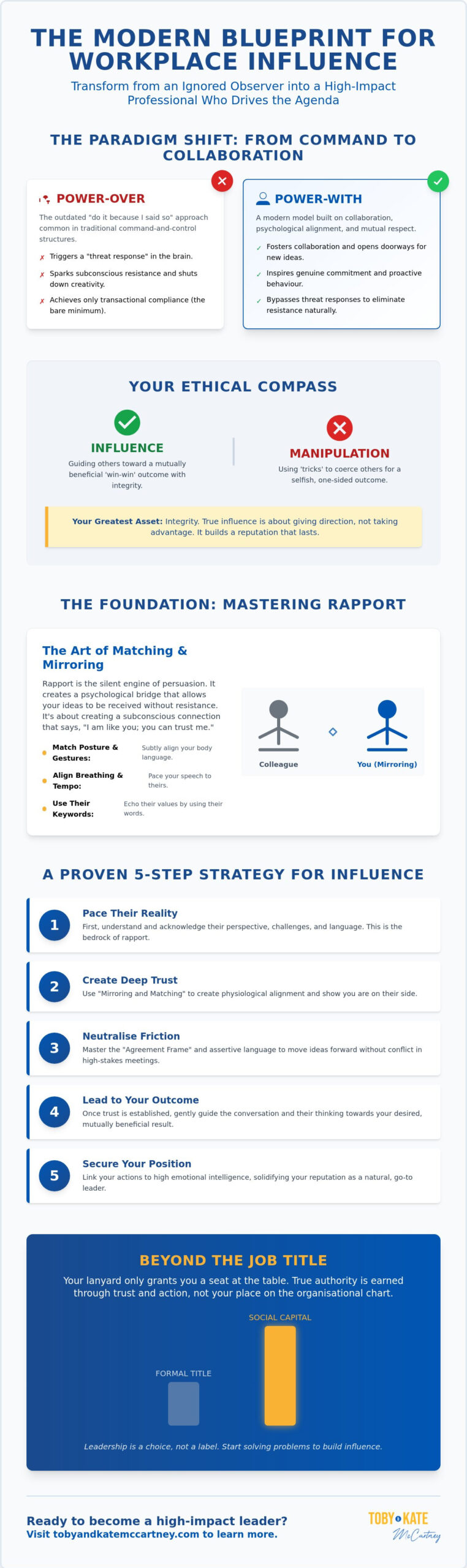
The corporate world has shifted. In 2026, the old “do it because I said so” approach is not just ineffective; it’s a liability. We have moved from an era of “Power-Over” to a culture of “Power-With”. This shift isn’t just a management trend; it’s a biological necessity. When you understand the psychology of social influence, you realise that direct commands often trigger a “threat response” in the human brain. The amygdala perceives a blunt order as an attack on autonomy, which immediately shuts down creative thinking and sparks subconscious resistance. You might get transactional compliance, where people do the bare minimum to avoid trouble, but you will never get genuine commitment that way.
Mastering how to influence people at work requires a deep level of self-awareness. You cannot lead others if you haven’t mastered your own internal state. Influence is an energetic exchange. If you enter a meeting feeling desperate or aggressive, your colleagues will mirror that tension. High-impact professionals in 2026 focus on becoming an influential presence first. They understand that their behaviour sets the “emotional thermostat” for the room. By staying calm and certain, you bypass the threat responses of others and open a doorway for collaboration rather than conflict.
The Myth of the Job Title
Your lanyard doesn’t give you authority; it only gives you a seat. In 2026, formal titles are the weakest form of influence available. Whilst a manager can demand a report, an informal leader can inspire a revolution. Informal leaders often drive the vast majority of organisational change because they operate on trust rather than hierarchy. You don’t need permission to lead. Stop waiting for a promotion to start making an impact. When you solve problems without being asked, you build “social capital” that is far more valuable than any corporate rank. Leadership is a choice, not a label.
Influence vs Manipulation: The Ethical Distinction
Is persuasion dirty? Only if your intent is selfish. True influence is a “win-win” psychological alignment where both parties move toward a better outcome. Manipulation is about taking; influence is about giving direction. Integrity is your greatest asset in this journey. If people suspect you are using “tricks” to get your way, your reputation will evaporate instantly. Using NLP for conflict resolution allows you to navigate high-stakes friction whilst maintaining strict ethical boundaries. It ensures that everyone leaves the table feeling heard, respected, and ready to take action. This is how to influence people at work with longevity and honour.
Mastering Rapport: The Foundation of Unspoken Influence
Rapport is the silent engine of persuasion. It isn’t merely about being “liked” or making small talk by the coffee machine; it is a profound state of mutual trust and responsiveness between two people. Without it, your most brilliant ideas will fall on deaf ears. With it, you create a psychological bridge that allows your suggestions to travel directly into the other person’s mind without triggering their internal gatekeeper. If you want to master how to influence people at work, you must stop focusing solely on your message and start focusing on the connection.
While many seek expert advice on influencing at work regarding high-level strategy, the real power lies in the physiological alignment you build in real-time. This is about more than just agreeing. It is about creating a shared reality where influence feels like a natural evolution of the conversation. When you are in rapport, the other person becomes more open to your perspective because, at a subconscious level, they feel understood and safe.
The Art of Matching and Mirroring
Match their posture. Align your breathing. If they speak slowly, slow down your own tempo. It’s about becoming a mirror that says, “I am like you; you can trust me.” Pay attention to their specific “keywords”, those recurring terms they use to describe success or frustration. When you feed these words back to them, you bypass their conscious filters and speak directly to their values. Avoid the trap of mimicry; mirroring should be subtle and delayed by a few seconds to remain natural. If they cross their legs, wait ten seconds before you do the same. This creates a subconscious bond rather than a conscious distraction.
Sensory Acuity: Reading the Unspoken
Sensory acuity is the ability to observe minute physical changes in others to guide your influence. You must develop an internal radar for the unspoken. Look for the tightening of a jaw, a shift in breathing, or a fleeting micro-expression that signals doubt before they even say a word. Calibration is the key. If you notice a colleague’s energy drop, stop pushing. Adjust your approach. You can even maintain rapport whilst delivering challenging news by matching their serious tonality before leading them toward a solution. This level of mastery is exactly what we explore in our leadership training, where you learn to read the room with surgical precision.
Language Patterns that Command Respect and Action
Words are the architects of your professional reality. If you’ve ever wondered how to influence people at work without a formal title, the answer lies in the linguistic structures you deploy. Most professionals weaken their authority before they’ve even finished their opening sentence. They use permission-seeking phrases like “I think” or “I feel”, which subconsciously signal a lack of conviction. To command respect, you must shift to assertive framing. Replacing “I think” with “I am certain” or “The data demonstrates” immediately changes the power dynamic in the room. You aren’t just sharing an opinion; you’re presenting a reality that others can align with.
Beyond simple assertion, you can guide team focus using presuppositions. These are linguistic “short-circuits” that assume a specific outcome is already inevitable. Instead of asking “If we hit our targets,” try saying “When we hit our targets, which department will benefit first?” By presupposing success, you bypass the debate about whether the goal is achievable and move the conversation toward the logistics of victory. This subtle shift in language determines your perceived level of authority and makes your leadership feel like a natural force of nature.
The Agreement Frame: Turning “No” into “Yes”
Resistance is often just a sign that someone doesn’t feel heard. The Agreement Frame is a master-level tool for bypassing this friction in meetings. It involves using phrases like “I appreciate that point” or “I agree with the importance of…” to validate a colleague’s perspective before redirecting the energy. Crucially, you must eliminate the word “but” from your vocabulary. “But” is a verbal eraser; it negates everything said before it. Replace it with “and”. For example: “I appreciate your concern about the timeline, and that’s exactly why we’ve streamlined the second phase.” You’ve validated them without surrendering your position.
Precision in Communication
Authority is leaked through filler words and unnecessary qualifiers. Terms like “just”, “kind of”, or “sort of” act as linguistic brakes on your momentum. Our advanced communication skills training focuses on refining this verbal impact to ensure every word serves a strategic purpose. You might also experiment with the Milton Model, using artfully vague language to invite consensus. By keeping the big-picture vision broad enough, you allow others to project their own values onto your idea, making it much easier to achieve a collective “yes” whilst maintaining your direction.
A 5-Step Strategy to Influence Any Project at Work
Execution is where theory meets reality. You’ve mastered the internal state and the language patterns; now you must apply a systematic framework to drive your initiatives forward. This five-step strategy is your blueprint for how to influence people at work when the stakes are high and the deadlines are tight. It moves beyond mere persuasion into the territory of psychological leadership, ensuring that your ideas aren’t just heard, but adopted as the collective priority.
- Step 1: Pacing. Validate the current reality of your colleagues. If the team is exhausted, acknowledge the workload. If a project is failing, state the facts plainly. You must enter their model of the world before you can hope to change it.
- Step 2: Calibrating. Measure the level of rapport and resistance in real-time. Are they leaning in, or have they crossed their arms? Use your sensory acuity to determine if you have “permission” to move to the next stage.
- Step 3: Reframing. Change the context of the problem. A problem is only a problem because of the frame it’s viewed through. Shift the perspective to reveal a solution that was previously invisible.
- Step 4: Leading. Once you have aligned with their reality, start moving the group toward your desired outcome. Because you paced them first, they will follow your lead naturally.
- Step 5: Future Pacing. Secure long-term buy-in by helping the team visualise the success of the initiative. Describe the positive outcomes so vividly that they can already feel the relief and pride of completion.
Pacing and Leading: The Influence Dance
You cannot lead someone if you aren’t standing next to them. Pacing is the act of meeting someone exactly where they are; mentally, emotionally, and linguistically. If a stakeholder has major objections, don’t argue. Pace their objection by saying, “I hear your concern about the budget, and I agree that fiscal responsibility is our top priority.” By pacing their reality, they feel understood. Only after this validation can you begin the subtle transition to taking command. If you lead too early, you create friction. If you pace for too long, you lose momentum. The mastery lies in the timing of the shift.
Reframing for Elite Impact
Reframing is the ultimate “secret weapon” for high-level influence. It involves taking a situation and giving it a new meaning. For example, a “budget cut” can be reframed as a “strategic focus on efficiency” that will actually make the team more agile. You can use a “Context Reframe”, where a behaviour that is seen as a weakness is shown to be a strength in a different setting. Alternatively, use a “Meaning Reframe” to change what a situation signifies. Mastering interpersonal skills at this level allows you to pivot group perspectives in seconds. It’s about being the person who defines the meaning of events for the entire organisation.
Ready to move beyond basic tactics and step into true professional mastery? Our NLP Practitioner Certification provides the deep-level training you need to apply these frameworks with surgical precision in every meeting you attend.
Stepping into Mastery: The Pathway to Leadership Influence
Mastery isn’t a destination that you reach and then stop; it’s a muscle that requires consistent, deliberate practice. You’ve explored the psychological frameworks and the tactical language patterns, but knowledge alone won’t move the needle. To truly master how to influence people at work, you must integrate these tools into your daily behaviour until they become second nature. It’s about moving beyond the “how-to” and becoming the person who naturally radiates authority. This transition requires a profound level of emotional intelligence for leaders, where you manage your own internal state as effectively as you manage the room. When you master yourself, you master the environment.
Long-term influence is the bridge between individual success and organisational leadership. Anyone can win a single argument; very few can shift the culture of an entire company. This is where your journey takes a significant turn. You stop being a contributor who happens to have good ideas and start being the visionary who defines the path forward. Professional certification plays a vital role here. It isn’t just about the credentials on your profile; it’s about the internal shift in authority that occurs when you know, with absolute certainty, that you possess a master-level skill set. You become the go-to person because your results are consistent and your presence is undeniable.
The Elite Pathway to Impact
NLP serves as the underlying operating system for elite communication. It provides the invisible structure for the work that happens before you even open your mouth. Seeking an NLP practitioner certification UK is the definitive step toward professional mastery. It’s the difference between guessing why a conversation went well and knowing exactly how to replicate that success. The most influential leaders in 2026 understand that their communication toolkit is never “finished”. They are constant students of human behaviour, always refining their ability to connect, persuade, and inspire whilst others are stuck in old patterns of command and control.
Your Journey Starts Today
You have a choice. You can return to the friction of being ignored in meetings, or you can claim your inherent value right now. Toby and Kate McCartney are here to act as the catalyst for your professional shift. We don’t just teach theory; we facilitate rapid, tangible transformations in how you show up and how you lead. It’s time to stop playing small. It’s time to command the respect you’ve already earned through your expertise. Step into a more capable version of yourself and start demonstrating how to influence people at work with the confidence of a true master. Your new professional life is waiting for you to take the first step.
Command Your Professional Future
The transition from feeling invisible in meetings to becoming a definitive leader doesn’t happen by accident. It’s the result of mastering the deep psychological nuances of rapport, assertive language, and strategic reframing. You now possess the essential blueprint for how to influence people at work by aligning with the reality of others before leading them toward a superior outcome. These aren’t just corporate tactics; they’re life-changing skills that ensure your voice is heard and your most ambitious projects are green-lit with enthusiasm.
Since 2003, we’ve dedicated over two decades of mastery to perfecting these methods for high-stakes professional environments. We’ve seen transformative results for thousands of leaders who decided to stop waiting for permission and started creating their own impact. If you’re ready to unlock your full potential and drive results with surgical precision, it’s time to take the next step. Discover how to master elite influence with our NLP Practitioner Certification and begin your journey toward professional mastery today. You already possess the value; now it’s time to ensure the room recognises it.
Frequently Asked Questions
How can I influence my boss when I have no formal authority?
You influence upward by aligning your suggestions with your manager’s primary objectives and pressures. Instead of presenting what you want, frame your idea as a solution to a problem they are currently facing. By pacing their reality and demonstrating how your proposal drives their specific KPIs, you become a trusted partner rather than just an employee. This shift in perspective turns you into an indispensable asset whose guidance is sought after.
Is it possible to influence people at work if I am an introvert?
Absolutely; introverts often possess superior sensory acuity, which is a massive advantage in reading a room. Influence isn’t about being the loudest person; it’s about the precision of your communication and your ability to build deep rapport. By listening more than you speak, you can identify the exact psychological levers needed to move a project forward with quiet, undeniable authority that extroverts often overlook.
What is the difference between influence and manipulation in a professional setting?
The distinction lies entirely in your intent and the outcome for the other person. True influence creates a “win-win” scenario where both parties benefit from the alignment. Manipulation is a self-serving tactic that ignores the other person’s needs. In 2026, transparency is vital; if you use your skills to empower others whilst achieving your goals, you build lasting professional capital and trust that manipulation would otherwise destroy.
How do I handle a colleague who is resistant to my influence?
Start by pacing their resistance rather than fighting it. Use the Agreement Frame to validate their concerns, saying “I appreciate your perspective on the risks,” before redirecting the energy toward a solution. Resistance is often a sign that the person doesn’t feel heard. Once they feel their reality is acknowledged, their physiological threat response lowers, making them far more open to your lead and eventual consensus.
What are the most effective NLP techniques for workplace influence?
Mastering how to influence people at work often begins with rapport-building techniques like mirroring and matching. Once a connection is established, using presuppositions and the Milton Model allows you to guide conversations toward consensus without triggering defensiveness. These tools create a seamless flow where your ideas feel like the natural next step for the entire team to take together, bypassing the friction of traditional command structures.
How long does it take to see results from using influence techniques?
You can see immediate shifts in responsiveness the moment you begin matching someone’s tonality or pacing their objections. However, building a reputation as a high-impact leader takes consistent practice over several weeks. As you refine your sensory acuity and linguistic precision, your ability to command respect becomes an effortless part of your professional identity that colleagues rely on daily for direction and clarity.
Can influence skills be learned, or are people just born with them?
Influence is a high-level skill set that can be mastered through deliberate practice and formal training. Whilst some people have a natural inclination toward persuasion, anyone can learn how to influence people at work by understanding the underlying psychological drivers of human behaviour. It’s like learning a new operating system; once you know the code, you can navigate any professional environment with total confidence and mastery.
How do I use influence to resolve conflicts within my team?
Use reframing to shift the team’s focus from the interpersonal friction to a shared external goal. By changing the meaning of the conflict from a “disagreement” to a “diversity of perspectives needed for a better solution,” you neutralise the emotional charge. This allows you to lead the team toward a collaborative outcome where everyone feels their contribution has been instrumental in the final success, fostering a culture of mutual respect.