What if the most stubborn “no” in your boardroom wasn’t a dead end, but actually the secret catalyst for your next strategic breakthrough? You’ve likely felt the frustration of a project stalling because of a negative departmental narrative or a stakeholder who simply refuses to see your vision. It’s exhausting to react emotionally to professional criticism when you know your ideas have merit. By mastering elite nlp reframing techniques for business, you’ll stop reacting and start commanding. You’ll gain the psychological tools to pivot a conversation’s energy instantly, turning every setback into a calculated advantage.
This isn’t about mere positive thinking. It’s about the precision-engineered ability to redefine reality itself. We’ll explore how to dismantle limiting beliefs and rebuild them into a framework of resilience and influence that sets you apart as a visionary leader. You’re about to discover how to wield linguistic mastery to ensure your voice isn’t just heard, but becomes the driving force behind every professional outcome. Step into a more capable version of yourself and learn to lead with conviction.
Key Takeaways
- Grasp the “Picture Frame” metaphor to shift your focus from limitations to possibilities without ignoring the reality of the situation.
- Master the strategic application of context and content reframing to influence stakeholders and change the energy of any professional interaction.
- Adopt powerful nlp reframing techniques for business through a six-step framework that identifies the positive intent behind counterproductive behaviours.
- Discover how “Sleight of Mouth” patterns allow you to dismantle objections and command boardroom conversations with linguistic precision.
- Transition from practising techniques to embodying the identity of a resilient leader who naturally pivots every setback into a strategic opportunity.
What is NLP Reframing? The Alchemy of Professional Perspective
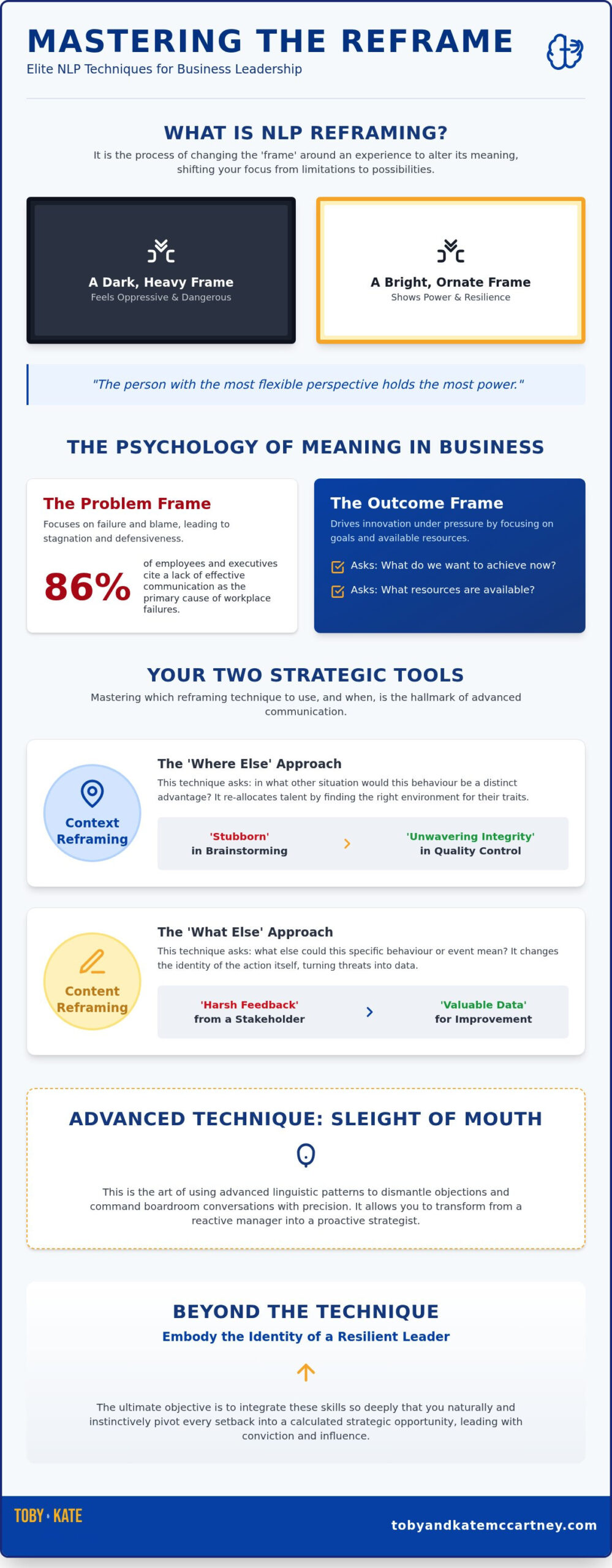
Imagine looking at a painting of a stormy sea. In a dark, heavy frame, it feels oppressive and dangerous. Place that same canvas in a bright, ornate frame, and it becomes a testament to nature’s raw power and the resilience of the vessels upon it. The content hasn’t changed, but your emotional response has. This is the essence of Neuro-Linguistic Programming (NLP) reframing. It’s the process of changing the ‘frame’ or context of an experience to alter its meaning entirely.
In the high-stakes world of British commerce, the McCartney philosophy is clear. The person with the most flexible perspective holds the most power. When you master nlp reframing techniques for business, you aren’t just ‘looking on the bright side.’ You’re performing a strategic pivot. Whilst denial ignores reality, reframing masters it by finding a more resourceful way to interact with the facts. It’s about command, not comfort.
The Psychology of Meaning in Business
Facts are neutral. A missed quarterly target or a resigned executive doesn’t have an inherent meaning until you apply a frame to it. Most teams get trapped in ‘problem frames.’ They focus on why things failed and who’s to blame. This leads to stagnation and a culture of defensiveness. Research indicates that 86% of employees and executives cite a lack of effective communication and collaboration as the primary cause of workplace failures. This often stems from conflicting frames of reality amongst leadership.
Visionary leaders use ‘outcome frames’ instead. They ask what they want to achieve now and what resources are available. This shift is what drives innovation under pressure. Reframing is the art of finding the opportunity hidden within the obstacle. It’s the difference between being a victim of circumstances and being the architect of your own success.
Why Elite Leaders Master the Reframe
Mastering the reframe is a foundational pillar of business leadership training UK. It builds an ironclad resilience amongst senior management, particularly during periods of market volatility. When the economic climate shifts, leaders who pivot the narrative from ‘threat’ to ‘market redistribution’ are the ones who capture new territory and maintain team motivation.
This skill is the ‘secret weapon’ for those pursuing NLP practitioner certification UK. It transforms you from a reactive manager into a proactive strategist. You’ll learn to command boardroom conversations by subtly shifting the focus of every stakeholder involved. It’s not just a technique; it’s a new way of being that unlocks your full professional potential.
Context vs Content Reframing: Choosing Your Strategic Tool
Mastery in the boardroom requires more than just knowing what to say; it demands knowing how to shift the very ground the conversation stands on. By deploying specific nlp reframing techniques for business, you can dismantle opposition before it even solidifies. There are two primary tools in your arsenal for this: context reframing and content reframing. Knowing which to use, and when, is a hallmark of advanced communication skills training. It’s the difference between a clumsy rebuttal and a surgical strike on a limiting belief.
Before you apply either, you must consider the ‘ecology’ of the reframe. A new meaning must be more than just clever; it has to be believable and beneficial for everyone involved. If the reframe doesn’t land as true, you lose rapport. When it does land, you don’t just change the topic. You change the reality of the room.
Context Reframing: The ‘Where Else’ Approach
Context reframing is about location. It asks: in what other situation would this behaviour be a distinct advantage? Imagine a team member who is frequently labelled as ‘stubborn.’ In a fast-paced creative brainstorming session, they might be seen as a bottleneck. However, if you shift that person into a compliance, audit, or quality control role, that ‘stubbornness’ is suddenly ‘unwavering integrity’ and ‘principled attention to detail.’ You haven’t asked them to change; you’ve changed where they stand. This approach allows you to re-allocate talent within your organisation based on actual utility rather than personality clashes. It’s a powerful way to turn a perceived departmental flaw into a strategic asset.
Content Reframing: The ‘What Else’ Approach
Content reframing is about identity. It asks: what else could this specific behaviour mean? Consider receiving ‘harsh’ feedback from a major stakeholder. A reactive leader feels attacked and becomes defensive. A master reframer sees a stakeholder who is ‘deeply invested in our long-term success’ and is providing a clear roadmap for improvement. By changing the meaning, you maintain departmental morale and focus on the solution rather than the sting. You can practice this today. Take a current business ‘problem’ and list three alternative meanings for it. Is a budget cut a ‘loss of resources’ or an ‘incentive for lean innovation’? Is market volatility a ‘threat’ or a ‘redistribution of opportunity’?
Integrating these psychological shifts into your daily routine is a core component of high-level leadership training. It ensures you remain the most resourceful person in the room, regardless of the challenges thrown your way. You stop being a victim of the narrative and start being its author.
The Six-Step Reframing Process: A Strategic Framework for Behavioural Change
To lead with absolute precision, you must understand that every counterproductive habit has a hidden, beneficial purpose. The Six-Step Reframing process is a robust psychological tool designed to upgrade these habits without losing the underlying benefit. It is a staple amongst high-achievers who refuse to let internal friction slow their progress. By applying these nlp reframing techniques for business, you move from fighting yourself to orchestrating your full potential.
The process begins with clarity. First, identify the undesirable behaviour, such as procrastinating on high-stakes reports. Second, establish communication with the ‘part’ of your psychology responsible for this habit. You must recognise that this part has a positive intent. Third, discover that intention. Is it trying to protect you from the risk of professional failure? Fourth, engage your ‘Creative Part’ to generate three new, more effective ways to achieve that same protection. Fifth, gain agreement from the original part to trial these new behaviours. Finally, perform an ‘Ecological Check.’ Ensure these new actions don’t interfere with your other business goals or values. This ensures your growth is sustainable and strategically sound.
Translating the 6 Steps for the Boardroom
This framework is equally transformative when applied to team dynamics. Consider a department resisting a new digital transformation programme. Instead of viewing them as obstacles, acknowledge their positive intent. They might be trying to safeguard current service levels or protect company stability. Professional reframing recognises that every departmental friction is simply a misaligned attempt at achieving success. By identifying the shared positive intent, you can guide the team to find three alternative ways to ensure stability whilst embracing the new technology. This shifts the energy from resistance to collaborative innovation and builds immediate trust.
Testing and Implementation
To ensure these shifts stick, use the ‘Future Pace’ technique. Spend a few moments visualising yourself successfully using your new behaviour in next week’s board meeting. See the reactions; feel the renewed confidence. This mental rehearsal bridges the gap between theory and boardroom reality. Monitoring the ROI of these behavioural shifts is essential for any leadership team. You’ll see it in reduced conflict, faster decision-making, and improved departmental morale. This rigorous framework is why reframing remains a core element of executive coaching and mentoring. It provides a repeatable, strategic pathway to leadership mastery that delivers measurable results.
Sleight of Mouth: Advanced Linguistic Reframing for Influence
Beyond the structural shifts of the Six-Step process lies the surgical precision of ‘Sleight of Mouth’. This system consists of 14 distinct linguistic patterns designed to instantly dismantle an objection or a limiting belief. It’s the ultimate toolkit for anyone using nlp reframing techniques for business to maintain control under pressure. Two of the most potent patterns in this arsenal are ‘Intent’ and ‘Redefine’.
The ‘Intent’ pattern involves addressing the positive purpose behind a stakeholder’s objection. If a board member questions your strategy, they aren’t necessarily attacking your vision; they’re likely trying to ensure the company’s financial security. By acknowledging that intent first, you lower their defences. The ‘Redefine’ pattern is equally powerful. It involves swapping a negative or restrictive word for a more resourceful one whilst keeping the core meaning intact. These patterns are essential for public speaking for leaders, particularly when you need to handle hostile Q&A sessions with poise and authority.
Winning the Negotiation with Linguistic Agility
Imagine a prospect tells you, ‘Your services are too expensive.’ A reactive seller defends the price. A master of linguistic agility reframes the entire premise. You might say, ‘You are clearly prioritising a high-level ROI and long-term value over a cheap, temporary fix.’ This uses the ‘Redefine’ pattern to shift the focus immediately. You can also employ the ‘Hierarchy of Criteria’ to move the client’s attention from immediate cost to eventual impact. This ‘stealth’ advantage allows you to guide the conversation toward a favourable outcome without ever appearing confrontational. It’s about moving the goalposts so the target becomes attainable for everyone involved.
The Ethics of Influence
At the heart of the McCartney philosophy is an ‘Integrity First’ approach. These patterns are incredibly persuasive, which is why they must always aim for a ‘Win-Win’ outcome. You aren’t trying to trick people. You’re trying to help them see a more useful reality. If you use nlp reframing techniques for business purely for personal gain, you’ll eventually come across as ‘slick’ or manipulative. True mastery requires grounding your reframes in genuine empathy. When you understand the other person’s perspective, your reframes land as helpful insights rather than clever tricks. Mastery of language is the final frontier of executive development. It’s where your technical skill meets your human influence.
Take the first step toward becoming a master of influence by enrolling in our leadership training programmes.
Beyond the Technique: Integrating Reframing into Your Leadership Journey
Reframing isn’t just a tactical manoeuvre for the boardroom; it’s a fundamental shift in how you process reality. To truly master nlp reframing techniques for business, you must move beyond the mechanical application of steps. It requires consistent, deliberate practice until it becomes a natural leadership trait. You aren’t just ‘doing reframing’ anymore. You are becoming a reframer. This is the hallmark of an elite leader. You’ll find yourself naturally identifying the path to success where others see only immovable walls. It’s about claiming your authority and leading with absolute certainty.
The Path to Professional NLP Certification
Reading about these techniques is a vital first step. However, the immersive transformation found in a Toby and Kate McCartney programme is where the real shift occurs. It is about attainable excellence. You’ll learn amongst a dedicated community of high-achievers, all focused on unlocking their full professional potential. In the UK market, formal accreditation is more than a simple badge. It’s a testament to your commitment to professional mastery and provides the weight of authority behind your influence. For those ready to reach the pinnacle of this psychological art, the NLP master practitioner certification offers the definitive pathway to elite mastery. This is where you move from understanding the language of influence to speaking it as your native tongue.
Your Next Step to Mastery
Leadership is a choice. It starts with the frame you choose today. Will you continue to react to obstacles, or will you command them? The journey to becoming an Empowering Master of your own professional narrative is available right now. You already have the inherent value; we simply provide the catalyst to release it. Don’t let another boardroom conversation pass where you feel stuck in a negative narrative. Download our curriculum or book a discovery call to see how these skills integrate into your specific leadership context. Your future as a visionary innovator starts with a single decision to master your perspective. Enquire about our upcoming NLP Practitioner Certification and transform your professional impact.
Command Your Narrative and Lead the Room
You’ve discovered that the most powerful tool in any boardroom isn’t a spreadsheet; it’s your ability to define the meaning of the moment. By mastering nlp reframing techniques for business, you shift from being a spectator of corporate challenges to being their architect. You’ve explored the structural precision of the six-step process and the linguistic agility of Sleight of Mouth. Now, the journey moves from theory to transformative action. It’s time to claim the influence you deserve.
With over 20 years of expertise in NLP and executive leadership, Toby and Kate McCartney provide dually-led, world-class training to help you excel. Our specialised programmes for public speaking and professional impact are designed for high-achievers who refuse to settle for the status quo. Your identity as an elite leader is waiting to be unlocked. Step into your power, choose your frame, and lead with absolute certainty. Success is a choice, and it starts with the perspective you adopt today.
Master the art of influence; explore our NLP Practitioner Certification today.
Frequently Asked Questions
Is NLP reframing just a way of ‘sugar-coating’ bad news?
No, reframing is fundamentally different from sugar-coating because it doesn’t ignore the reality of a situation. Whilst sugar-coating tries to hide the negative, reframing seeks a more resourceful way to interact with the facts. It’s about finding the strategic opportunity within a challenge. You aren’t pretending the problem doesn’t exist; you’re changing the context so you can solve it more effectively. This distinction is vital for maintaining professional integrity.
Can I use reframing to help a team member who is resistant to change?
Absolutely. Resistance is often a signal that a team member is trying to protect something valuable, such as company stability or service quality. By using nlp reframing techniques for business, you can acknowledge their positive intent whilst helping them find new ways to achieve it. This approach reduces defensiveness and builds a bridge toward the new direction. You transform a perceived obstacle into a collaborative partner for innovation and growth.
What is the difference between context reframing and content reframing?
Context reframing involves shifting the situation to find where a specific behaviour becomes an asset. For instance, a “controlling” manager might be a perfect fit for a high-risk compliance role. Content reframing, on the other hand, changes the meaning of the behaviour itself. Instead of seeing a client’s silence as a lack of interest, you might reframe it as deep consideration of your proposal. Both are essential tools for any high-achieving professional.
How do I reframe a direct criticism from my boss without sounding defensive?
Start by identifying the positive intent behind the criticism. If your boss points out a flaw in your report, reframe it as their commitment to your professional development and the project’s success. You might say, “I appreciate your focus on ensuring this report meets our highest standards.” This shifts you from a defensive posture to a collaborative one. It demonstrates high emotional intelligence and a genuine desire to deliver elite results for the organisation.
Are there any risks to using reframing in a high-stakes negotiation?
The primary risk is losing rapport if the reframe feels manipulative or dismissive of the other party’s concerns. This is why the “Ecological Check” is so important. A reframe must be believable and beneficial for everyone involved. If you push a meaning that feels dishonest, you’ll damage the trust necessary for a successful outcome. Always ground your nlp reframing techniques for business in genuine empathy to ensure a sustainable win-win negotiation.
How long does it take to master ‘Sleight of Mouth’ linguistic patterns?
You can learn the 14 patterns in a single intensive session, but true mastery comes through consistent application in real-world scenarios. It’s like learning a new language; the more you use it, the more natural it becomes. Most high-achievers find that after a few weeks of deliberate practice, they start to see the patterns in every conversation. It eventually becomes a seamless part of your leadership identity, allowing you to pivot energy instantly.
Do I need professional training to use these techniques effectively in business?
Whilst you can understand the theory from reading, professional training provides the immersive experience needed to “install” these skills as automatic responses. In a dually-led programme with world-class masters, you get the feedback and practice required to use these tools with surgical precision. It’s the difference between knowing the rules of a game and playing at a professional level. Formal accreditation also provides the authority needed to lead with absolute certainty.
How does reframing improve my emotional intelligence as a leader?
Reframing is a direct pathway to higher emotional intelligence because it forces you to look beyond your own initial reaction. It develops your ability to see multiple perspectives and find the positive intent in others’ behaviours. This leads to greater empathy and significantly higher resilience in the face of business setbacks. Instead of reacting emotionally to criticism or failure, you maintain a calm, strategic focus on the outcome. You become the steady centre of your team.