
What if the difference between a rejected proposal and a unanimous “yes” isn’t the quality of your data, but the psychological frequency you’re broadcasting? You’ve likely felt the frustration of a brilliant idea falling flat in a boardroom or the cold spike of anxiety before a high-stakes presentation. It’s exhausting to watch less-qualified voices command the attention you deserve simply because they’ve mastered a hidden language of influence. You know you’re capable of more, yet the bridge between your expertise and their buy-in remains elusive.
This is where your transformation begins. By engaging in elite persuasive communication training, you’ll stop hoping for influence and start engineering it with clinical precision. We’re moving beyond basic rhetoric into the realm of psychological mastery. You’re about to discover how to command any room and influence outcomes by mastering the frameworks of human behaviour. We will explore how to align stakeholder desires with your vision, project an unshakable authority, and turn every interaction into a catalyst for your success in 2026’s fast-paced corporate environment. It’s time to step into a more capable version of yourself and claim the seat at the table you’ve earned.
Key Takeaways
- Understand why persuasive communication is about aligning your listener’s reality with your vision whilst maintaining authentic rapport.
- Discover how your internal state dictates your perceived authority and learn to master the psychological foundations of credibility.
- Identify the critical differences between generic courses and immersive persuasive communication training that delivers real-time behavioural transformation.
- Gain specific linguistic tools to reframe objections and set the context of any meeting before it even begins.
- Learn how a structured journey through NLP and leadership mentoring provides the ultimate secret weapon for commanding any professional arena.
What is Persuasive Communication Training and Why is it Essential?
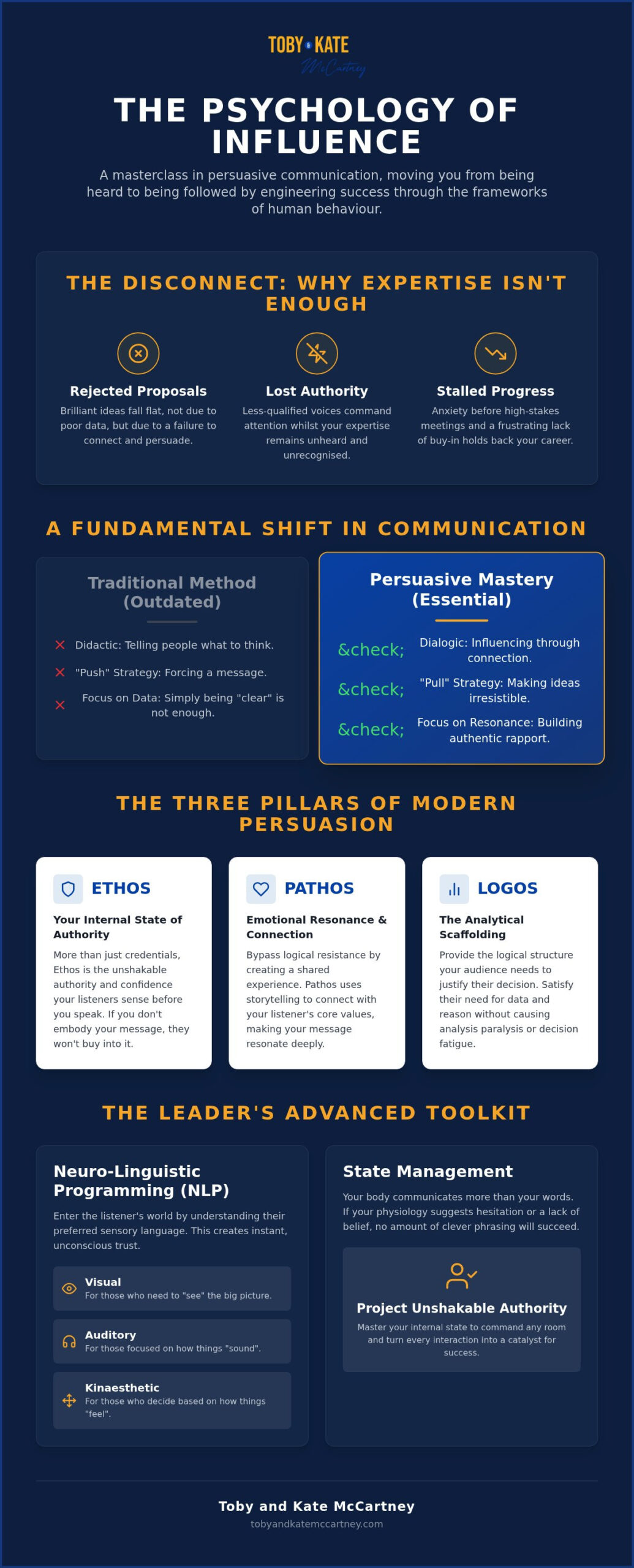
At its core, persuasive communication training is the art of aligning others with your vision whilst maintaining deep, authentic rapport. It’s the difference between being heard and being followed. In 2026, the professional landscape is drowning in data. Simply being “clear” is no longer enough to win hearts or minds. You must master the psychology of persuasion to cut through the noise and command attention. True influence isn’t about the volume of your voice; it’s about the resonance of your message.
Traditional communication was didactic. It was about telling people what to think. Modern mastery is dialogic. It focuses on influencing through genuine connection and shared purpose. This shift reflects a move away from “push” communication toward a “pull” strategy where your ideas become irresistible. Many people fear that persuasion is synonymous with manipulation. It’s quite the opposite. Whilst manipulation seeks to trick or coerce, authentic persuasion seeks to empower both parties toward a mutually beneficial outcome. It is an ethical commitment to excellence.
The ROI of Persuasive Excellence in Leadership
For UK executives, the stakes couldn’t be higher. Persuasive communication training is no longer a luxury; it’s a career-defining necessity. Poor communication isn’t just a soft-skill deficit. It’s a financial liability that manifests as missed contracts, team misalignment, and stalled projects. Persuasion is the bridge between an idea and its execution. When you master this bridge, your career moves from a steady climb to an accelerated ascent. You become the person who doesn’t just manage teams, but inspires them to exceed every target and outpace the competition.
Beyond Public Speaking: A Multi-Dimensional Skill
Don’t make the mistake of thinking this only matters when you’re behind a lectern. True influence happens in the quiet hallway conversations, the high-pressure boardroom debates, and the casual team lunches. It’s built on a foundation of interpersonal trust and psychological agility. This is why advanced communication skills training is so vital. It provides the multi-dimensional toolkit you need to lead in every arena. Whether you’re providing one-to-one mentoring or presenting to global stakeholders, your ability to persuade determines your ultimate impact. It’s the master key that unlocks every door in your professional journey.
The Three Pillars of Persuasion: Psychology Meets Rhetoric
Aristotle’s classical rhetoric remains the bedrock of influence, but the modern professional arena requires a psychological evolution. Whilst the art of persuasion hasn’t changed in two millennia, our understanding of the human brain has advanced significantly. High-level persuasive communication training transforms these ancient pillars into actionable psychological tools that work in real-time. It’s about moving beyond what you say to how you are perceived on a subconscious level.
Ethos is often misunderstood as merely a list of credentials. In reality, it’s your internal “state” of authority that listeners sense before you even open your mouth. If you don’t embody your own message, your audience won’t buy into it. Pathos is the emotional resonance that bypasses logical resistance. It’s not about being “emotional,” but about using storytelling to create a shared experience that resonates with the listener’s values. Finally, Logos provides the analytical scaffolding. It satisfies the listener’s need for logic and data without drowning them in unnecessary complexity that leads to decision fatigue.
NLP and the Internal Map of the Listener
Effective persuasion requires you to enter the listener’s world. Neuro-Linguistic Programming (NLP) teaches us that everyone has a preferred sensory language. Some stakeholders are Visual; they need to “see” the big picture. Others are Auditory or Kinaesthetic, focusing on how things “sound” or “feel.” By identifying these patterns, you can tailor your delivery to match their internal map. Matching and mirroring their physical behaviour creates instant, unconscious trust. This isn’t a trick; it’s the ultimate form of rapport that makes your message feel like their own internal discovery.
State Management: The Speaker’s Secret Weapon
Your body communicates far more than your words ever will. If your physiology suggests hesitation, no amount of clever phrasing will save the deal. State management is about taking control of your nervous system before you step into the room. You must learn to centre yourself, moving from a state of performance anxiety to one of grounded power. This allows you to project “Certainty” amongst a room of sceptics. When you are certain, you become the emotional anchor of the room. This level of mastery is a core component of our Leadership training programmes, where we bridge the gap between academic theory and physical presence.
Comparing Training Methods: Immersive Mastery vs. Generic Online Courses
You cannot learn to swim by watching a webinar. Similarly, you cannot master the psychology of influence through passive video lectures. Whilst mass-market platforms offer low-cost entry points, they often fail to deliver the behavioural shifts required for true professional authority. Generic courses treat persuasion as a list of tips to memorise. In contrast, elite persuasive communication training treats it as a muscle to be developed through rigorous, real-time application. If you want to command a room, you need more than information; you need an immersive environment where your micro-behaviours are refined by experts.
High-stakes influence requires immediate feedback. When you’re in the middle of a complex negotiation, you don’t need a theoretical framework; you need the instinctive ability to read a room and pivot your strategy. This level of agility is what separates the “Beginner Module” from an “Elite Pathway.” Even prestigious academic options, such as Harvard’s Persuasive Communication program, recognise that narrative and evidence must be coupled with measurable impact. To truly transform, you must move beyond the screen and into a space where your physiological and linguistic patterns are challenged and polished.
Why Certification Matters for Professional Influence
There is a significant psychological benefit to being an accredited “Master” of your craft. It isn’t just about the piece of paper; it’s about the internal certainty that comes from meeting rigorous standards. For those in the UK, obtaining an NLP practitioner certification UK provides a recognised benchmark of excellence that carries far more weight than a simple completion certificate. This foundation allows you to build a portfolio of communication success. As you progress toward an NLP master practitioner certification, you gain access to the most sophisticated tools for deep-level influence, ensuring your seat at the table is permanent.
Personal Mentorship vs. Scaled Learning
Scaled learning is designed for the masses, but leadership is inherently bespoke. High-level executives often possess unique quirks that can either be their greatest asset or a subtle liability. Through executive coaching and mentoring, these nuances are addressed with surgical precision. A mentor doesn’t just teach you a syllabus; they act as a mirror, showing you exactly how you are perceived by your peers and competitors. This personalised approach fits seamlessly into a busy schedule, focusing only on the specific gaps in your persuasive arsenal. It’s the difference between a one-size-fits-all suit and a tailored masterpiece.
Five Masterclass Techniques to Enhance Your Persuasive Impact
Mastery in the modern professional arena isn’t about having the loudest voice; it’s about having the most sophisticated toolkit. High-level persuasive communication training provides you with “secret weapons” that allow you to influence outcomes before you even finish your first sentence. These techniques move beyond basic rhetoric. They tap into the psychological architecture of your audience, ensuring your message isn’t just heard, but deeply felt and acted upon. When you master these five pillars, you stop being a participant in meetings and start becoming the architect of their results.
- The Power of the “Pre-Frame”: You must set the context before the meeting begins. By defining the purpose and the “rules of engagement” early, you prevent the conversation from drifting into irrelevant territory.
- Linguistic Reframing: This is the art of shifting perspectives. You can turn a staunch objection into a compelling reason to buy by changing the frame of reference from “cost” to “future-proofed investment.”
- Utilising “Anchoring”: Learn to associate specific physical gestures or tonal shifts with positive emotional states. This allows you to trigger a sense of confidence or agreement in your audience at key moments.
- The Art of the Pause: Silence is a formidable persuasive tool. A well-timed pause commands the room, forces the audience to digest your point, and projects an aura of unshakable authority.
- Strategic Storytelling: Move away from “data-dumping.” Human brains are hardwired for narrative. Use stories to wrap your data in emotional resonance, making your proposals memorable and irresistible.
Overcoming Resistance and Objections
Objections are not roadblocks; they are requests for more information. To handle tough questions from senior stakeholders, use the “Agree and Redirect” technique. Instead of using the word “but,” which creates immediate conflict, use “and” to acknowledge their point whilst seamlessly pivoting to your solution. You can also employ “Sleight of Mouth” patterns to challenge the underlying logic of a critic’s argument without breaking rapport. This allows you to maintain a polished, professional exterior even when you are fundamentally shifting the room’s perspective. It’s about being the most flexible person in the conversation.
Public Speaking for Maximum Influence
When you step onto a stage, you are no longer just delivering information; you are performing leadership. Integrating persuasive frameworks into your presentations ensures every word serves a strategic purpose. This is where public speaking for leaders differs from standard speech-making. It requires you to master your physical “centre,” using the stage to project authority and certainty. By aligning your physiology with your message, you eliminate the “congruency gap” that often undermines less experienced speakers. If you are ready to command the room with this level of precision, explore our Public Speaking programmes to begin your transformation today.
Elevate Your Influence: The McCartney Pathway to Mastery
True mastery is a journey, not a destination. Whilst we have explored the psychological pillars and masterclass techniques of influence, the McCartney Pathway to Mastery represents the ultimate integration of these skills. Toby and Kate McCartney offer a sophisticated blend of NLP and leadership mentoring that transcends standard corporate workshops. Their programmes are designed for those who refuse to settle for “good enough” and instead demand excellence in every interaction. With over two decades of expertise, they provide the secret weapon you need to dominate your industry.
The journey begins with the NLP Practitioner Certification, where you lay the foundation of psychological influence. From there, you advance to the Master Practitioner level, refining your ability to handle complex human dynamics with surgical precision. For those who wish to lead and inspire others on a global scale, the NLP Trainer Training serves as the pinnacle of persuasive communication training. This structured pathway ensures that your influence isn’t just a set of learned tools, but a core part of your professional identity. You move from simply “knowing” the techniques to “embodying” them.
What truly sets this approach apart is the “Personal Breakthrough” coaching. Many leaders possess the right words but are held back by internal blocks or subconscious hesitation. By removing these barriers, you align your internal state with your external goals. You stop fighting yourself and start commanding the room with a natural, effortless authority that others can’t help but follow. This is about total alignment between your vision and your voice.
A Journey of Continuous Professional Development
Understanding human behaviour is a lifelong pursuit that requires constant refinement. Toby and Kate support a vibrant community of high-achievers who understand that the professional world in 2026 demands constant evolution. This isn’t just about a single course; it’s about a commitment to personal excellence and measurable success. We invite you to step into your most powerful self and join a network of leaders who are redefining the boundaries of professional influence.
Booking Your Consultative Discovery
Your career goals deserve a bespoke strategy rather than a generic solution. A one-to-one mentoring session allows you to assess your current level and align your ambitions with the right certification. Whether you are looking for comprehensive leadership training or specific public speaking programmes, this is your moment to choose the elite pathway. Claim your seat amongst the UK’s most persuasive leaders. Begin your transformation today and ensure your voice is the one that shapes the future.
Step Into Your Future as a Master of Influence
You now understand that true influence is not an accident of birth; it’s a meticulously crafted skill set. By mastering the psychological pillars of Ethos, Pathos, and Logos, you’ve moved beyond simple clarity into the realm of deep alignment. You know that generic, information-only courses cannot compete with transformative, immersive experiences that focus on your internal state and physiological presence. This journey through persuasive communication training is the elite pathway that separates the participants from the architects of industry.
Toby and Kate McCartney bring over 20 years of expertise and elite NLP Master Trainer status to your development. With dozens of personal breakthrough success stories, they have proven that any leader can unlock their inherent potential and command the room with certainty. It’s time to stop letting your ideas go unheard and start engineering the outcomes you deserve. Discover how Toby and Kate McCartney can transform your communication and influence today. The seat at the head of the table is waiting for you; all you need to do is claim it.
Frequently Asked Questions
What is persuasive communication training exactly?
It is a specialised development process that teaches you to align others with your vision whilst maintaining deep, authentic rapport. Unlike basic public speaking, it focuses on the psychological frameworks of influence, such as NLP and state management. You learn to read micro-behaviours and use linguistic patterns to guide outcomes. This training transforms you from a passive communicator into a strategic architect of professional dialogue, ensuring your ideas command the room.
Can introverts truly excel in persuasive communication?
Absolutely, as introverts often possess superior listening skills and a keen eye for subtle psychological cues. Persuasion is not about being the loudest person in the room; it’s about the precision of your message and your ability to create authentic connection. Many introverted leaders find that persuasive communication training provides them with a structured, reliable toolkit to project authority without needing to adopt a fake, extroverted persona. It turns their natural thoughtfulness into a strategic advantage.
How long does it take to see results from this training?
You will likely notice an immediate shift in your internal confidence and the way you frame requests during your very first session. Whilst mastering the full spectrum of psychological influence is a journey, the application of core techniques like “pre-framing” or “anchoring” delivers tangible shifts in stakeholder buy-in within days. Consistent practice of these masterclass methods ensures that your influence becomes a permanent, instinctive part of your leadership style over several months.
Is persuasive communication the same as NLP?
Persuasive communication is a broad professional objective, whilst Neuro-Linguistic Programming (NLP) is the powerful methodology used to achieve it. NLP provides the specific linguistic patterns and psychological tools that make high-level influence possible. By studying NLP, you gain a deeper understanding of how the human brain processes information and makes decisions. This allows you to tailor your communication to the listener’s internal map, making your proposals far more compelling and resonant.
Will this training help with conflict resolution at work?
Yes, because it equips you with the emotional intelligence and linguistic flexibility to de-escalate tension whilst maintaining your position. You learn techniques such as “agree and redirect” and “reframing,” which allow you to acknowledge a colleague’s perspective without losing sight of your goal. By understanding the underlying psychology of an objection, you can address the root cause of the conflict and guide all parties toward a mutually beneficial outcome that preserves professional trust.
Do I need prior experience to join an NLP Practitioner course?
No prior experience is required to begin your journey with an NLP Practitioner course. These programmes are designed to take you from a foundational understanding to professional mastery through a structured, step-by-step pathway. Whether you are a mid-level manager or a seasoned executive, the training meets you at your current level. It provides the essential building blocks of persuasive communication training, ensuring you have the confidence to apply these skills in real-world scenarios immediately.
What is the difference between a communication coach and a mentor?
A communication coach typically focuses on refining specific skills or performance goals, such as preparing for a high-stakes keynote. In contrast, a mentor like Toby or Kate McCartney provides a broader, long-term pathway to mastery. Mentorship involves a deeper personal connection where the mentor shares their two decades of expertise to help you navigate complex career challenges. It is a more holistic approach that blends skill development with strategic leadership guidance for high-achievers.
How does persuasive communication help in high-stakes sales?
In high-stakes sales, persuasion is the difference between a stalled negotiation and a closed contract. It allows you to move beyond product features and speak directly to the client’s core values and unconscious desires. By using advanced techniques like “anchoring” and sensory-specific language, you create a sense of certainty and trust that bypasses logical resistance. This results-oriented approach ensures that your proposals are seen as essential solutions rather than optional expenses in a competitive market.